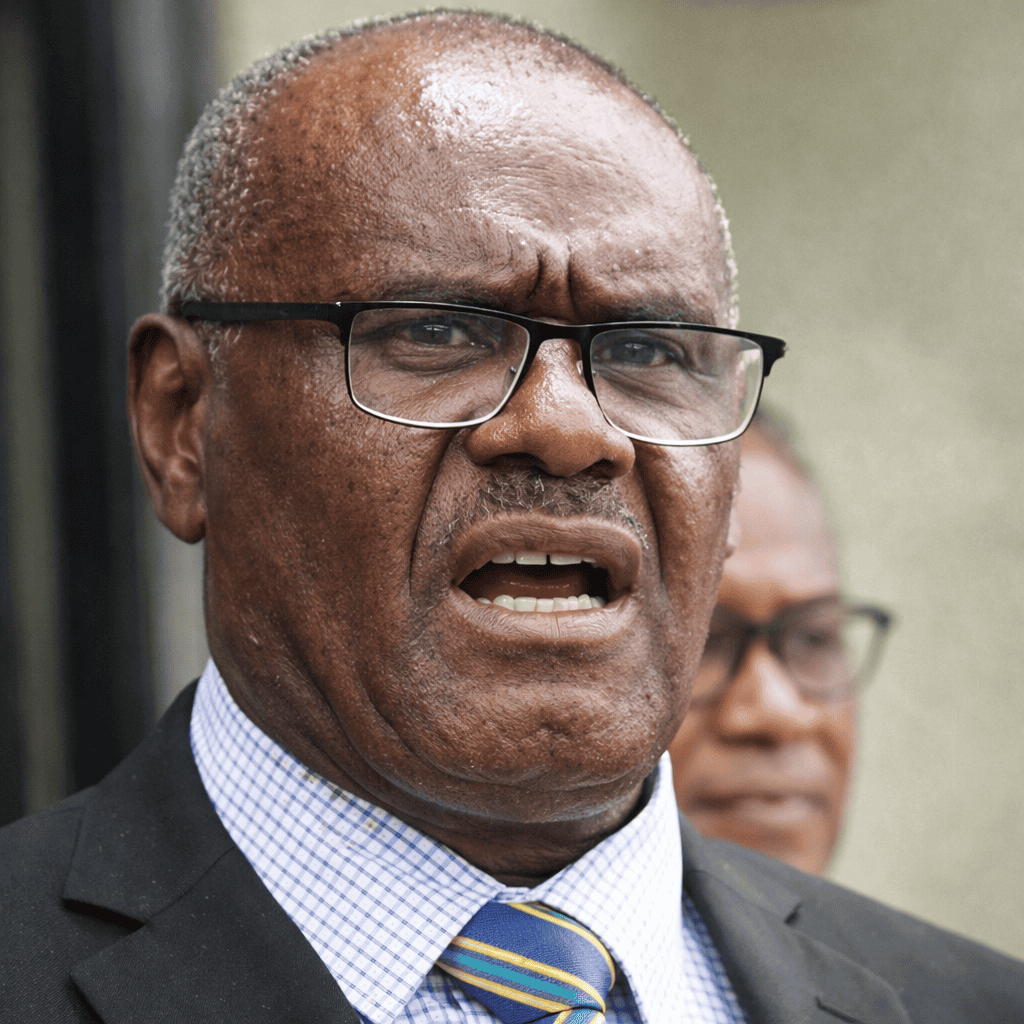
THE Solomon Islands has been gripped by a protracted leadership crisis since March 2026. Prime Minister Jeremiah Manele has been fighting a rearguard battle to retain office.
On 16 March, close to half of his cabinet resigned and crossed the floor to join the Opposition. Now boasting 28 of the 50 MPs, the greatly strengthened Opposition petitioned the Governor-General, Sir David Tiva Kapu, to summon Parliament to hear a motion of no-confidence. Sir David refused, insisting that he had no constitutional authority to order Parliament to sit. The Opposition took the matter to Court. On 14 April, Chief Justice Sir Albert Palmer ordered the Prime Minister to convene Parliament within three days to hear the no-confidence motion. Failing that, the Governor-General has been empowered to use his ‘residual constitutional powers’ as a ‘last resort’ to force a parliamentary sitting.
Manele initially assumed office as Prime Minister in the aftermath of the April 2024 election, replacing his mercurial predecessor, Manasseh Sogavare, who had served a record four times as head of government (2000-01, 2006-7, 2014 17, 2019-24). Both politicians contested as members of the Ownership, Unity and Responsibility (OUR) Party, as did close to the entirety of the outgoing cabinet. They did not fare well. Half of the former ministers lost their seats. None of the party’s newer candidates were successful. The OUR Party still managed to scrape back into government, but to attract the support of the three-MP Peoples First Party, as well as non aligned and first-time MPs, they had to sacrifice their former leader: Manasseh Sogavare. Since then, Manele has faced two no-confidence challenges, the second of which, in April 2025, saw Sogavare switch across to join the Opposition in a failed bid to recapture the leadership. Now Sogavare has leap frogged back to rejoin the government he abandoned only a year earlier. Despite many offers of ministerial portfolios, and—the Opposition alleges—up to $SBD 300,000 each in cash, Manele has so far been unable to persuade other deserters to return.
The rebels’ objections have not been primarily directed against the softly-spoken Prime Minister, who is a former diplomat and foreign affairs minister. Their sharpest criticisms are directed against his China-aligned backers, dubbed the three TTTs due to their surnames Tran, Tovosia and Tanagada. Namson Tran is a Vietnamese-born naturalised citizen who owns the biggest casino in the country. Bradley Tovosia, a polarising politician, was sacrificed as Deputy Prime Minister during the last big reshuffle to avert a no-confidence challenge in April 2025. His shady deals with Chinese company Win-Win Investment include a ‘road to nowhere’ which stops abruptly 20 kilometres into the mountainous interior of his East Guadalcanal constituency. In 2024, In-depth Solomons exposed the real objective as prospecting for minerals. The third T, Jimson Tanagada, the police minister, took to social media to denounce the defectors as deceitful, divisive and driven by self-interest.
The rebellion has been brewing, behind the scenes, ever since the April 2024 election. When the ruling OUR Party gathered at the Cowboy’s Grill in eastern Honiara after the poll, it was Morovo MP Chachabule Rebi Amoi from the People First Party who brokered the coalition deal that brought Manele’s GNUT (Government of National Unity and Transformation) into office. Amoi, a prosperous businessman from the west of the country, has preferred to assume a backseat role, leaving fellow People First MP Frederi the helm as parliamentary leader of the party. Ever since April 2024, People First has been steadily accumulating support within the GNUT caucus, including that of politicians repelled by the three TTTs. Those previously non-aligned MPs who joined Manele’s government mostly preferred to identify with People First, rather than the OUR Party. When Manele dropped Tovosia as Deputy Prime Minister in order to survive the August 2025 no-confidence motion, Kologeto was given the deputy job to accommodate the growing strength of his party. After finance minister Harry Kuma was reshuffled following a September 2025 dispute about the import–export trade from the wharves along Honiara’s foreshore, he defected from OUR Party and joined People First. It was a protest against the breach of trust created by the sacking of two People First aligned ministers a month earlier that precipitated the block resignation in March.
Whether the Governor-General has powers to call a parliamentary sitting when a government loses its majority has been a matter of dispute in the past in the Solomon Islands, as it has in neighbouring Papua New Guinea. The Constitution does not explicitly grant the Governor-General such powers. But nor does it permit a Prime Minister to hold office in defiance of Parliament. In his March letter to the Opposition, Sir David Kapu cited a 1999 Court of Appeal judgment to support his contention that “I have no power to convene a meeting of Parliament.” Yet that was not the only case when this matter was brought before the Solomon Islands courts. In 1994, the government of Francis Billy Hilly lost its majority, but declined to call a parliamentary sitting because this would result in a vote of no-confidence. The Governor General rejected this refusal and ordered Parliament to sit. The Court upheld that decision. The situation in 1999 was quite different. The Isatabu insurrection was underway. When parliament did sit, Bartholomew Ulufa’alu’s government was able to defeat a vote of no-confidence. When that government was eventually ousted, in June 2000, it was at gunpoint. The militia group, the Malaita Eagle Forces, in a ‘joint operation’ with the paramilitary Police Field Force removed Ulufa’alu and later that month engineered a replacement puppet government into office. That occasioned Sogavare’s first stint in office as Prime Minister. Those events precipitated the years of unrest that culminated in the arrival of the Regional Assistance Mission to the Solomon Islands (RAMSI) in July 2003.
The circumstances today bear a close resemblance to those in 1994. Like Hilly, Manele has lost his majority. The case before the Court of Appeal revolves around whether the issue is justiciable, whether the Court has the right to step in and whether the Governor-General has reserve powers to act if the Prime Minister continues to refuse to convene Parliament. If the Court of Appeal upholds Justice Palmer’s verdict, Parliament must sit – either ordered to do so by the Prime Minister or the Governor-General.
Under those circumstances, there are three options: Manele resigns, knowing that he faces an impending defeat on the f loor of Parliament; the motion is tabled and the Opposition wins; or the GNUT is able to entice either the defecting MPs or those who have long sat on the Opposition benches to cross the floor. So far, the 28-MP Opposition has held fairly firm, but there have been many past cases of unexpected realignments in the midst of coalition reconfigurations. After all, nearly all of the longer-serving MPs will have served together with every other such MP in past governments. All will be desperate to avoid a long stint on the Opposition benches, as the country moves towards elections scheduled for 2028. Incumbency has its advantages.
In Papua New Guinea, as in Germany, motions of no confidence must name an alternative Prime Minister. In the Solomon Islands, they do not. Opposition MPs can unite to oust a sitting government but later splinter when it comes to choosing a replacement. This has happened many times in the past. On the Opposition benches, several politicians harbour leadership aspirations, including Matthew Wale, who has missed out numerous times in the past. Former foreign minister Peter Shannel, who defected in March, also has his eyes on the top job, as does former PM Gordon Darcy Lilo. Few would rule out a fifth comeback by Sogavare. After a successful no-confidence vote, the options for Opposition politicians change. Any on the verge of losing out in the negotiations may calculate that they have better prospects by striking a deal with the ousted government.
Solomon Islands politics is often depicted as if it were a microcosm of geopolitical rivalries, with one side aligned with Beijing and the other with Washington. In fact, it is the local alliances that are of primary significance and both sides will look for support from Beijing, as well as Canberra and Wellington. Nevertheless, Australia and New Zealand will have cause for concern if the GNUT government survives, with the TTTs rejoined by Sogavare. Sogavare and Manele, as Prime Minister and Minister for Foreign Affairs, presided over the country’s 2019 diplomatic switch from Taiwan to China and then struck a security deal with Beijing in 2022, through which Chinese police officers have been deployed to the country. At the time, Labor’s Penny Wong, who has since become Australian Foreign Minister, called the deal the ‘worst failure of Australian foreign policy in the Pacific since the end of World War II. Whoever retains or assumes office is likely to sustain the China link. For a small island state with limited avenues for economic development, it is pragmatic politics to play both sides off against each other.