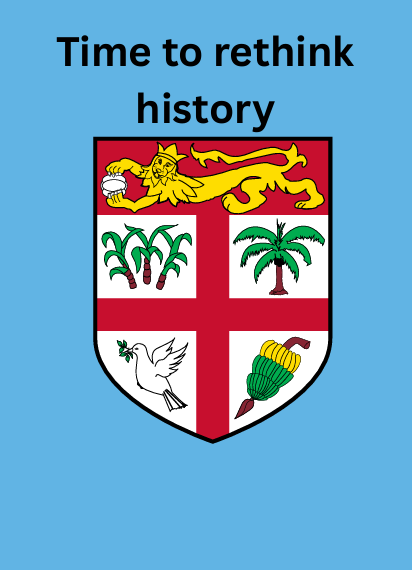
WHEN Ratu Seru Cakobau ceded Fiji to Queen Victoria in 1874, he did so for reasons which were practical but intensely personal.
On a practical level, he wanted to escape the huge financial responsibility and burden placed on him and his fledgling government by the United States’ consul, John D. Williams, over the destruction of property on Nukulau.
On a personal level, cession provided him the opportunity to pursue a desire to become king of Fiji, title which did not exist in islands comprising a multiplicity of kingdoms.
Cakobau was completely unaware that his actions would ultimately lead to these independent chiefdoms being subsumed into an empire, which was cementing its place as a world leader in commerce and industry as industrialisation took hold across the globe.
Fiji played a small but vital role in that empire over which it is said the sun never set. It provided a strategic outpost in the Pacific Ocean, taxes for Britain’s exchequer, and supplies of cotton, sugar, copra, and banana. Fijians—or in actuality, Cakobau—escaped debt and received the protection of a global superpower.
However, in doing so, he inadvertently sold traditional knowledge, philosophies, and values.
The British political structure of a king with the House of Lords, House of Commons, land laws and a church which served the crown became the model for a post-contact iTaukei or Fijian society.
We also embraced the British or world thought process around social structures and, later, development models.
The benevolent, British benefactors were soon revealed for what they truly were – a society which had emerged from barbarianism, only 1200 years earlier. In their considered opinion and through the philosophies of Rene Descartes, they asserted that the iTaukei were epistemologically inferior and, therefore, “savage” and in need of “civilization”.
Fijian or iTaukei Christians proudly claim to be products of the “enlightenment” brought to the islands by the missionaries. The same is true for many Pasifika communities. Of course, that implies that they were a people in darkness and, therefore, their wisdom and structures were “heathen”. That also means their processes of social inclusion – today, conceptualised in the words “leave nobody behind” were considered at the time to be inferior.
And so, the iTaukei pursue individual success and happiness in direct contradiction of their ancient philosophies, which put the community and the other above the personal and the self. The question is: What was barbarous or savage about a social system which ensured parity of wealth and care for all? Secondly, is there a way to incorporate the values of that system into the development models used today?
The need to reframe how we think about development.
Have we sold ourselves by embracing foreign values?
Scholars including Aisake Casimira at the Pasifika Communities University speak of the need for metanoia, a profound, transformative change of heart, mind, or worldview. It is more than a rejection of the old and rather a change, a shift one’s mind or perceive differently), it describes a deep spiritual or psychological awakening rather than a simple shift in opinion. However, transformation must be deliberate and intentional and based on love, which is mutual and all-encompassing, inclusive of care for
the oikos, the greater household of creation.
So, as a Pasifika household, could we encourage our governments to combine their knowledge of indigenous systems to propose a regional development model based on duty of care and a communal approach? The obvious difficulty with this approach is that the
Pacific has become entrenched in a world in which development projects are defined by the convenience and efficiency they bring to individuals or the community.
And despite the many conferences on regionalism, our governments remain largely insular, focusing on bilateral rather than regional agreements. It is only when we find and implement this new model can we regain our birthright of a communal-based caring model of development.