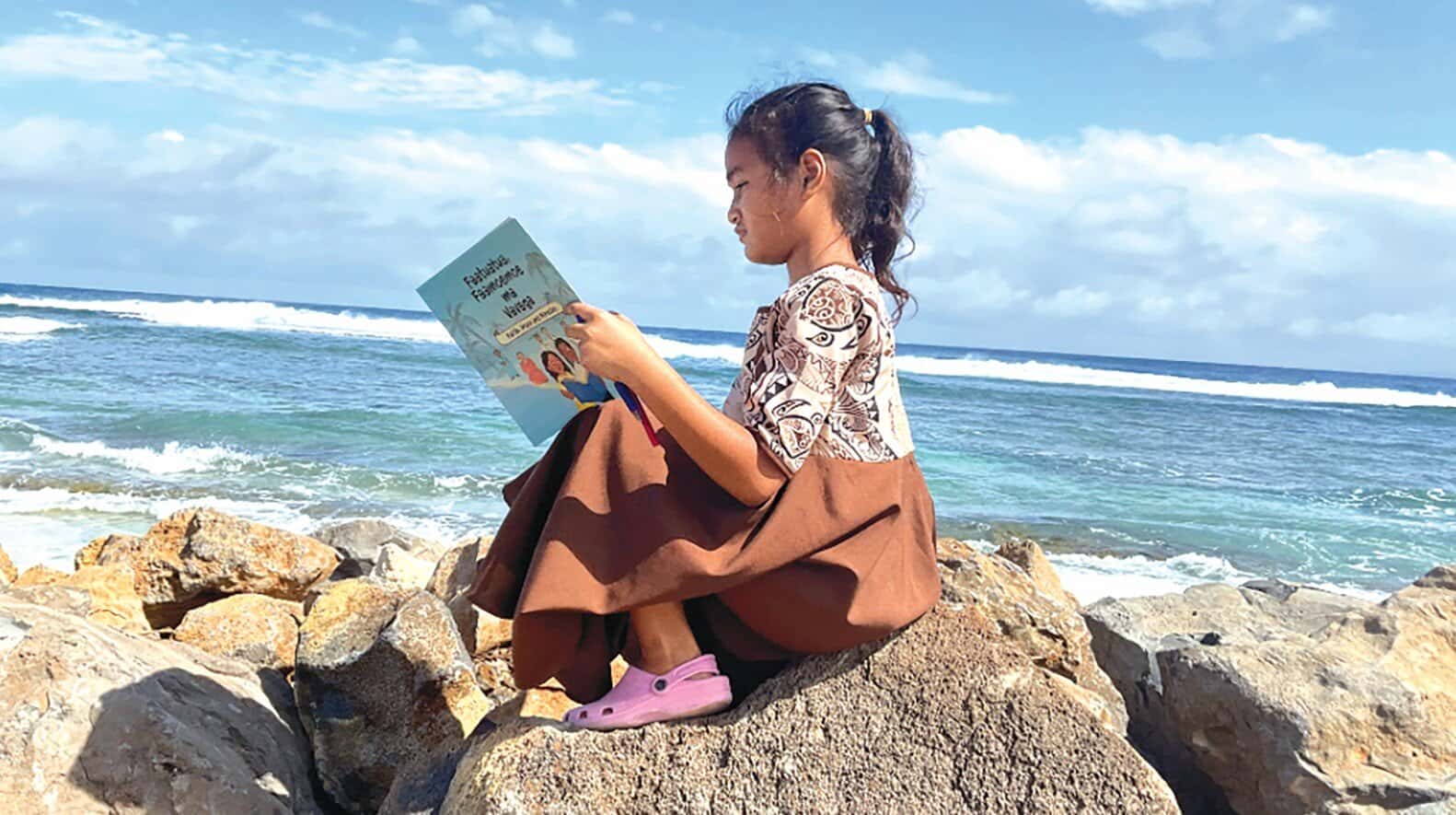
WHY do we read, and is it important? We tend to see reading just as a skill that we acquire at school and then use for various tasks in our lives. But reading is so much more. Indeed, it is a means of safeguarding our heritage, and it is essential for sustainable socio-economic development in the Pacific.
While our oral traditions remain strong in the Pacific—with knowledge continuing to be passed down through generations via the spoken word—we are increasingly reliant on written records to preserve our languages, cultural traditions, and histories.
Oral transmission is vulnerable to disruption through the loss of elders, changes in lifestyles, migration and, increasingly, climate displacement. By recording knowledge such as our traditional stories, our approaches to governance and our solutions to issues, including time-honoured strategies for protecting our resources, we are preserving our shared wisdom.
When we read those records, we are learning from our ancestors. And by passing on the skill of reading to young people, we are ensuring that future generations will always have access to our Pacific wisdom and can benefit from it.
The ability to read not only allows us to learn from the past, but it also expands our future opportunities.
Large-scale assessments of primary school students by the Pacific Community (SPC) over the past decade have consistently found that high reading proficiency is linked to better academic performance overall.
This finding supports research that identifies reading as a foundation skill. Strong reading skills not only allow readers to read books, opening doors to boundless knowledge; they also enable learners to fully comprehend the content of other school subjects, including explanations of scientific theories, word problems in mathematics, and technical instructions in vocational training. Without strong reading skills, learners often cannot fully understand the information conveyed in such subjects and therefore face difficulties in completing Why we must read assignments, thinking critically, and applying knowledge in real-life situations. Moreover, students without strong reading skills are more vulnerable to disruptions to education caused by disasters and disease because they are not as capable of independent learning as strong readers are.
Given that those who are successful at school are more likely to gain entry to higher education and find skilled employment, which generally translates to better socio-economic outcomes, reading can be considered the most important skill to be mastered at school.
Beyond school, reading remains a vital skill. Research by UNESCO has found that societies with high literacy levels tend to be healthier and more resilient.
Strong reading abilities allow us to better understand health and nutrition information, often leading to wiser choices in what we eat and how we live. Even in lower-income countries, communities with higher literacy rates tend to have lower rates of disease and better child health outcomes.
Reading skills also help us make wiser choices at the ballot box. Because reading skills are linked to independent learning and the development of critical thinking skills, possessing strong reading abilities enables us to access various sources of information, avoid being misled, and choose our leaders prudently.
The ability to read also enables us to better understand information about disaster risks and how to prepare for, and even prevent, disasters, which increases resilience in society as a whole.
A population with strong reading skills is, quite simply, the bedrock on which we can build sustainable development in the Pacific region. Reading is a skill that enables us to perpetuate our cultural traditions and live by our values, while also enabling us to gain the knowledge to succeed in school and the modern workforce. It empowers us to make informed decisions, ensuring our societies are healthier, safer and more prosperous in the long term.
Ellen Meleisea is a Report Writer and Tera Narayan is a Communications Assistant with the Pacific Community (SPC).