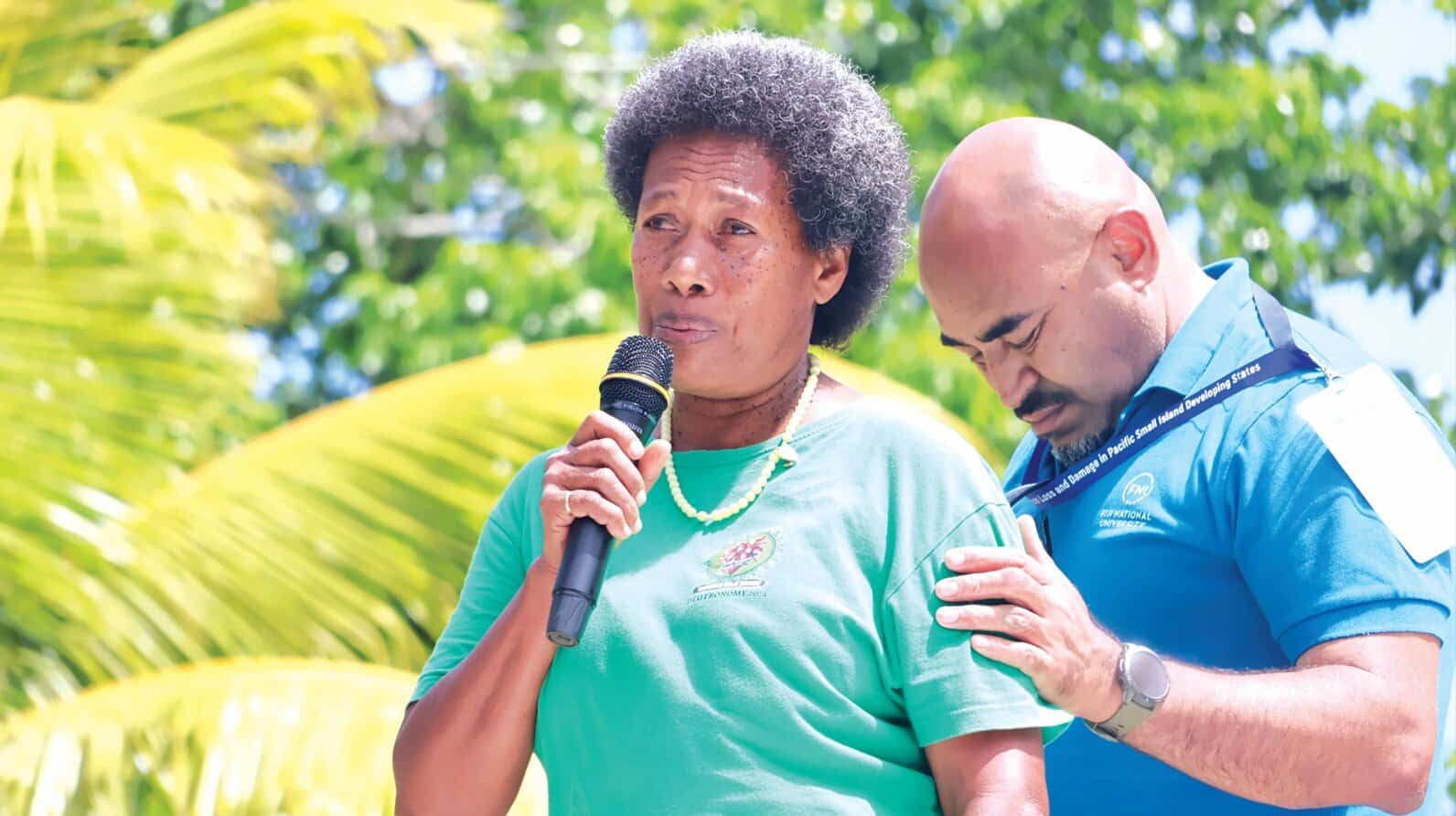
“WE will never leave this land, no matter what. It is a vow we made to our paramount chief.”
These words cut through the humid air, carried by a portable speaker during the traditional Fijian ceremony that welcomes visitors onto sacred ground. They came from Mareana Sorowaqa – headwoman of the village, community health worker, and chairperson of the disaster risk committee in Vunisavisavi, a coastal community near Savusavu, on Fiji’s Vanua Levu.
Her voice faltered. Tears welled. Around her, silence hung heavy, broken only by the sound of waves against a coastline that has been shrinking year after year. Theirs is a story of loss – of lives, culture, and places forever changed by climate impacts. Each crumbling house and salt-scorched field stands as a reminder of what has already been lost.
Vunisavisavi is no ordinary village. It is the original home of the paramount chief of Cakaudrove Province. More than 200 years ago, he relocated to nearby Taveuni Island but commanded his people to never abandon this land. That vow remains unbroken to this day.
Yet the land itself is slipping away. Rising seas and stronger cyclones have left scars that cannot be hidden. Along the shoreline lie the remnants of homes – only concrete slabs remain where families once lived. When Cyclone Winston—the strongest storm ever to hit Fiji—struck in 2016, villagers fled into the hills with their children, the elderly, and those who were ill, as storm surges swallowed the entire community.
“For weeks, we had no food of our own,” Sorowaqa recalls, her voice shaking.
“Our plantations were gone. We survived only on government rations. Many who had married into the village left. Some of our young people also left. But those [of us] who remain stay because we must fulfill our vow to our chief. This is our land.”
For the people of Vunisavisavi, the impacts are no longer abstract. “Before, we thought this was something that only happened in other countries,” Sorowaqa admits.
“But when we began losing our ancestral land to the sea, we knew it had reached us.”
It was here, in Vunisavisavi, that the inaugural Pacific Research Symposium on Loss and Damage took place this year. After days of dialogue in Savusavu town, researchers, policymakers, and practitioners walked the eroded coastline and saw what cannot be conveyed through data alone.
For many, it was their first direct encounter with a community living on the frontlines of loss and damage. The sight of seawater creeping into gardens and the determination of people like Sorowaqa revealed more than any words in a report.
Among the participants was the International Organization for Migration (IOM), which joined the symposium and the visit to Vunisavisavi. For IOM, it was a moment to listen, learn, and renew its commitment to supporting Pacific communities as they navigate the pressures of a changing environment.
Across the Pacific, IOM works alongside governments and communities to plan for safe and dignified mobility in the face of environmental challenges. This includes developing tools for planned relocation, strengthening disaster preparedness, and ensuring that those who must move—temporarily or permanently—do so with their rights, culture, and dignity protected.
The visit to Vunisavisavi brought into focus what is often discussed in conference halls – that loss is no longer a distant warning but a lived reality. And while no organisation alone can stop the tides, IOM works with partners to help communities find pathways that honour their traditions and protect their future.
As part of the visit, participants helped plant mangroves – a village-led effort to find sustainable, nature-based solutions, knowing that concrete walls alone cannot hold back the rising seas.
When the visit ended, Sorowaqa’s words stayed with every guest – a vow binding her people to their traditions, culture, and customs, all now at risk of being lost to the tides. In that vow lies both the resilience and fragility of many Pacific communities. It is a reminder that behind every statistic are people, cultures, and histories rooted in land that cannot be replaced.
For IOM, standing in solidarity with communities like Vunisavisavi is not only about responding to today’s disasters, but also about ensuring that Pacific voices lead the global call for action – so future generations will not have to choose between survival and heritage.
The Pacific Research Symposium on Loss and Damage was jointly hosted by the Pacific Community (SPC), Monash University, and the Fiji National University (FNU), bringing together more than 150 academics and development partners to share knowledge and strengthen collaboration on addressing loss and damage across the Pacific.
Roneel Lal is a Senior Media and Communications Assistant with IOM’s Coordination Office for the South Pacific. He has over 20 years of experience writing for Fijian media, civil society, and regional organisations.