THE University of Fiji builds its teaching on ancient Indian philosophy and the human values of the Arya Samaj tradition, shaping an ethical and cooperative campus culture.
The university embeds human values like integrity and respect across all roles, from senior leaders to janitorial staff, fostering a collegial and supportive environment.
It’s a new university—only 20 years old—but the institutional approach supports positive academic and social outcomes by encouraging kindness and cooperation. Operated by the Arya Samaj, which is largely a Hindu organisation, UniFiji as opened its doors and programmes to iTaukei (indigenous Fijian) learning.
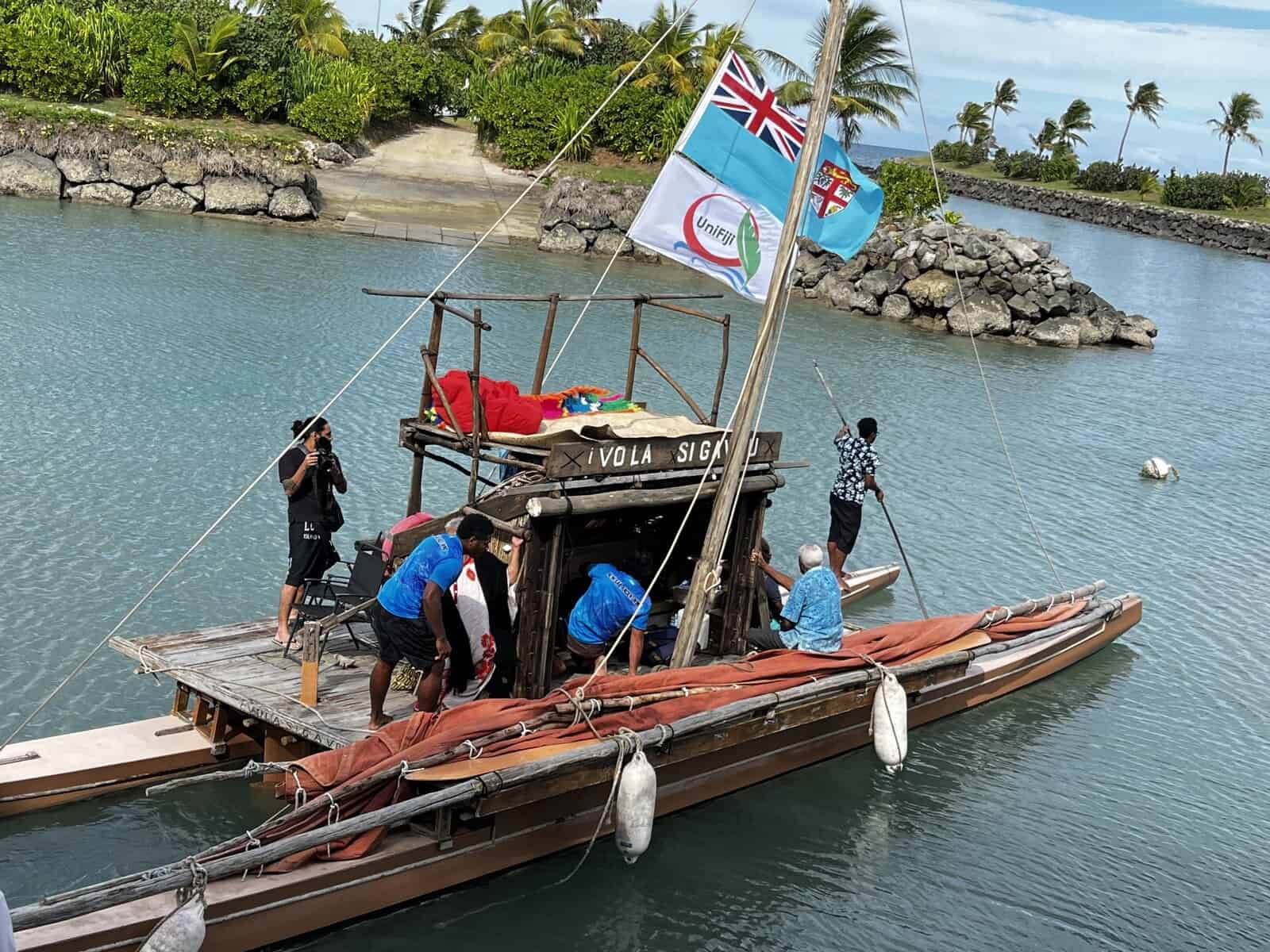
“We have established a heutagogic (self-directed learning) methodology using the original Indian educational concept of gurukul, combined with our journey on the drua – together, this means a ‘journey in holistic education,” said Professor Shaista Shameem, Vice-Chancellor of UniFiji.
Gurukul is a holistic education, focusing on academics, moral values, life skills, and spirituality within a natural, family-like environment, emphasising experiential learning and discipline. Drua is the iTaukei double-hulled canoe, a floating classroom where crew learn celestial navigation, winds, stars, currents, teamwork, and relationality.
“This was known as praxis in early Greek knowledge. In the 21st century, it responds to academic challenges like AI misuse, siloed learning, and social problems affecting students’ effective learning. It emphasises interdisciplinary approaches over narrow disciplines,’’ Shameem said. “The ancient wisdom of our communities is imparted alongside state-of-the-art modern education for the 21st century.”
Human values are integrated into all first-year compulsory courses, including English, ITC, conversational iTaukei, and Hindi language and culture, ensuring early exposure to core principles.
She said the curriculum supported interfaith dialogue and respect through joint festival celebrations and language diversity.
The university has set out to be a crucible for multiracial learning, as well as an institution that helps students learn and appreciate a wide range of philosophies.
UniFiji’s philosophy drives its role as a catalyst for social stability and broad-based education in Fiji and the Pacific. The university positions holistic education as key to national
and regional peace and development, aiming to reduce conflicts through shared human values.
Shameem said this vision extended beyond youth to adults, promoting empathy and reasoned dialogue as tools for social harmony.
“UniFiji encourages stepping into others’ shoes as a practical orientation for staff and students.
“The approach responds to regional needs for broad-based education, not just specialised skills, recognising it as a legal right.
“This philosophy shapes the university’s outreach and curriculum, designed to meet wider societal needs.” UniFiji actively influences regional education policy and development, with its programmes recognised by governments and stakeholders across Oceania. The university leverages strategic partnerships to broaden its educational reach, and has entered relationships with the University of Goroka (PNG), Atenisi Institute (Tonga), and University of Canterbury (New Zealand).
“These collaborations enrich curricula and facilitate student and staff mobility within the Pacific.
“UniFiji is actively recruiting more Pacific academic staff to ensure cultural and developmental relevance,” she added. However, the university identifies a need for more funding to conduct physical visits to island countries to deepen impact.
The university embeds community, social, and environmental responsibility into its strategic plans and staff evaluations, ensuring alignment of operations with regional needs.
According to Shameem, the 2022–2026 and upcoming 2027–2031 strategic plans include KPIs focused on community and environmental impact.
“Partnerships with local stakeholders like the Levuka Town Council, the Sugar Research Institute, and the Fiji Museum help deliver educational services widely,’’ she said. “Collaboration with the Ministry of Local Government enhances outreach and operational effectiveness across multiple campuses.”
UniFiji plans to deepen its regional role through new collaborations and strategic initiatives, including increased enrolment of regional students in 2026.
Shameem stated that these initiatives aim to strengthen the university’s influence and the quality of its services across the Pacific.
“These efforts align with the university’s long-term strategy to be a regional leader in holistic and inclusive education.” The institution aims to attract a diverse student body by offering a wide range of courses that meet the needs of both local and international students.
A time to decolonize the classroom
WHEN the missionaries arrive in the Pacific in 1797, a new form of education began to take shape in the islands. Schools were operated by missionaries or colonial powers, ostensibly to civilize the people. But who is to say that Pacific people were not a highly civilized people with centuries of knowledge and learning? Was their intricate understanding of nature inconsequential?
So successful was colonization that it changed forever the way Pacific people thought about learning, knowledge, and wisdom. Whatever was introduced was good, ancient ways— tried and trusted—were considered evil.
Later, in universities, the lack of material written by the ancestors meant that Pacific scholars relied heavily on research conducted and collated by missionaries and colonial administrators. These brought a certain bias to scholarship and it is unlikely that many of these self-appointed anthropologist fully understood the cultures of their hosts.
Today, Pacific scholars have started to rewrite history from the perspective of islanders, using local philosophies and lenses.
At the Pasifika Communities University (PCU), this exercise is about decolonizing Pacific minds and introducing pride in regional and national scholarship. Later in 2026, Pacific scholars will meet at the PCU to challenge accepted norms in education, including the acceptance of current thought on history through the minds and eyes of the colonisers.
These are exciting times as Pacific people help each other break free and create an education system for the region.