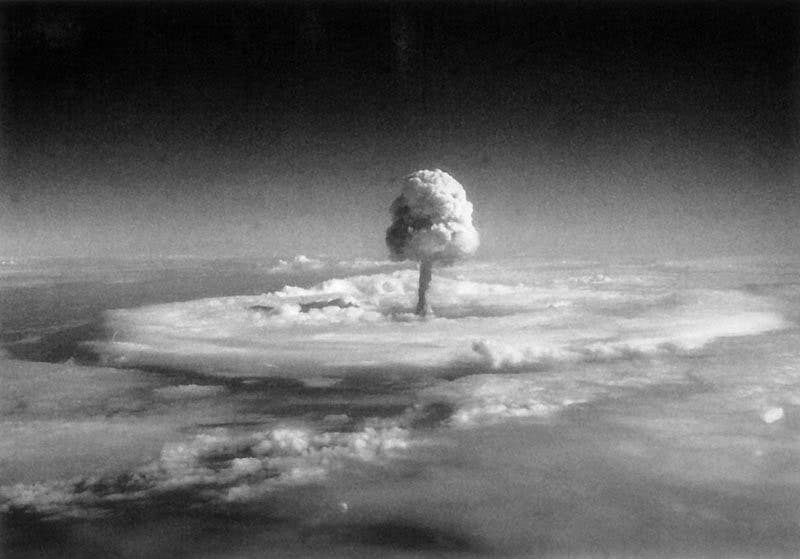
BY the time the nuclear tests stopped in 1996, the Pacific had already carried the burden for three decades.
What came after, according to Vehia Wheeler, was not closure but a slow, inherited emergency: cancers, women’s health problems, mental health strain, and a public-health system still struggling to respond to the legacy of France’s nuclear programme in French Polynesia.
Wheeler—a PHD candidate at the Australian National University, who has spent the past 10 years working on climate change and environmental justice in Tahiti—said nuclear history has been pushed to the margins even as its effects continue to shape daily life.
“The more I’ve been working on it, like climate, environment, the more I realise how much our nuclear history has been marginalised,” she said.
“We just need to learn more about it and know how to address the ongoing issues that we’re facing because of it.”
At the centre of that case is health. Wheeler said the fallout did not stay confined to the test sites at the remote atolls of Mururoa and Fangataufa.
“We have many cases of radio-induced illnesses in our society such as cancers, women’s health issues, even mental health issues,” she said. “It’s caused a lot of hurt to our people, and we continue to see the health and environmental impacts for our generation.”
She described the effects as intergenerational rather than historical. The tests ended, but the contamination didn’t
“This is really a long-term battle, an intergenerational battle that our people will be facing,” she said, pointing to plutonium’s long radioactive life as part of the reason the issue remains urgent.
In her telling, the real harm is not only what happened in the test years, but what followed: illness, anxiety, trauma and the constant work of proving that the damage is real.
That fight, she said, has been made harder by the official reluctance to fully confront the scale of the problem. France passed a law in 2010 acknowledging responsibility for health impacts from the testing period, Wheeler noted, and recognised 23 illnesses as potentially linked to nuclear testing. But she said the list is too narrow, and the process too conservative.
“It’s really hard to trust their information, their data when they do it, conduct it themselves,” she said.
Health care, accountability and justice
For Wheeler, the issue is not simply one of classification. It is one of care. Doctors know that cancers are complex, she said, and the government should not be using a limited list of diseases to define the full moral obligation.
“It should be that our health care is just taken care of because it has numerous impacts,” she said.
Those impacts, she added, can include congenital disabilities and other conditions that communities may still not fully understand.
The health crisis is also a political one. Wheeler argued that affected communities are not receiving adequate support or compensation and said the state has never properly apologised.
“No, not at all,” she said when asked whether support has been adequate. “They remain limited on the health care and the environmental remediation that is owed to us from this time period.” Public education, she said, is part of the failure. “There’s no public education about it in the schools.”
That silence leaves younger people disconnected from a history that still shapes their health. It also leaves France’s Pacific territories carrying memories that are both personal and collective, with too few institutional channels for testimony, care or redress.
Wheeler said the minimum response should be more honest public discussion, more space for survivors and workers to speak, and more support for independent research.
She pointed out that serious medical studies, especially on intergenerational harm, can be prohibitively expensive.
“One genetic study and clinical trials aimed to look at intergenerational cancers can cost up to $USD6 million.
Without outside expertise and proper funding, the affected communities remain trapped in a cycle in which they must constantly prove the harm to receive help.”
Her message to Pacific governments is honest: put people first. “Maintain our agency, maintain the needs of the people,” she said.
“Don’t fall into the needs of the other developed countries and what they want and need. Don’t sacrifice our people.”
In Wheeler’s view, the nuclear legacy is not just about what happened on remote atolls. It is about the present tense of illness, the gaps in care, and the burden of living with a history that has never been fully acknowledged.
For Tahiti and the wider Pacific, she said, nuclear justice begins with health: telling the truth, funding the research, treating the sick, and refusing to let the damage disappear into silence.