THE fuel crisis will impact heavily on the stretched and strained maritime service industry, even as Fiji and the Marshall Islands host the inaugural PBSP Ministerial Council meeting in Majuro.
It’s too early to tell just how long and deep the new global oil crisis will be. Best case scenario is we will have elevated prices and constrained supply for several months to come.
However, there is a strong risk that this becomes a protracted crisis and high prices and fuel shortages become the new norm.
With our micro-economies at the very end of long and thin supply chains, and with our limited storage options, we can predict with certainty that Pacific communities are highly vulnerable and will face among the highest price increases.
We are the most dependent region globally on imported fuels; we have no production or refining capacity (PNG and Timor Leste aside). Imported oil was already a crippling handbrake on all our island economies.
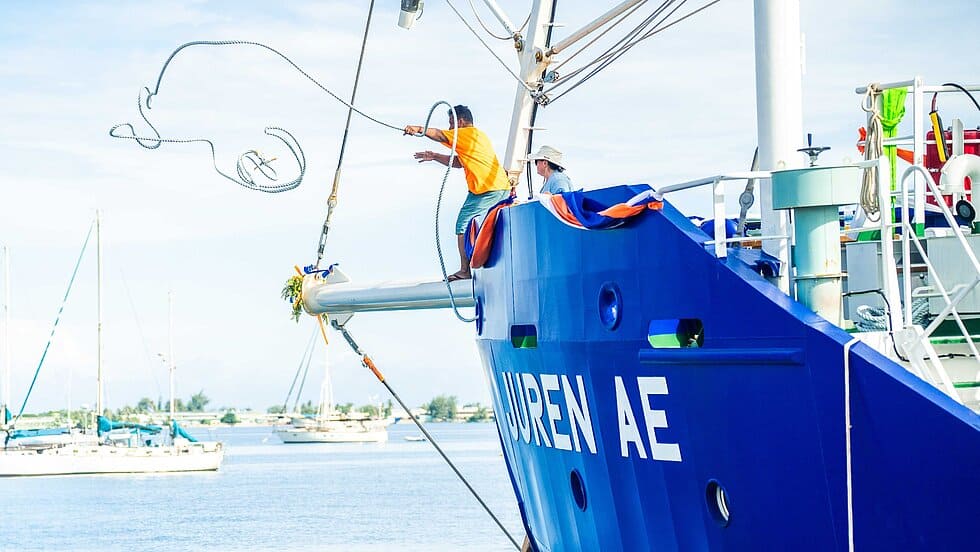
As maritime nations, we are totally dependent on shipping and air connectivity, both internationally and domestically, for almost all trade and economic activity. Apart from one small freighter, the Juren Ae in RMI, all shipping and aviation services are completely dependent on imported fossil oil.
What can be done? The first thing to remember is that this is not a new situation; we have been here before, in the 1970 80s, when fuel prices rose by 15 times and then more recently during COVID.
COVID taught us that we could survive without air connectivity – albeit at a huge cost to our economies, especially the tourism-dependent ones. But we could not survive without shipping. In some ways, this is lucky because we have a number of available options for shipping while there are not any real fossil-oil free solutions for aviation that are ready today or on the horizon.
Of the options for shipping, the most logical, accessible and affordable is using wind as a hybrid energy source. Let’s consider the lessons from the crisis that started in 1973 in the Middle East. First lesson – no one was prepared. So, response took time.
The cost of fuel for outer island shipping services was identified from the outset as a high priority by the countries and by various agencies, including UN and ADB. But there was no research base to work from and no financing available.
By 1980, there was agreement that wind energy should be investigated – but it took until 1984 for the first projects to be funded.
Several projects were outstanding successes. The retrofit of GSS ships, first Na Mata-i-Sau and later the Cagidonu, with sailing rigs designed in Fiji and fitted in Walau Bay, delivered an average of 30 per cent fuel savings across all Fijian routes.
The EU paid the villagers on Kabara to build their own 50-ton sailing ship, the Tai Kabara. She operated for the first three years without a motor at all, and provided regular service to the Lau for the next twenty years.
Feasibility studies and ship designs were drawn up for a Ha’apai trading ship. There was a brigantine hospital ship operating in the Marshall Islands, and FAO and Save the Children Fund were building wind-assist small vessels for fishing and village transport in several of our countries.
ADB ran a large regional workshop that brought together naval architects and shipping energy experts; all agreed that wind assisted propulsion was feasible, effective and achievable.
But by 1987, oil prices were down to the lowest value since World War II, and all the projects were closed down. Everyone assumed that the oil crisis was a temporary and one-off affair, and that cheap imported fossil oil would go on being the
business-as-usual option forever.
Unfortunately, when our region turned back to the issue of our diesel dependency in the face of a growing climate emergency over the past two decades, shipping’s energy needs have been largely ignored while renewable electricity generation has been prioritised.
The worst time to prepare for a crisis is once you’re in one. Unfortunately, for shipping, that’s exactly where we are today. The other thing we know with certainty is that it will always be more expensive to transition away from fossil oil tomorrow than it is today.
Wind is still the most logical option for us to be investing in 2026. And 40 years on from the last oil crisis, we now have a whole host of new technologies and options coming up on the radar.
The other difference with the 1970s crisis is that this time, we aren’t coming from a standing start. We now have a solid decade of research available to support our countries from a growing network of both local and international experts. We have our first proof-of-concept prototype designed, built and in operation.
Now, we need to replicate and scale. We need to demonstrate what fuel and cost savings are available to the private sector in real time and in full Pacific settings. They won’t invest until there is clear proof of concept. Nor should they.
The next step is building a fleet of representative types of low-carbon ships and deploying them in real time on a range of Pacific routes. Achieving that requires a willing coalition of Pacific countries to agree to collaborate and coordinate. This is the objective of the Pacific Blue Shipping Partnership. Very timely indeed.