AS the FIFA World Cup returns and captures global attention, the 2026 tournament marks a significant moment for Oceania football.
Expanded from 32 to 48 teams, the new format grants Oceania a direct qualification spot for the first time, increasing the chances of regional representation on football’s biggest stage.
Yet despite this historic change, qualification remains heavily concentrated. New Zealand continues to dominate the region, leaving most Pacific Island countries with little realistic prospect of reaching the World Cup.
However, the Pacific’s greatest football success story may not be found on grass at all. Instead, it emerged on the sandy beaches of French Polynesia.
French Polynesia—an overseas collectivity of France, with a population of just over 280,000 people spread across 118 islands—would seem an unlikely candidate to become a global football success story. Tahiti is the largest and most populous island of French Polynesia and has become the territory’s sporting identity abroad.
Located thousands of kilometres from major sporting centres and dispersed across a vast expanse of the Pacific Ocean, it faces many of the challenges commonly associated with Pacific Island societies, including small populations, limited resources, and logistical isolation.
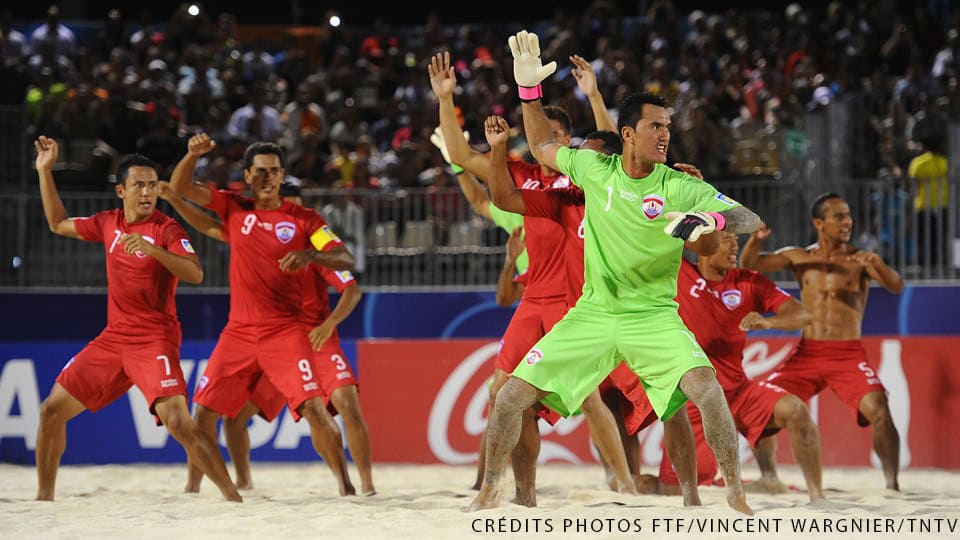
Yet under the name Tahiti, its national beach soccer team—known as the Tiki Toa—has become one of the world’s most successful sides.
Since making its international debut in 2006, Tahiti has established itself as a perennial contender at the FIFA Beach Soccer World Cup. After hosting the tournament in 2013 and finishing fourth, the Tiki Toa reached consecutive World Cup finals in 2015 and 2017, losing only to traditional powerhouses Brazil and Portugal. No other Pacific Island team has achieved comparable success in any FIFA competition, making Tahiti the most successful football story the region has produced.
The question is not simply how Tahiti became successful, but why beach soccer has provided opportunities that conventional football has not. While Pacific Island countries have long struggled to compete in the highly professional and resource-intensive world of eleven-a-side football, beach soccer rewards a different set of advantages.
French Polynesia’s tropical geography provides an ideal environment for the sport. With abundant soft-sand beaches accessible year-round, beach soccer is not a specialised activity requiring significant infrastructure, but a readily available part of everyday life. The physical demands of playing on sand also develop balance, strength, and technical adaptability in ways that differ from conventional football, particularly aerial control and improvisation.
Tahiti’s small population may also be an advantage rather than a disadvantage. In a territory of fewer than 300,000 people, many elite players have competed alongside one another since childhood, creating a level of familiarity and cohesion that is difficult to replicate in larger and more fragmented sporting systems. Rather than relying on a vast talent pool, the Tiki Toa have benefited from continuity and long-term team chemistry.
Equally important is the nature of beach soccer itself. Compared with eleven-a-side football, the sport remains relatively small and less commercialised. The lower barriers to entry reduce many of the advantages traditionally enjoyed by larger and wealthier football nations, creating opportunities for smaller territories such as Tahiti to compete on a more equal footing.
Tahiti’s emergence as a beach soccer powerhouse was further accelerated by hosting the 2013 FIFA Beach Soccer World Cup. Playing on home sand, the Tiki Toa achieved a remarkable fourth-place finish, capturing the attention of both local audiences and the wider beach soccer community. The tournament not only demonstrated that a small Pacific territory could compete with the world’s best but also sparked greater public interest in the sport across French Polynesia.
The impact extended well beyond the tournament itself. Increased international exposure created new opportunities for Tahitian players to compete abroad, allowing them to gain valuable experience in some of the world’s strongest beach soccer leagues and clubs. Several members of the 2015 World Cup squad secured overseas contracts, while Heimanu Taiarui’s Golden Ball award as the tournament’s best player further elevated Tahiti’s international reputation. Rather than representing a one-off success, the 2013 World Cup helped establish the foundations for the Tiki Toa’s continued presence among the sport’s elite.
Tahiti’s experience suggests that success for Pacific societies does not necessarily depend on overcoming geographic constraints.
In some cases, success emerges when activities are aligned with local conditions, existing skills, and community structures.
Rather than competing directly with larger and wealthier nations on unequal terms, Tahiti found a sporting arena in which its natural environment and social cohesion became competitive advantages. More broadly, the Tiki Toa’s success challenges the tendency to view Pacific Island societies primarily through the lens of limitation and vulnerability.
Characteristics often portrayed as disadvantages—small populations, geographic isolation, and distance from major centres—can, under the right circumstances, become sources of strength. Tahiti’s rise in beach soccer demonstrates that success is not always achieved by replicating the pathways of larger nations, but sometimes by excelling in arenas that reward different capabilities.
The Tiki Toa is not entirely unique. Fiji’s success in rugby sevens and Olympic competition, Samoa’s and Tonga’s contributions to international rugby, and Nauru’s historical dominance in weightlifting all demonstrate that Pacific societies have often achieved
international sporting success through specialisation rather than scale. Beach soccer represents another example of how small island communities can achieve global recognition despite limited populations and resources.
As the football world focuses on the expanded FIFA World Cup and Oceania’s historic direct qualification pathway, Tahiti offers a reminder that Pacific sporting success cannot be measured solely by appearances on football’s biggest stage. Long before most Pacific nations have realistic hopes of competing at a FIFA World Cup, the Tiki Toa have demonstrated that a small island territory can compete with—and regularly challenge—the world’s best.
In doing so, they have produced perhaps the most remarkable football story the Pacific has ever seen, just not on grass.