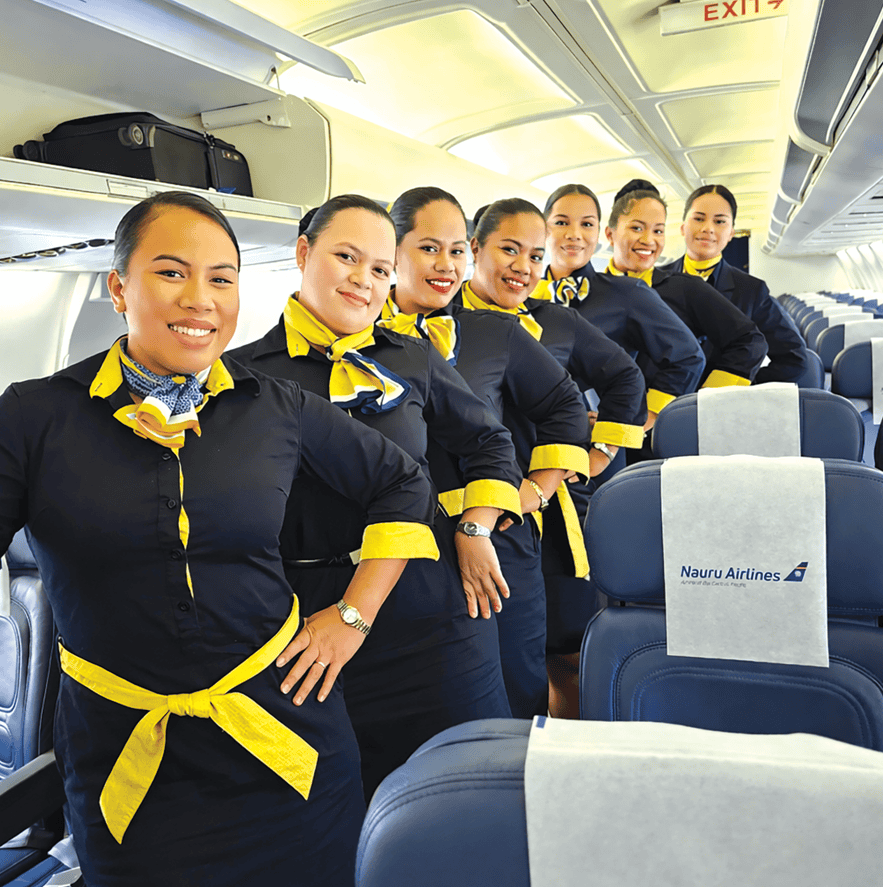
A SWEEPING strategic reset is underway at Nauru Airlines, as the national carrier restructures its business, sharpens efficiency, and prepares for fleet renewal and measured expansion.
Chief Executive Officer Robert Eoe said the airline began implementing restructuring measures, marking a shift to strengthen operations and position the carrier for future opportunities.
“For the first several months of this year, we have commenced work in a number of areas of restructure at Nauru Airlines under a strategic reset as we work towards future plans, including newer aircraft, greater marketability of our destinations through schedule improvements, and some likely new destinations,” he said.
A key focus of the reset has been improving operational efficiency, beginning with adjustments to the airline’s flight schedules.
Introduced on 26 March, the changes are designed to better structure services and enhance their market appeal.
“Amongst changes already underway, we have redesigned our schedules with effect from March26 offering greater marketability of our Australia-North Pacific Connector services through greater separation of northbound and southbound flights, and Brisbane to Nauru services more evenly spaced across the week, with overall increased cost efficiencies as a result,” Eoe said.
Beyond operational adjustments, the airline is also strengthening its financial base through new income streams – a move that signals a broader effort to diversify beyond traditional passenger operations.
One such initiative is the placement of an aircraft on a seven-year lease with cargo operator AFCOM Holdings in Chennai, India.
“The placement of an aircraft on a seven-year lease arrangement… has injected valuable new lease earnings into Nauru Airlines,” Eoe said.
At the same time, cost management remains a priority, with the airline implementing selective outsourcing to reduce overheads while maintaining service standards.
“We have also achieved significant cost saving initiatives through selected outsourcing opportunities that retain quality outputs at lower overhead cost rates,” Eoe said.
“Our strategic reset encompasses greater schedule marketability and efficiency, widening the airline’s horizons of business pursuits to take advantage of new opportunities outside of our previous scope, and seeking a significant reset of the cost base through selective outsourcing opportunities.” Looking ahead, the airline is exploring opportunities for selective network expansion to strengthen connectivity across its core markets.
Recent developments have already strengthened the airline’s presence in the region, particularly with the addition of Suva—through Nausori International Airport—as a second gateway to Fiji.
“Yes, selective network expansion is very much in our thinking. The introduction of Suva as our second Fiji gateway has proven to be very positive for Nauru Airlines and balances well our marketing of Fiji as both a gateway to further international destinations beyond Fiji via Nadi, along with the servicing of the student, government and inter- island business markets relating more closely to Suva,” Eoe said. In the longer term, fleet renewal remains central to the airline’s plans, with a transition already mapped out towards newer generation aircraft.
“The completion of our fleet renewal programme is currently a prime focus for the airline over the next several years, including the gradual phasing out of our B737 Classic fleet of -300 aircraft and their replacement with new generation 700–800 aircraft,” he said.
However, any increase in capacity will be guided by commercial viability and regulatory requirements.
“Growth in capacity will be dependent on expansion to new destinations identified as a result of our route development studies, and the conclusion of required associated Air Service Agreements,” Eoe said.
Like many airlines, Nauru Airlines is also navigating ongoing fuel cost pressures and supply uncertainty, which continue to affect operations across the sector.
“Nauru Airlines, like most other airlines, will need to recoup fuel cost increases by way of cost-related fuel surcharges added to fares… we are remaining in very close contact with our current suppliers throughout our network who are keeping us informed,” Eoe said.
Partnerships are expected to play an increasingly important role as the airline looks to expand its commercial reach and build resilience.
“We believe in carefully researched collaborations— that brings wins to both parties—such ventures can add significantly to the success of the parties involved.”
As the airline advances its reset strategy, Eoe said its focus remains firmly on delivering reliable services while strengthening connectivity across its network – a balance that will shape how the carrier navigates its next phase of growth.
Nauru Airlines has faced challenges in the past due to high operating costs linked to distance and multiple competitors on routes to remote destinations. But it was the region’s first truly international airline, operating to Australia and South east Asia well before any Pacific nation dared to explore the concept.
With its current operational plans, this just may be Nauru’s chance to soar to new heights.