VANUATU has officially welcomed an economic mission to Port Vila from New Caledonia’s Front de Libération Nationale Kanak et Socialiste (FLNKS), to discuss economic and political ties.
Vanuatu Prime Minister Jotham Napat welcomed a delegation led by FLNKS President Christian Tein to Port Vila, to attend VOICE 2030 between 4–7 May. The forum on ‘Vanuatu Opportunities for Investment and Caledonian Enterprises’ was organised by the Vanuatu Ministry of Trade.
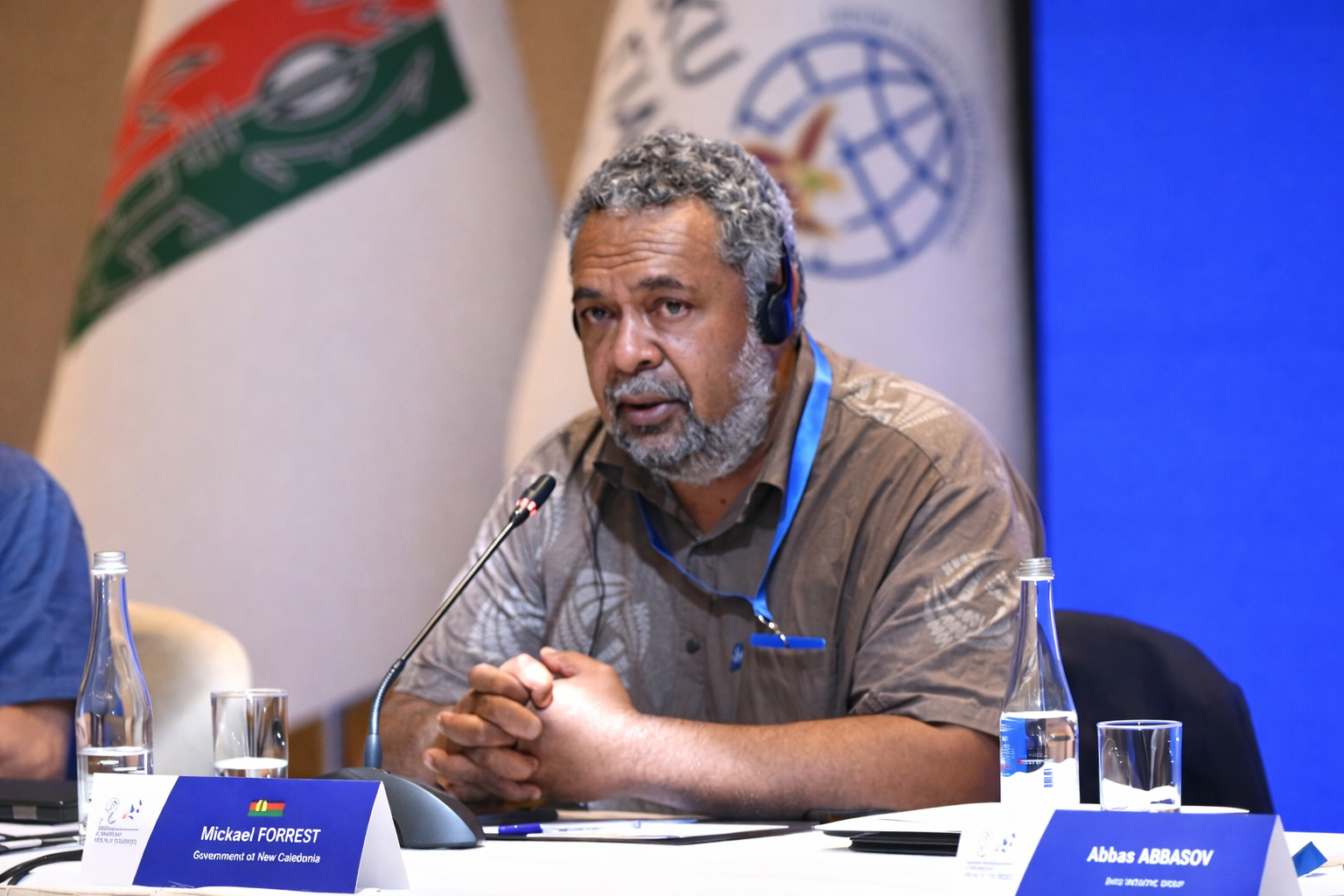
Speaking after the trade summit, FLNKS delegation member Mickaël Forrest told Islands Business that “the mission led by Christian Tein was well received by the Vanuatu government, after an official invitation was sent to the FLNKS. We had some very successful discussions with New Caledonian businesses, and FLNKS President Tein had some high-level discussions with the Vanuatu Prime Minister, the Deputy Prime Minister, the Foreign Affairs Minister, and the Director General of the Melanesian Spearhead Group.”
Despite this, the presence of the FLNKS in Port Vila sparked fury from anti-independence politicians in Noumea, leading to a war of words between the host government and France’s Ambassador in Port Vila, Jean-Baptiste Jeangène Vilmer.
The Government of New Caledonia is headed by President Alcide Ponga, leader of the anti-independence Rassemblement party. Despite its support for regional integration, the Ponga government issued an angry statement on 5 May, criticising the FLNKS mission. The media release, circulated by the French Embassy in Port Vila, stressed that “the President of New Caledonia is the sole authority authorised to represent New Caledonia abroad” and the government “emphasises that the delegation currently in Port Vila cannot be regarded as an official delegation of the Government.”
In a Facebook post, France’s Ambassador Jeangène Vilmer noted: “It was the President of the FLNKS–an opposition political party with no jurisdiction in this matter–who was presented as head of the delegation and officially welcomed at the airport by the head of protocol at the Ministry of Foreign Affairs and the chief of staff to the Minister of Trade.”
The FLNKS mission also sparked anger from Nicolas Metzdorf, leader of the anti-independence party Générations NC and a deputy in the French National Assembly.
“Vanuatu is openly mocking us,” Metzdorf tweeted. “Our closest neighbour continues to meddle in the internal politics of the territory by inviting the FLNKS President to lead an ‘economic delegation’ aimed at cooperation with New Caledonia.”
Christopher Gygès, the member of New Caledonia’s government responsible for finance, budgets and trade, then announced “the suspension of all work between New Caledonia and Vanuatu relating to the trade cooperation agreement.”
On 6 May, France’s ambassador met Vanuatu Minister for Foreign Affairs Marc Ati, so that his country’s position could be “properly understood”.
In subsequent days, Jeangène Vilmer continued a series of social media posts, ultimately prompting a public rebuke from the host government: “It is extremely unfortunate that the Ambassador’s posts on social media have unnecessarily provoked public misunderstanding and divided national opinions on the actual state of play.”
Expanding trade and investment The sharp reaction to the FLNKS mission highlights ongoing debates about regional integration and French attempts to regulate New Caledonia’s external relations.
Under the 1998 Noumea Accord, foreign affairs is a shared power between the French State and the Government of New Caledonia. The potential for greater regional integration is symbolised by the Pacific Islands Forum’s 2016 decision to make New Caledonia a full member. However, the Pacific dependency’s colonial status still restrains some independent partnerships with neighbouring countries.
These constraints were highlighted by the former President of New Caledonia Louis Mapou when he welcomed a mission of Forum Prime Ministers to Noumea in October 2024. At the time, President Mapou told Islands Business: “I raised with them some of the obstacles and constraints, which are directly related to our political status – we aren’t an independent state that has the freedom to work on many of these issues that we must all address in the future. Members of my government raised with the delegation that we have a trade agreement with Vanuatu, but we have been unable to bring it to fruition for more than two years.”
This tension has continued in recent years, as the French State has sought to develop a new statute to replace the Noumea Accord. The draft Bougival Accord (now rejected by the French National Assembly) raised the possibility of transferring control of foreign policy from Paris to Noumea. However, according to the draft text, New Caledonia would be required to conduct its diplomatic actions “in accordance with the international commitments and interests of France”.
This ongoing tension is most evident when Noumea’s regional interests clash with France’s broader Indo-Pacific Strategy, especially as Kanak independence leaders have sought to push the boundaries on international relations (such as President Mapou’s visits to the White House in 2022 and 2023 as a member of the Forum, to meet then-US President Joe Biden).
Talking trade in Port Vila Pro-independence Kanak politicians have long driven attempts to deepen regional economic and political ties, and it’s notable that the FLNKS—not the Government of New Caledonia—is the full member of the Melanesian Spearhead Group (MSG), alongside the independent states of Papua New Guinea, Solomon Islands, Fiji, and Vanuatu.
Mickaël Forrest is a member of the Government of New Caledonia, responsible for youth, sports and culture (but not trade). A member of the FLNKS delegation to Port Vila, Forrest told Islands Business that expanding trade and investment had been an MSG priority for decades, but the recent visit to Vanuatu also had political importance.
“It’s important for Kanak people to stay abreast of developments across the region,” Forrest said. “This month, there’s been the change in leadership in the Solomon Islands, the visit by the Australian foreign minister to Fiji, and the Melanesian Ocean Summit. It’s important for the Kanak people to get involved in regional affairs, because we’re a Melanesian land in the Pacific – we’re not a French department.”
Responding to the polemics from Loyalist politicians around the recent FLNKS mission, Forrest said that “we were very surprised, indeed embarrassed, by their public statements, which seem to be from another era. The relationship between Kanaky and Vanuatu dates back thousands of years, and it’s always strange to have these interventions from outside Melanesia.”
For decades, the two neighbouring Melanesian nations have sought to boost economic co-operation and trade ties, through bilateral talks but also through Melanesian trade agreements facilitated by the MSG, which is headquartered in Port Vila. Formally established in 1988, MSG members first signed a trade agreement in 1993, which was updated and modified in 2005. In 2013, meeting in Noumea, Melanesian leaders adopted the MSG 2038 Prosperity for All Plan, which opened the way for further revision of the MSG sub-regional trade agreement. To draw in private sector businesses, the MSG initiated a series of trade fairs in Nadi (August 2013), Port Moresby (November 2014), and Noumea (November 2015).
“The FLNKS took the lead in 2013 to bring together both public and private sector at the MSG summit,” Mickaël Forrest said. “In November 2014, at the second commercial trade fair in Port Moresby, we opened up the delegation from New Caledonia to private sector, as well as government representatives.
“This partnership is part of a long tradition, shown again at this month’s VOICE summit,” he said. “There were Kanak, Caldoche and Javanese business leaders in attendance, not just those who vote for the FLNKS. In trade talks between New Caledonia and Vanuatu, there are 15 areas on the table, including agriculture, infrastructure, manufacturing, and other sectors. But it’s not for the FLNKS to choose amongst these: it’s our job to create the conditions for well-being and prosperity through diverse cooperation mechanisms.”
In recent months, Vanuatu has also sought to boost trade and investment partnerships with business leaders from its closest neighbour. Trade Minister Samson Samsen visited New Caledonia in March, to brief the private sector on opportunities for trade and investment. The VOICE 2030 summit built on this dialogue, with the Vanuatu government welcoming a range of business representatives to Port Vila. For Noah Patrick Kouback, Director General of Vanuatu’s Ministry of Trade and Commerce, “the purpose of this forum is to bring the two countries together. While we share close ties, we have not been fully working together in terms of trade and investment. This platform allows us to exchange information and identify real opportunities.”
Beyond these meetings, there are concrete measures to strengthen trade ties through inter-island transport. Despite his criticism of the FLNKS delegation, Ambassador Jeangène Vilmer joined Vanuatu Deputy Prime Minister Johnny Koanapo on 9 May to inaugurate a new freight service linking Nouméa, Port Vila, and Luganville. New Caledonia’s Compagnie Maritime des Îles (CMI) will use the freighter Karaka, with a capacity of 1700 tonnes, to extend operations beyond the Loyalty Islands and transport goods to Espiritu Santo in Vanuatu, returning to New Caledonia with locally produced commodities.