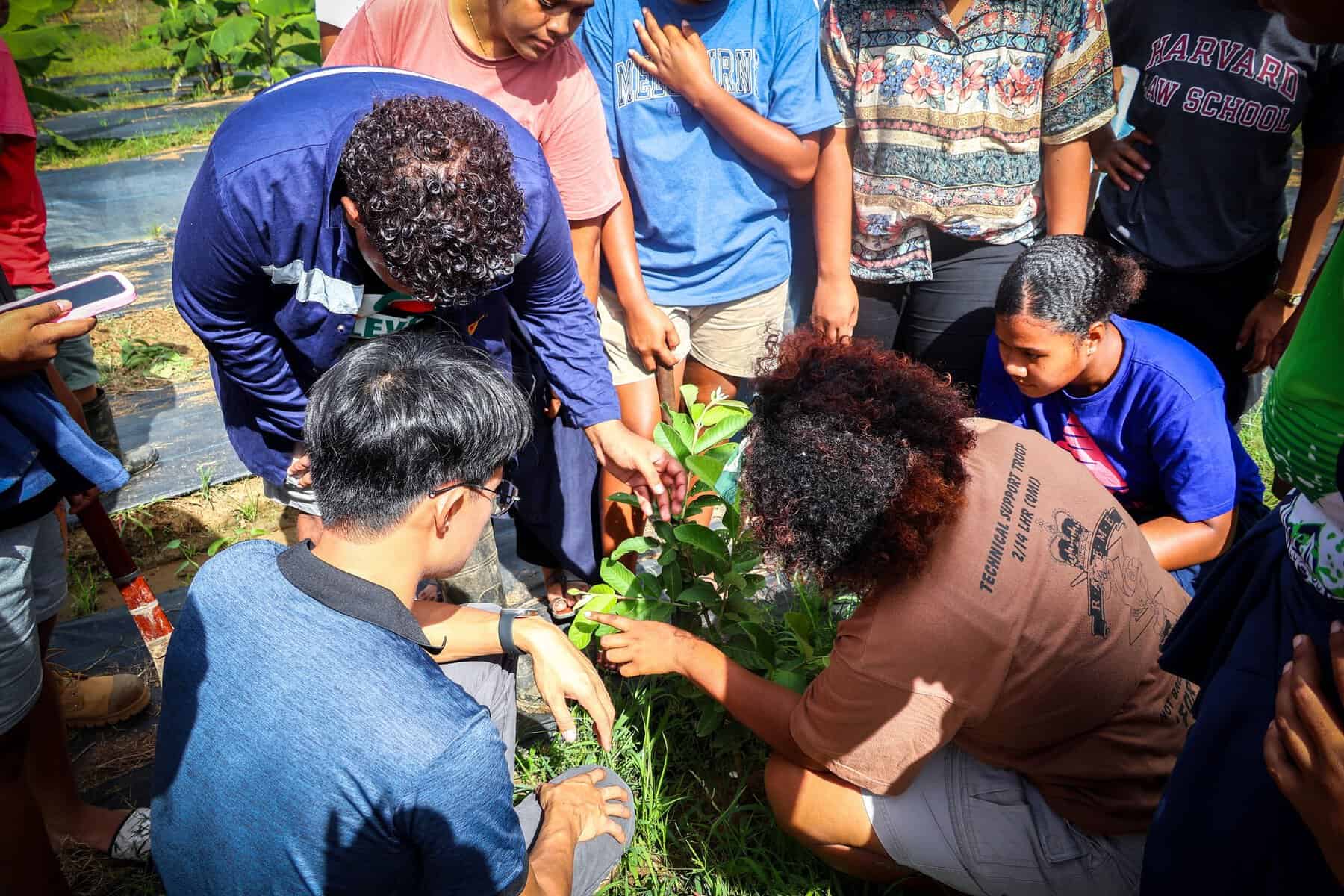
THE Taiwan Technical Mission (TTM) and Fiji National University’s (FNU) Koronivia Campus have partnered to establish a student training farm to strengthen agricultural education and support long-term food security in Fiji.
The initiative will provide students with hands-on training in modern and climate-resilient farming practices, while also creating opportunities for farmer demonstrations and agricultural extension activities.
The training farm will complement classroom learning by providing students with practical experience in crop production, nursery management, soil improvement, composting, irrigation, and general farm operations.
TTM Team Leader Shi-Chian Shiau said the collaboration reflects a shared commitment to strengthening agricultural capacity, youth engagement, and innovation in Fiji’s agriculture sector.
“Agriculture remains a key pillar of Fiji’s economy. Through the Koronivia Campus student training farm, we aim to provide students with practical skills and real-world experience that will help contribute to a more productive, resilient, and sustainable agriculture sector,” he said.
Discussions on the project began late last year after FNU students were sent to the TTM farm for internship training.
Following those exchanges, the University allocated land at the Koronivia Campus, where a small greenhouse, fruit trees, and vegetable plots have already been established.
Students will use the site to develop skills in pruning, crop cultivation, grafting, and farm management under the guidance of technical staff.
Officials say the farm is designed to bridge the gap between theory and practice by allowing students to apply classroom knowledge in a real farming environment.
The Taiwan Technical Mission says the project will also promote practical, low-cost, sustainable farming methods suited to local conditions.
In the longer term, the site is expected to support student learning, demonstration projects, trial work, and future farmer training programmes. Both parties are also discussing a memorandum of understanding to formalise the partnership and expand opportunities for student training and collaboration.
Officials from both organisations say the initiative comes at an important time for Fiji’s agricultural sector, which faces growing pressure to improve productivity, adapt to climate challenges, and attract more young people into the industry.
By giving students direct exposure to farming systems and technical support, they believe the programme can help develop a stronger pipeline of graduates equipped to support both commercial agriculture and community-based farming.
The partnership also reflects growing efforts to modernise agricultural training in Fiji and better prepare students for the realities of climate change, food security and sustainable farming.
Officials say initiatives like the Koronivia training farm will be critical to building a new generation of skilled agricultural professionals.
Chand’s journey on agricultural partnerships
The impact of the Fiji–Taiwan agricultural partnership can also be seen in the journey of Pritika Chand, who studied agriculture at FNU before joining the Taiwan Technical Mission as a Lab Technician.
Chand first developed an interest in plant science and agricultural development while studying at FNU, and later gained practical exposure through an internship connected to the Fiji–Taiwan partnership.
During her internship, she worked with a range of crops and production systems, gaining firsthand experience in farm operations, crop maintenance and production methods that complemented her academic studies.
The experience helped shape her career path and showed her how agricultural training could lead to opportunities beyond traditional farming.
She later received a scholarship to study in Taiwan, where she completed a Master’s Degree in Plant Biotechnology.
The programme strengthened her knowledge in agricultural innovation, crop improvement and plant propagation, while adding an advanced scientific dimension to the practical foundation she had built in Fiji.
Now working as a Lab Technician with the TTM, Chand applies those skills in laboratory-based plant propagation and agricultural research that supports local crop development efforts.
Her journey highlights how agricultural education can create pathways into science, research and technical innovation, while also serving as an encouraging example for young people—particularly women—considering a career in agriculture.