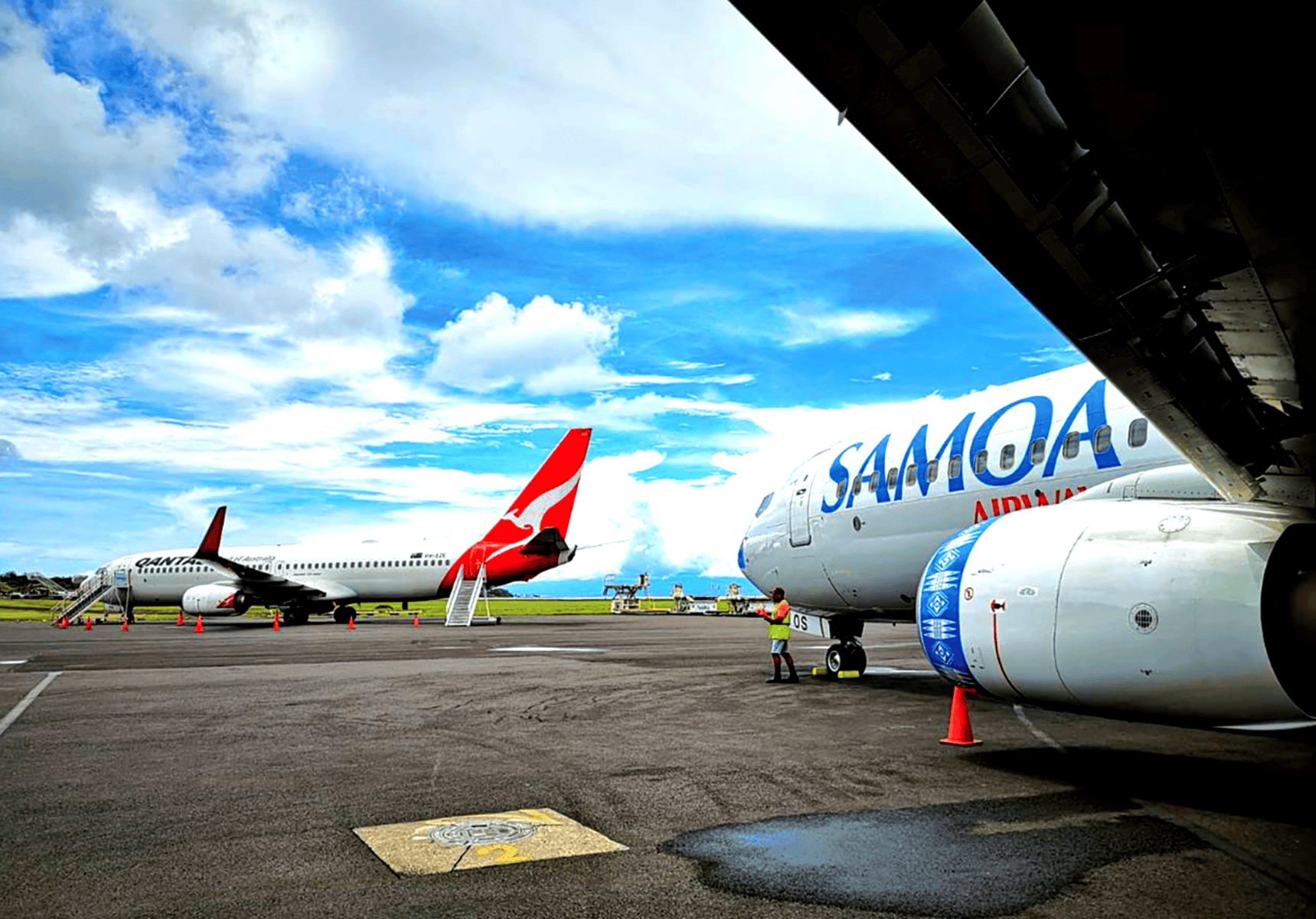
SAMOA’S national carrier will remain firmly on the ground, seven years after it soared into Pacific skies.
Plans to resume jet operations—which collapsed after COVID in 2020—have been walked back.
Initially, Samoa Airways was to acquire aircraft by the end of this year.
Deputy Prime Minister Mulipola Anarosa Molioo said the proposed aircraft initiative remained in the planning phase and is now part of a broader five-year development programme. The announcement follows a briefing in which officials stressed that infrastructure and investment discussions are ongoing.
“A plane does not come and land at a forest; it lands at our airport,” Mulipola said, noting that airport facilities and hotel capacity were under review as part of readiness planning.
The government had campaigned on a promise to restart Samoa Airways’ international flights, proposing to ask diaspora communities in Australia, New Zealand and the United States to contribute toward purchasing aircraft. The initial target for delivery was late 2026.
That has now shifted. Mulipola told media that rushing to reintroduce jets without full preparedness would be “unwise”. She estimated the annual operating costs for international service at WST30 million (approximately $USD11 million), excluding the cost of the aircraft itself.
A cabinet-approved task force is now working to align the investment plan with the Unit Trust of Samoa, the country’s sovereign wealth fund. Officials say diaspora groups have requested direct face-to-face meetings to clarify investment arrangements, and a government delegation is expected to travel abroad for further consultations.
While the government has not finalised whether it would purchase or lease aircraft, Mulipola confirmed that both dry lease and wet lease models were being considered. She stressed that the initiative remained stable and fully within the government’s long-term strategy.
Struggles of a national carrier The delay is the latest chapter in a turbulent history for Samoa’s national airline. Founded in 1959 as Polynesian Airlines, the carrier has long struggled to maintain consistent international service.
In 2005, the government suspended the airline’s international jet operations, citing rising costs that consumed more than half of the national budget. A joint venture with Australia’s Virgin Blue—later renamed Virgin Samoa—took over international routes. But the partnership was terminated in 2017 after disappointing performance, and the airline rebranded as Samoa Airways to resume flying under its own name.
In late 2017, Samoa Airways leased a Boeing 737–800 from Italian carrier Neos, and resumed flights to Auckland. But a more ambitious plan to acquire a Boeing 737 MAX 9 in 2019 was thwarted when the worldwide grounding of the MAX fleet followed two fatal crashes. The aircraft was never delivered. Then, in 2020, the airline suspended all long-haul jet operations due to the COVID-19 pandemic and has not resumed them since.
Today, Samoa Airways operates just three aging de Havilland Canada DHC-6 Twin Otter aircraft, with an average age of more than 44 years. The airline has been refurbishing these turboprops at a cost of WST10 million each. In a bright spot, the airline posted a net profit of WST11 million ($USD4.1 million) for the year ended June 2025 – its first profit after eight consecutive years of losses, largely thanks to government debt write-offs.