A coalition might be the option for Samoa’s leaders at the end of the August polls.
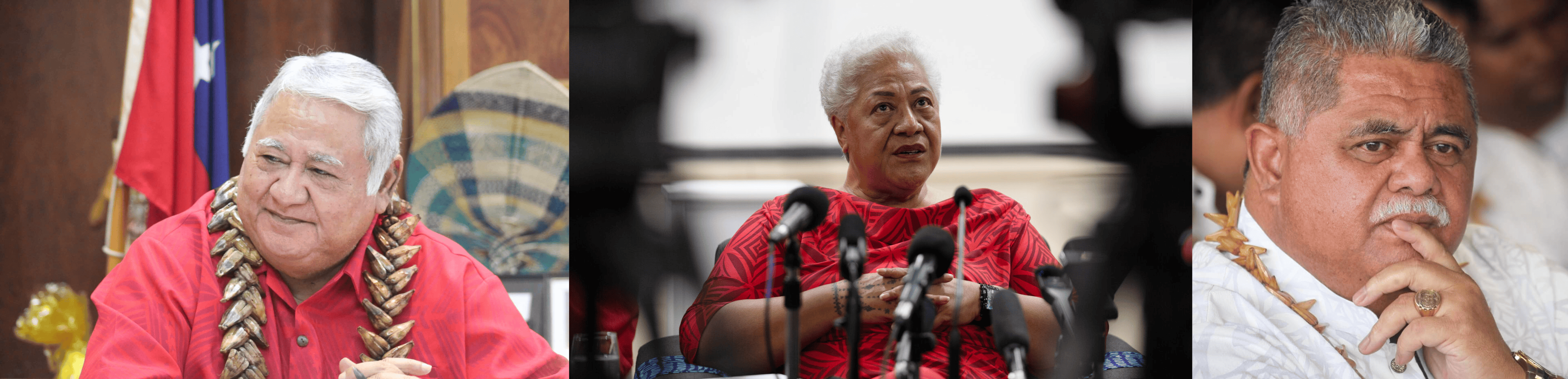
Three parties seem certain to command the majority of votes – HRPP, FAST, and SUP. If winning comes down to forming a coalition, HRPP is more likely to join SUP than FAST.
This was shown during the parliamentary sittings this year. HRPP moved the first motion of no confidence against caretaker Prime Minister, Fiame Naomi Mata’afa, only to be defeated because La’auli Leuatea Schmidt would not support Samoa’s previous head, Tuilae’pa Sa’ilele Malielegaoi.
There is no love lost between the two men. In the second parliamentary sitting this year, FAST majority pushed for a motion of no confidence, which was defeated because HRPP would not support it. However, both HRPP and FAST voted against supporting the budget.
HRPP remains the oldest player in the game. Tuila’epa has led since 1998, but there have been notions of a rift, the latest being Maulolo Tavita Amosa, who has now joined SUP.
Maulolo voted for constitutional amendments when the HRPP directive was to vote against it. Tuila’epa, the seasoned campaigner, has downplayed the rift, stating the party is as united as ever.
In a recent meeting with candidates, it was observed that the HRPP still commands significant support. More than 40 businesspeople, professionals, including academics and civil servants, were present looking for a ticket to contest the election.
Unlike 2021, HRPP is unlikely to repeat the mistake of having more than one candidate in a constituency. This was another reason HRPP lost in 2021.
La’auli is the one with the star power when it comes to FAST. The man has a massive following. His ability to draw support is mainly based on his ability to deliver speeches and addresses in Parliament in the style of Samoan orators.
Despite his involvement in deals such as the Sasina Economic Zone, where land was leased to Chinese developers in his constituency to set up cryptocurrency companies— even when the nation does not have laws that govern such dealings—he is considered by some as the man to lead the nation.
Other dealings that have raised eyebrows about La’auli include companies owned by his children being contracted for the tour deal when the inaugural direct flight from China landed in 2023. He was in Hong Kong, where Samoa was declared a partner of three stock exchange companies, and the sale of 400 acres of agricultural land to American Samoa to breed cattle.
FAST demands a lot of support from overseas Samoans; however, the current criminal trial of La’auli and five others—which includes another FAST politician, Fepuleai Faimata Sua—holds the fate of the two.
A conviction would most likely render the two men ineligible to contest the election. Many are pondering what the future FAST would be without La’auli.
The new political party has players who have long been in the game, too. Fiame, Olo Fiti Vaai, Leutimuia Uelese Vaai, Tuala Iosefo Ponifasio, and other political heavy hitters are with SUP. Fiame leads the party and is favoured to win again in her constituency, as are other cabinet ministers.
SUP has not made any promises except for holding true to the rule of law. Other promises are likely to follow in the coming weeks.
The new party can also pull a few surprises, but elections in Samoa have rules unknown in other countries.
In Samoa, only matai (chiefs) are allowed to contest elections. Before 1991, only chiefs were allowed to vote. A common man is deprived of the right to contest an election, but anyone in Samoa can become a matai if the price is right. Matai installations over the years have lost their significance.
Some chiefly installations are made because of the financial gains to the village council chiefs.
This presents a few problems, the biggest being the influence on voters through the chiefly system. The candidate or matai, favored by the village council, either through kinship or the amount of money rendered in providing service, gets the votes.
The councils would declare that everyone in the village or district vote for the favored candidate; failure to do so results in village penalties, which are hefty fines amounting to thousands of tala (the local currency) and, in some cases, banishment.
The tradition of gifting is another issue. Simply put, candidates have been known to give financial gifts—in the guise of tradition—in return for promises of votes. Politics is lucrative in Samoa and for some, a pathway to financial gains.
Some gifting issues end up in court after the results are declared.
While cases can be filed, presenting evidence before the courts has been easier said than done.
Mechanisms demanding transparency and accountability are missing, allowing the system to be manipulated. Late last year, the government talked about introducing anti-corruption and right to information laws. The political rift in the ruling party has not allowed many of the laws to be put through the House.
Counting down to August 29
Registering voters is the current focus, along with the issuance of the writ of elections. The OEC has its work cut out for it, and there will be added pressure as the people required for the elections will have to be brought in from other government ministries.
This will impact the functions of other government departments, but it is a necessary move. The OEC will need to train personnel to carry out the elections. There will be assistance from Australia and New Zealand to finance the elections and, to some extent, to ensure that they are conducted in a free and fair manner.
Will the elections be free and fair? Only time will tell.