IN response to growing concerns about the state of its ocean, Fiji’s government invited the National Geographic Pristine Seas team to explore and assess the health of its marine ecosystems.
The goal: to generate vital scientific knowledge that can guide conservation and sustainable management efforts. “Prior to the expedition, we had conversations with local partners and the Fiji Government [and] it was clear there was great interest in getting more information about their ocean,” said Whitney Goodell, National Geographic Explorer and Deep Sea Science Lead for the Rotuma expedition.
“We’re really excited that our team can contribute information to the Government of Fiji and the community and share conservation insights.”
Unlike typical research expeditions, Pristine Seas emphasises collaboration and local engagement.
“We at Pristine Seas don’t come into a country, collect data, and leave,” said Expedition Leader Keiron Fraser. “It’s about working with local partners, with governments, and with organisations in-country. Collaboration is key.”
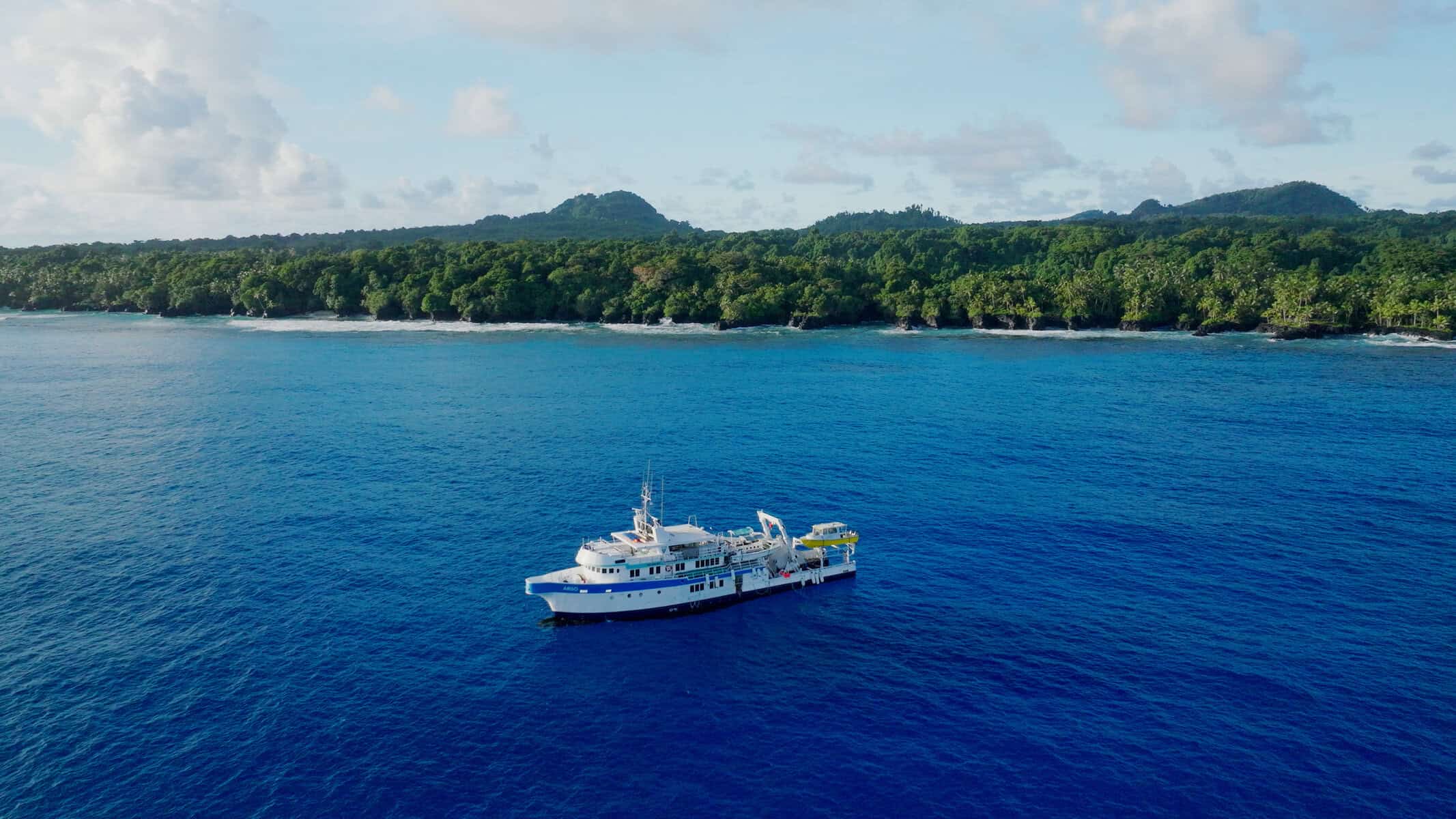
Fraser highlighted that much of the ocean deeper than 50 metres remains unexplored, especially in the Pacific. With the help of Argo, their specialised research vessel equipped with advanced tools like submersibles and drop cameras capable of reaching 6000 metres, the team is able to access and study
these depths in partnership with nations that may not have such capacity.
Their first stop: the remote volcanic island of Rotuma, surrounded by uninhabited islets and largely untouched waters – a perfect benchmark for understanding healthy marine ecosystems.
The Council of Rotuma formally welcomed the Pristine Seas team. Council Chair Gagaj Manav said, “The Council of Rotuma welcomes National Geographic Pristine Seas to help us better understand the richness of our ocean. Rotuma continues to commit to protecting our cultural heritage anchored in the ocean that surrounds us and safeguarding our people’s well-being through science, education, awareness, cooperation, and well-meaning dialogue.”
From the beginning, the team was immersed in Rotuman hospitality. But beyond that, they were deeply moved by the community’s profound connection to land, ocean, and cultural identity. “It is very impressive to me that there is this effort and emphasis on retaining culture and tradition, and that it
extends into the ocean as well,” Goodell said. “All of it is essentially a preservation of identity – and the ocean is a part of their identity here.”
Recognising the value of Indigenous knowledge, the team invited Rotuman traditional knowledge holders onboard for parts of the expedition. “They are a fountain of knowledge,” Goodell noted. “They would guide us to specific underwater features, identify shallower areas, or even suggest where we might spot tuna or tiger sharks. When deploying floating equipment, they would predict its movement based on currents – and they were spot on.”
The knowledge exchange went both ways. Locals were fascinated by the discovery of a rare shark species found in their waters – something they could now understand more deeply, thanks to the team’s scientific tools.
Rotuma’s northwest offshore banks—Alexa Bank, Louisa Bank, and Morton Bank—revealed thriving marine life, including abundant snappers and emperor fish, species often overfished in more populated areas. Goodell described thesebanks as a “great example of a healthy ecosystem with all the components that should be there.”
The expedition confirmed that much of Rotuma’s deep sea remains relatively untouched – a rare and valuable condition in today’s oceans.
“Rotuma is far away from the rest of Fiji and Tuvalu, and this isolation has important implications for biodiversity,” Goodell explained.
“There’s a higher likelihood that there are species found only around Rotuma. We’ve spotted several potentially endemic species, and that tells us two things: it’s an area of high biodiversity value, and there’s still so much to be discovered.”
Among the rare sightings was the oceanic white-tip shark, a critically endangered species globally threatened by commercial fishing.
“It’s a rare sighting because of how endangered it is, and we observed it at the northwest bank,” said Goodell.
However, not all findings were pristine. While much of the region remains healthy, signs of human impact—particularly in areas closer to communities—were evident. “There are clear signs that people rely heavily on the ocean for their livelihoods,” Goodell said. “Species were less abundant near the island compared to the offshore banks.
Still, this region is a very healthy part of the ocean, and that makes it a powerful opportunity – to ensure it stays that way for future generations.”
To support transparency and build trust, all findings and data collected are shared with the Fiji Government, other local partners like the Rotuman community, and its leadership.
“The Council of Chiefs and the broader community are being incredibly thoughtful about how they move forward,” Goodell noted. “Continuing to explore marine protection is essential to keeping the ocean healthy.”
Even in this remote region, the global crisis of ocean pollution made an appearance. The team observed some floating debris and plastics, likely carried in from distant parts of the world. It served as a sobering reminder.
“We live in one ocean,” Goodell said. “What happens in one part of the world can affect even the most remote places.”
The National Geographic Pristine Seas team has now moved on to Tuvalu for the next phase of their research and will return to Fiji for continued exploration. But one message from the Rotuma deep seas mission rings clear. “The ocean looks different when you leave it alone and let it be in its natural state,” Goodell said.