EIGHTY years ago, on 6 August 1945, the Enola Gay took off from Tinian Island in the Northern Marianas, flying towards the Japanese city of Hiroshima.
Commanding the US bomber, Captain Paul Tibbetts and his crew dropped an atomic bomb on the city, massacring tens of thousands of civilians. Three days later, another plane flew from Tinian carrying a nuclear weapon—codenamed Fat Man—to devastate the city of Nagasaki. Tens of thousands of people died instantly – others still live with the effects of ionising radiation.
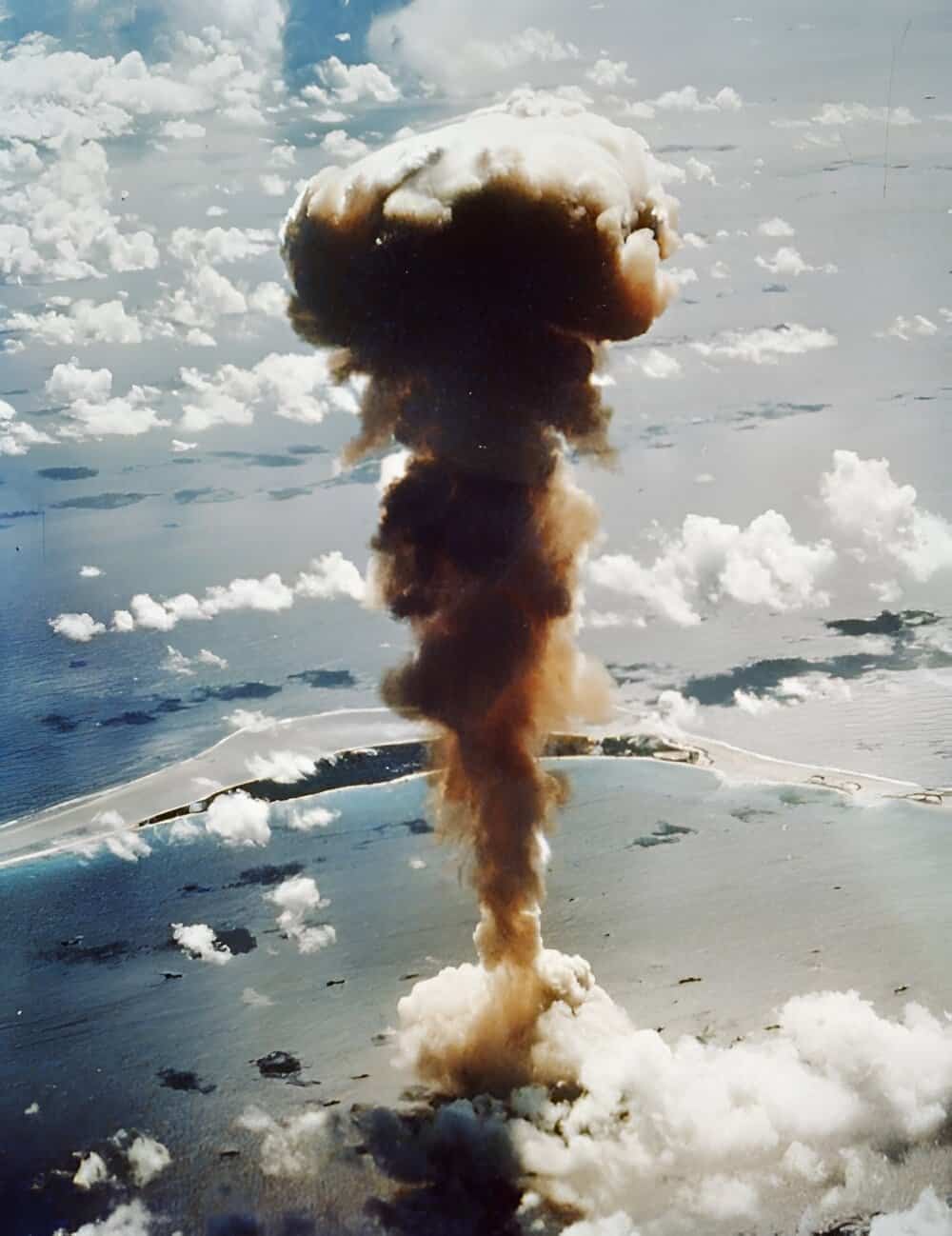
As people around the globe commemorate the bombing of Hiroshima and Nagasaki eighty years ago, it’s important to remember that the Pacific Islands were central to the nuclear era and the development of nuclear weapons technology.
The use of nuclear weapons against Japan in World War Two led to the Cold War arms race between the United States and Soviet Union, and the later development of nuclear arsenals by other powers. For fifty years—between 1946 and 1996—the United States, Britain, and France developed their nuclear arsenals in Oceania, testing more than 315 nuclear weapons at 10 sites in Australia and the Pacific Islands.
This month’s 80th anniversary of Hiroshima and Nagasaki parallels other important milestones. In our region, this year is the 40th anniversary of the French terrorist attack against the Greenpeace flagship Rainbow Warrior on 10 July 1985, which had just evacuated Marshallese from Rongelap island, to
escape hazardous levels of radiation from US nuclear testing.
It’s also the 40th anniversary of the Rarotonga Treaty for a South Pacific Nuclear Free Zone (SPNFZ), first signed on Hiroshima day, 6 August 1985.
At the height of the US-Soviet Cold War in the 1980s, Pacific governments took the lead to declare
their territory nuclear free through the SPNFZ treaty.
However, SPNFZ has a number of loopholes: in the early 1980s, the Australian government led by Prime
Minister Bob Hawke worked to water down more comprehensive restrictions on nuclear activities, such as the transit of nuclear armed ships and aircraft in the zone [see article by Michael Hamel-Green on strengthening SPNFZ for the 21st Century on page 11].
In the same way that Pacific governments are working today to extend international law on climate change and human rights, PSIDS (Pacific Small Island Developing States) diplomats are seeking action on nuclear disarmament and the legacies of fifty years of nuclear testing in the Pacific.
Aotearoa-New Zealand and ten Forum Island states have ratified the Treaty on the Prohibition of nuclear weapons (TPNW), the nuclear ban treaty that includes unprecedented provisions requiring parties to assist nuclear survivors and contribute to environmental remediation. Unlike most members of ASEAN and the Pacific Islands Forum, the Albanese government in Australia has not yet signed the TPNW, even
though Indigenous Aboriginal communities bore the brunt of UK atomic testing in South Australia in the 1950s.
Since adopting TPNW, Pacific governments have been working to promote concrete steps to address the
environmental and health legacies of nuclear weapons. At the United Nations General Assembly, Kiribati and Kazakhstan have led a TPNW initiative to develop a funding mechanism to assist nuclear survivors.
Despite pledges of partnership with Forum Island countries, Britain and France repeatedly vote No on UN disarmament resolutions advanced by Pacific nations. In 2023 and 2024, for example, Paris and London joined Moscow and Pyongyang to vote against this support to nuclear survivors.
Last month, the French National Assembly released a detailed report on the legacies of 193 French
nuclear tests in Mā’ohi Nui (French Polynesia).
Initiated by Mereana Reid Areblot, a member of the independence party Tavini Huira’atira, the report calls
on the French government to address the diverse legacies of 193 French nuclear tests at Moruroa and Fangataufa atolls.
In late 2024, the United Nations General Assembly voted to establish a 21-member independent scientific panel to undertake a new comprehensive study on the effects of nuclear war, with its final report due in 2027. Supported by Forum Island countries, France and the United Kingdom joined Russia as the only three nations to vote No.
In May this year, six members of the Pacific Islands Forum initiated a resolution to the 2025 World Health Assembly (WHA), calling on the World Health Organization (WHO) to renew its research on the health effects of nuclear weapons, and update previous studies from 1983 and 1993. The WHA resolution was co-sponsored by Fiji, Marshall Islands, Federated States of Micronesia, New Zealand, Samoa, and
Vanuatu, joined by Iraq, Burkina Faso, Peru, Guatemala, Ecuador, and Kazakhstan (which suffered 456 Soviet nuclear tests).
The WHA resolution passed on 26 May by 84 – 14 votes, with 28 abstentions. For the nuclear weapons states, the US didn’t participate in the debate after the Trump administration withdrew from the WHO last January. China, India, Pakistan, and Israel all abstained, while Russia, North Korea, France, Britain, and most other NATO countries voted No.
At their next summit in Honiara in November, Forum leaders will discuss a proposal to declare the region an “Ocean of Peace”. But as citizens mourn the dead of Hiroshima and Nagasaki in 1945, and the murdered non-combatants in Gaza, Ukraine, and Iran in 2025, will this Forum declaration have any concrete proposals to address the nuclear legacies that still haunt our islands and waters?