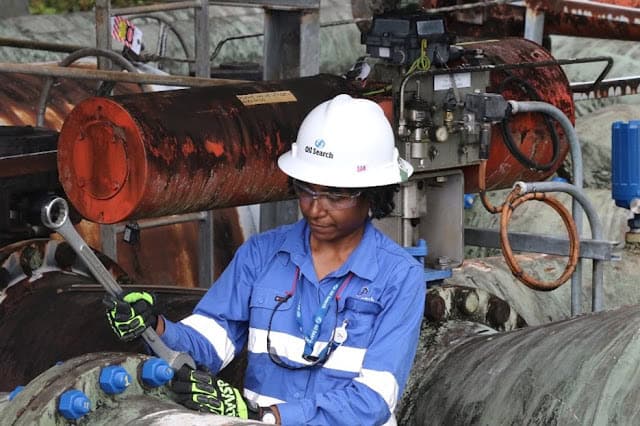
WOMEN are steadily carving out space in the energy and construction sectors—industries long dominated by men—despite facing persistent challenges.
At a recent panel discussion, leading voices from the region shared insights into the barriers women face and the progress being made.
Helle Buchhave, Senior Social Development Specialist and Task Team Leader of the Women in Power initiative, opened the discussion by citing World Bank data showing that only 43% of Pacific women
participate, in the labor force, compared to 60% of men. “This is not just a gender issue; it is an economic one.
Closing the gender gap could raise GDP per capita by an estimated 22% across the Pacific,” Buchhave stated.
She highlighted four key barriers restricting women’s participation: lack of supportive institutions and
family-friendly policies, weak legal protections, persistent social norms, and a mismatch between women’s skills and labor market demands.
“Addressing just one barrier is not enough; comprehensive, multi-level action is required.” Chief Financial Officer of Women in Construction and Trade (Fiji), Julianne Verma, highlighted the everyday obstacles
women encounter on job sites.
“Women are entering the trades sector but continue to face barriers like poor jobsite facilities and limited support,” she said.
“There are no dedicated bathrooms or conveniences for women in the field, forcing them to use the same as men, which may seem small but has a big impact on whether women stay on site.”
Verma emphasised the importance of creating safe spaces for women to network and access opportunities. “Our role is to provide a platform where women can connect, share experiences, and find project leads in an environment where they feel supported.”
Leihani Anjain, Chief Financial Officer at Marshalls Energy Company, acknowledged the underrepresentation of women in leadership and technical roles within her organisation. “Out of seven board members, only one is a woman. In management, it’s one out of five,” she said.
“Technical roles had zero women; now we have increased that to five. We’ve partnered with local training institutions to create internships specifically for young women interested in engineering and energy,” Anjain explained.
“We’re also reviewing our hiring and promotion practices to ensure they’re equitable and supportive of women’s advancement.”
She emphasised that visibility and mentorship are critical. “When young women see others like them succeeding in these roles, it changes what they believe is possible.”
Dr Daniel Wood, Senior Fellow and Discipline Coordinator for Mechanical Engineering at the University of the South Pacific, shed light on the pipeline problem.
“At university, women make up about 60% of total enrolments, but in engineering programs, female
participation is much lower – around 30% in civil engineering and only 14% in mechanical and electrical engineering,” he said.
Wood stressed the need to start early. “To increase women in STEM [Science, Technology, Engineering, and Mathematics], we need to engage girls in science and mathematics from kindergarten through high school, not just rely on scholarships at the university level.”
Adding to the conversation, Tara Chetty, Deputy Director of the Human Rights and Social Development Division at the Pacific Community (SPC), addressed the underlying social norms that affect women’s participation.
“The absence of girls moving into these spaces to become women leaders and technical experts’ rests on problematic social norms, including the widespread existence of violence against women and gender-based violence in our communities,” she said.
Chetty emphasised the importance of both regional policy commitments, such as the Pacific Leaders Gender Equality Declaration, and specific community-based approaches.
“Legislative reforms and school interventions—like campaigns to attract girls to physics and STEM camps—are essential. Transforming these social norms from an early age will help break down the barriers girls and women face.”
These voices echo a shared message: that shifting the status quo in male-dominated industries is not just about hiring more women; it’s about changing the systems, environments, and mindsets that have historically kept them out.