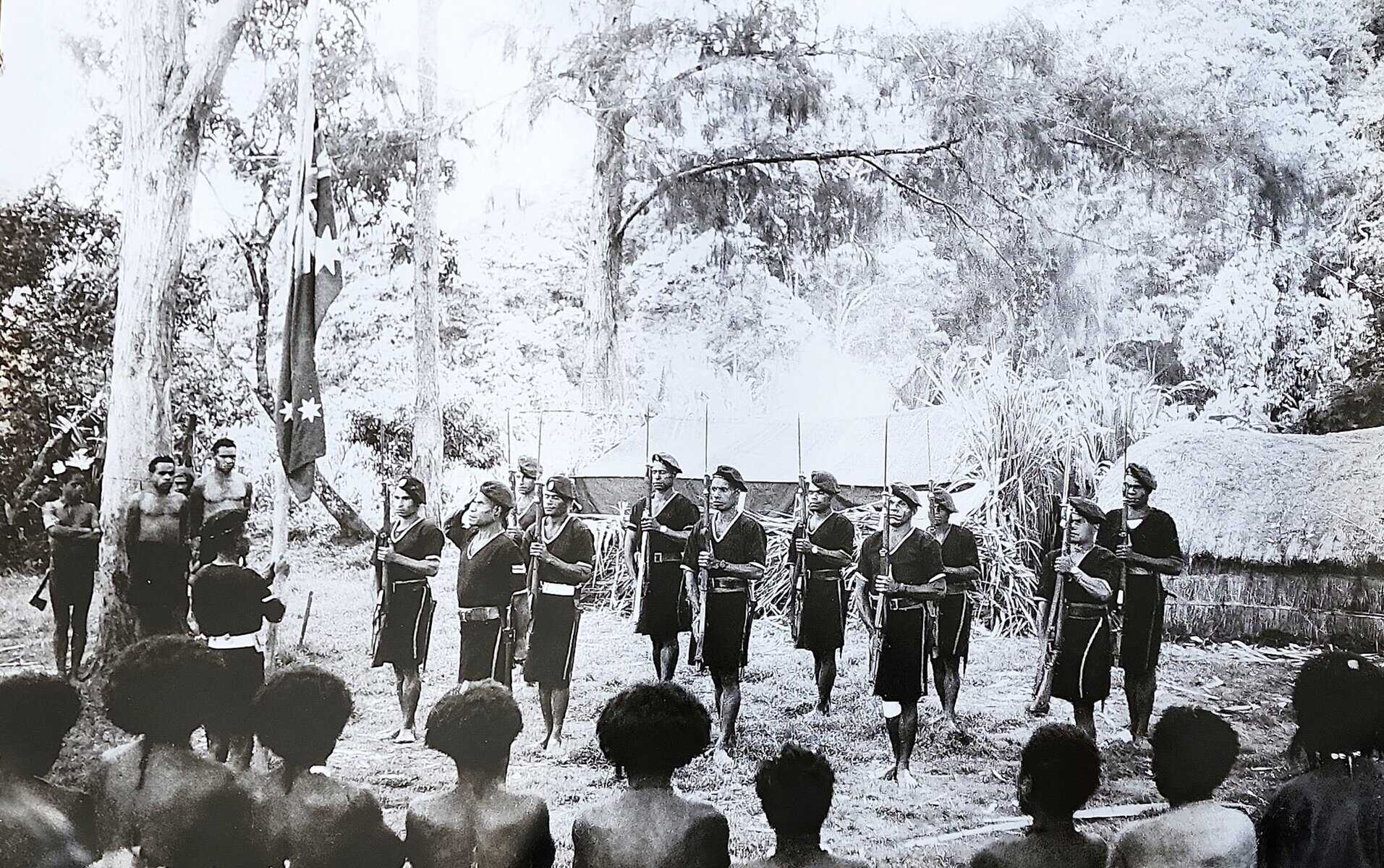
THEY were called kiap – young, physically fit officers who walked the length and breadth of the Territory of Papua and New Guinea, representing the government.
In fact, they were the only government many of the people on the second largest island in the world had. When Australia was mandated in 1946 to govern the territory, a total of 2000 men were appointed over 28 years to take the law and justice to the people. A kiap (from the word captain) was administrative
officer, local magistrate, and policeman rolled into one. He was the personification of a government unseen, somewhere in the distance.
Accompanied by a troop of 10 local policemen, the officers would walk from village to village, ensuring that, over a one-year period, every community would have the opportunity to raise their issues with a representative of the government. It also provided a mobile legal service, as the kiap would adjudicate on local disputes and order compensation in place of retributive killing or violence.
This would prove problematic for the new nation of Papua New Guinea, which continues to struggle with the issue of compensation some 80 years later.
A primitive form of governance at the least, and a proactive effort to maintain contact with the people at best, this was the introduction of government for most of remote Papua New Guinea.
This mobile form of government was perhaps designed to build trust with a community which had not invited outsiders to govern their land.
Unlike Fiji, where the British created an overall king in Ratu Seru Cakobau, who then ceded the islands—which were not his—to Queen Victoria, the Papuans did not open their doors to the outside world.
Instead, Britain and Germany divided half of the island between themselves at a conference on the other side of the world in 1884, as imperialism and expansionism gripped Europe and were manifested in colonies across the globe.
The Netherlands took the second half – Dutch New Guinea or today’s West Papua. The British took control of the German-occupied New Guinea through the intervention of Australian troops at the
outbreak of World War I. In the islands and highlands, life for the people continued as normal. Only the colonial occupying force changed.
The Papuan people were by no means a homogenous people. They were tribes with relationships through marriage and necessity. Their independence as small communities remain today, with over 850 languages spoken in an independent nation.
In 1914, Governor Sir Herbert Murray made clear the self-determined mandate the colonial power had given itself. “The duty of the Papuan Government is not only to develop the resources of the territory, but also to preserve the Papuan and raise him eventually to be the highest civilization of which he is capable,” he said. Three decades later, the Australian kiap would project this vision into the community, providing a form of direct rule among a people who did not necessarily want to be told what to do.
The administrative service was invaluable to the administration in the provincial capitals and the national
capital, Port Moresby. Through the work of the kiap, the government performed annual censuses, recorded births, deaths, and marriages, dispensed justice, and collected statistics.
A rural medical service provided basic health care. With the information from these teams, the administration had some control—although minimal—of this huge territory. Throughout the 1950s, the kiap and their local colleagues, who would have been essential in translation services and understanding of local culture, worked hard to put an end to trouble in the communities.
Some historians have termed this as pacification of warring tribes. It was more likely the introduction of a new form of dispute settling among tribes who fought over their differences, in an indigenous form of justice. To say that the kiap played a large role in the creation of modern Papua New Guinea would be unfair and an understatement.
They laid the platform for a form of central national government, a concept seemingly impossible in 1884. That was possible only through trust created by face-toface contact—today called immersion—in the community.
It was made possible through personal relationships between government officials and the people. Pacific politicians may have a lesson to learn from the kiap. Success in the community cannot be achieved from the national capital. It is achieved on the ground, among the people. That is the lost legacy of the kiap.