AUSTRALIA faces a threat from China on three fronts – commercial, political, and military.
Politicians and members of the public alike appear to accept that there is a looming “Red Threat”, to borrow from post-World War II rhetoric and propaganda around the emergence of communism.
At a National Press Club event in June, Australian Prime Minister Anthony Albanese described his country’s perception of China in this way: “We have strategic competition in the region. We have that; we have a Defence Strategic Review, which outlines what Australia’s defence needs are. And we engage constructively in the region, including with China and including with ASEAN nations.”
His comment appeared to be an attempt to play down the military threat Australian tacticians believe is posed by China, with its standing military force of over two million troops, and a further half million in reserve.
In a poll conducted by the Lowy Institute, 69% of respondents viewed China as very likely or somewhat likely to be a military threat in the next 20 years. This was down from a high of 75% in 2022 and 2023.
Around the same percentage—67%—supported Australia acquiring nuclear-powered submarines and 60% favoured doing more to work with allies to deter China’s use of military force.
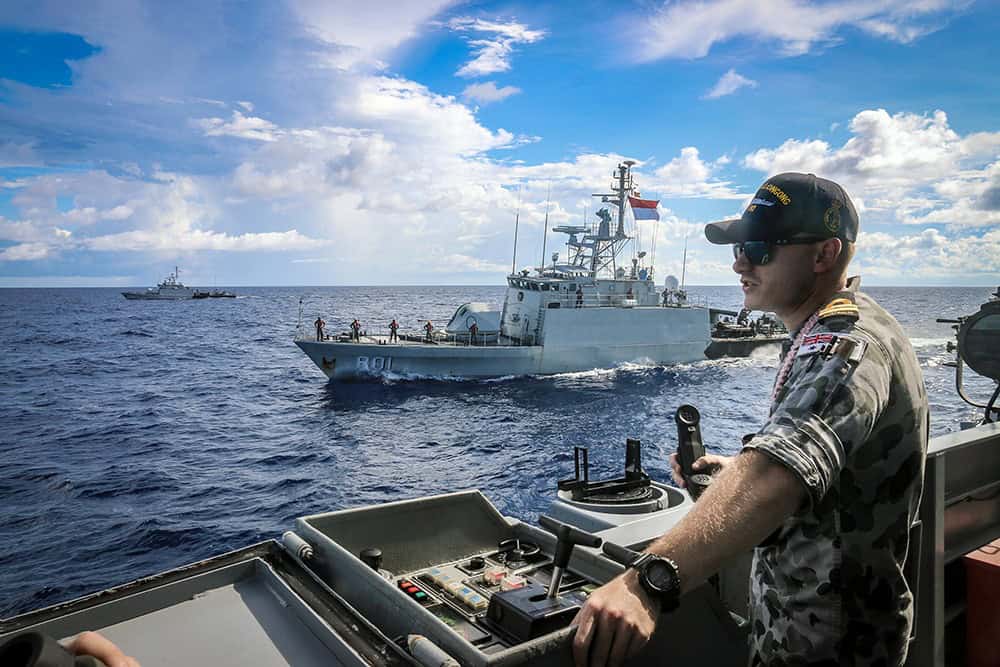
The apparent reduction in Australians who saw China as a military threat may be linked to increased Australian military involvement in the region. This includes joint operations with regional military forces in the Operation Talisman Sabre exercise involving Fiji, France, New Zealand and Papua New Guinea.
Australia has also started to project its military influence over the horizon by repairing a navy base and training facility on Manus Island, where it can share space with the PNG Defence Force. In Fiji, Australia has entrenched its land force element within the Black Rock Training Facility in Nadi, and is building a maritime surveillance centre in the capital, Suva.
And throughout the region, Australian-built Guardian Class patrol boats provided coastal surveillance, from the Republic of the Marshall Islands in the Northern Pacific to Tonga in the south, and from PNG in the west to Samoa in the east.
When the Pacific Patrol Boat Scheme is fully operational, 24 Australian boats will be available for nominal defence. But more importantly for the Australians, advisers will be embedded in as many as 17 territories, ostensibly to support safe operations.
From a military intelligence perspective, this offers Australia the opportunity to place human listening devices in the capital cities and among the military forces of its closest neighbours. They will be highly valuable assets in terms of relaying critical insights on security, defence, and diplomacy to Canberra in real time.
In essence, these will be intelligence gatherers in plain sight, with fingers on the pulse of their host nations and, more importantly, the military or police forces in which they are embedded.
While Albanese was coy with his response to the China question, Defence Minister Richard Marles was more direct at a Defending Australia summit: “In terms of our own defence capability needs, our risk is not so much the invasion of the continent. We are fortunate that we are an island nation surrounded by oceans, but on the other hand, we are deeply reliant on our sea lines of communication. The supply of the country – almost all of our liquid fuels are imported by sea, but also through export revenues. And so that is our strategic risk. It’s the disruption of those sea lines.”
China has made no secret of its plans to build a pathway for exports of its manufactured goods, and the gathering of natural resources, along the Belt and Road Initiative implemented in 2013 by President Xi Jinping. As a central pillar of Chinese foreign policy, this new Silk Road has connected China to around 75% of the world’s population.
In the Pacific, Chinese companies are involved in mining, logging, oil, and gas exploration, and the central government subsidises the fuel costs of the huge fishing fleet, which steams around the Pacific Ocean chasing valuable tuna.
That presence on the high seas provides the ability to disrupt Australia’s supply of liquid fuels and other critical commodities. Safe oceans will be essential for Australia’s strategic defence over the next 20 years.
This year, the Royal Australian Air Force deployed C-27J Spartan aircraft to Fiji and PNG to assist with humanitarian and fisheries surveillance work. The number of surveillance flights is expected to increase in 2026.
It’s clear that despite the mixed signals from within the government, Australia is watching and making its presence felt in the region.