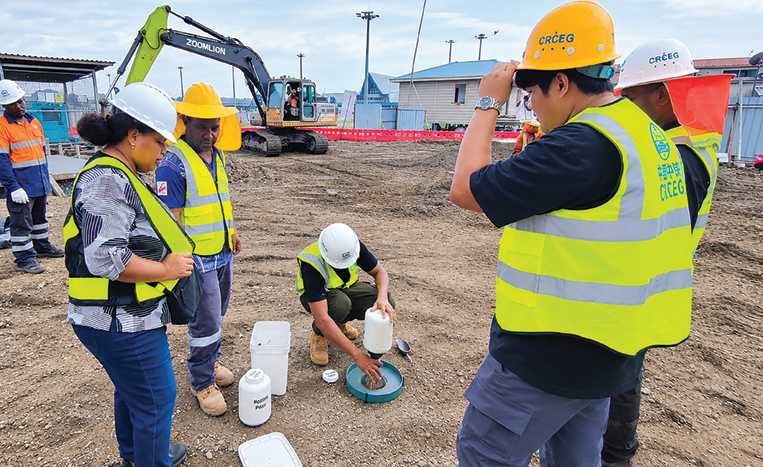
BEHIND the polished communiqués and diplomatic language that came out of the Sixth Pacific Regional Energy and Transport Ministers’ Meeting (PRETMM6) in Port Moresby, one message echoed repeatedly.
The Pacific has a problem – the challenge now is delivery. And so, the Pacific has a new declaration: the Manubada Call to Action.
Pacific ministers doubled down on an ambitious regional vision of a “100 per cent renewable energy and fossil fuel-free Pacific.”
Yet behind that collective ambition lies a harder truth – not every Pacific country is moving at the same pace, and many are still struggling simply to keep the lights on and fuel flowing.
Fiji has expanded solar and hydropower generation. Samoa is steadily progressing towards its renewable energy targets. Papua New Guinea remains both a fossil fuel producer and exporter, while simultaneously planning a renewable transition.
Smaller island nations such as Kiribati and Tuvalu continue to rely heavily on diesel, particularly across isolated outer islands where alternatives remain expensive and difficult to maintain.
Pacific Community (SPC) Deputy Director for Georesources and Energy Programme, Ngedikes Olai Uludong said the region needs to be honest about the realities behind the rhetoric. “The fossil fuel-free Pacific is an ambition that leaders put forward, but the reality paints a very different picture,” Uludong said.
“To move to a fossil fuel-free Pacific, countries will need to have the resources, technical expertise and finance to both set-up and maintain these alternative energy sources. “The truth is, small regional countries do not have the capacity to do that, and we have to realistically look into what that looks like for each country, because it does not look the same for all.”
That tension between political ambition and on-the-ground capacity was one of the defining themes of PRETMM6.
Cook Islands Maritime Security Officer Amy Ngatamaine said Pacific countries are increasingly cautious about renewable transitions that arrive without long-term support systems.
“It is also not an overnight fix,” Ngatamaine said. “There are also the resources, the capabilities, and structure to actually have systems in place. Now, we have to go back to the drawing board. If we don’t have the resources, how are we going to maintain it?”
She pointed to past renewable projects where infrastructure arrived, but training and maintenance support did not.
“We had some solar panels donated to our outer islands, but the people weren’t trained for maintenance. As a result, it just fell apart, and now we have all these lithium batteries just sitting in the outer islands.”
That experience, she said, has reshaped how Pacific governments now approach development assistance.
“Any further help must also include training and support for locals to maintain these alternative options.”
The meeting also formally elevated fuel insecurity as a regional strategic vulnerability, a recognition many Pacific Islanders would argue has long been obvious.
Across the region, households are already feeling the pressure through rising fuel costs, higher food prices, expensive building materials, and fragile supply chains.
Recent global conflicts and tensions in the Middle East have only sharpened those fears.
Papua New Guinea Prime Minister James Marape warned that Pacific countries remain dangerously exposed to global instability.
“In times of conflict, energy supply chains can be compromised, leaving small and vulnerable economies like ours effectively held hostage to global price fluctuations and geopolitical uncertainty,” Marape said.
“Our communities remain widely dispersed and heavily dependent on transport systems powered by imported fuel – fuel that underpins our trade, healthcare, education, communication, and quality of life.”
Yet Papua New Guinea is also positioning itself as part of the solution. Marape told ministers that PNG is preparing a major transition away from fossil fuel dependence between now and 2035, including investments in hydro, geothermal, solar, wind,
and ocean energy. “Papua New Guinea is blessed with vast natural resources, yet we share the same vulnerabilities as our Pacific neighbours,” he said.
“However, as a country with LNG and oil production, significant hydropower potential, geothermal prospects, growing solar and wind opportunities, and strong agricultural capacity for biofuels, Papua New Guinea is uniquely positioned to contribute to a stronger regional energy and transport framework.”
Marape also revealed plans for a national electric vehicle policy and discussions around electrically powered maritime transport, while signalling interest in battery technology partnerships with Chinese EV giant, BYD.
For some Pacific leaders, PNG is increasingly being viewed as a possible regional energy partner, as countries scramble to diversify supply chains and reduce exposure to global fuel disruptions.
Ngatamaine said those discussions had become more urgent.
“We can’t sit back and just wait and see what happens. We actually have to have a Plan B, C and D,” she said.
“It has actually been an eye-opener for a lot of us – not only for ministers but also heads of countries. There were also discussions about whether we could use Papua New Guinea as an alternative avenue to source our fuel, and I think the main question for our governments is how we move forward.”
One of the most significant outcomes of PRETMM6 was the formal linking of energy and maritime transport under a more unified regional framework.
For years, the sectors largely operated separately. Ministers have now politically elevated the Pacific One Maritime Framework (POMF), signalling a stronger push toward integrated regional planning around shipping, energy security, transport resilience, and infrastructure investment.
The meeting also discussed the possible establishment of a regional energy commissioner, a move that could centralise political coordination, financing advocacy, and implementation pressure across the region.
But outside the conference halls of Port Moresby, the reality on the streets painted a more sobering picture.
Walking through the city’s arts and crafts markets, local tour guide Rosa Koian pointed to the widening disconnect between high-level promises and everyday survival.
“You look around Port Moresby right now, the people live a very different life,” Koian said.
“We know that our Prime Minister is making all of these promises, but we do not feel it on the ground.”
Artists lined the roadside, selling bilums, paintings and handmade crafts under the hot afternoon sun. Nearby, a private fuel company tanker pumped fuel into a major hotel.
“You see that?” Koian said, pointing toward the tanker. “It is a true reflection of what we are going through. The rich can afford to purchase gas and the people are left to struggle with the high price of fuel.”
For many Papua New Guineans, the contradiction is hard to ignore.
“Which is sad considering that we produce the crude oil, export it to Australia, only for them to sell it back to us,” she said, shaking her head.
Yet even amid frustration, there remains a strong sense of resilience. “But look at us,” Koian smiled. “You will not see us whining to the government about it. My people are very resilient and can stand on their own two feet.”
As PRETMM6 concluded, and Pacific leaders prepare for the upcoming regional ocean summit and future climate negotiations, the questions now facing the region are becoming sharper: What concrete changes will Pacific households feel over the next 12 months? Can the Pacific realistically achieve its renewable ambitions without fixing weak grids, fragmented transport systems and long-term maintenance gaps? And perhaps most importantly, can the region finally move beyond declarations and into delivery?