THE Pacific has no shortage of declarations.
For more than a decade, its leaders have debated regional integration through the Boe Declaration on Regional Security, the 2050 Strategy for the Blue Pacific Continent and a succession of ministerial meetings.
They have identified common interests, set priorities, and endorsed plans intended to enable a scattered group of island states to act with greater collective strength.
Yet the region’s institutions remain difficult to align. Aviation rules differ from country to country. Cybersecurity capabilities are uneven.
Labour mobility is helping families while draining skilled workers from some island economies.
Regional bodies and secretariats are under review, even as governments continue to convene new meetings, set new priorities, and issue new declarations.
For Simon Kofe, Tuvalu’s Minister for Transport, Energy, Communication and Innovation, the central problem is no longer a shortage of ambition; it is the gap between what Pacific leaders agree to do and what they implement.
“There’s a lot of work that needs to be done, and I think the leaders recognise that,” Kofe said in an interview with Islands Business.
The region’s review of its institutional architecture, he said, offers an opportunity to bring those commitments into sharper focus, streamline overlapping structures, examine what has been delivered, and determine who is responsible for turning regional decisions into action.
The test, he said, is whether the Pacific can stop treating cooperation as a series of political statements and begin measuring it through working systems: reliable energy networks, common standards, secure digital infrastructure, functioning transport links, and enough skilled workers to keep essential services operating at home.
From climate advocacy to implementation
Energy is where Kofe sees the gap most clearly.
Pacific countries have positioned themselves as leading voices in the global campaign for stronger climate action.
But the region’s dependence on imported fossil fuels leaves it vulnerable to shocks beyond its control. A recent fuel crisis, driven primarily by the war in the Middle East, exposed that vulnerability yet again.
“It’s a wake-up call for us to really take the steps to implement what we’ve declared around the energy transition,” Kofe said.
Tuvalu’s own experience shows how difficult that transition can be. The country had set a target of reaching 100 per cent renewable energy by 2030, but problems integrating solar power into its grid and network have created what Kofe described as a major setback.
The target year could now shift.
The difficulty is not simply a matter of political will, but a technical capacity and the suitability of the technology being deployed, challenges that are magnified in small island states with limited infrastructure, and narrow pools of expertise.
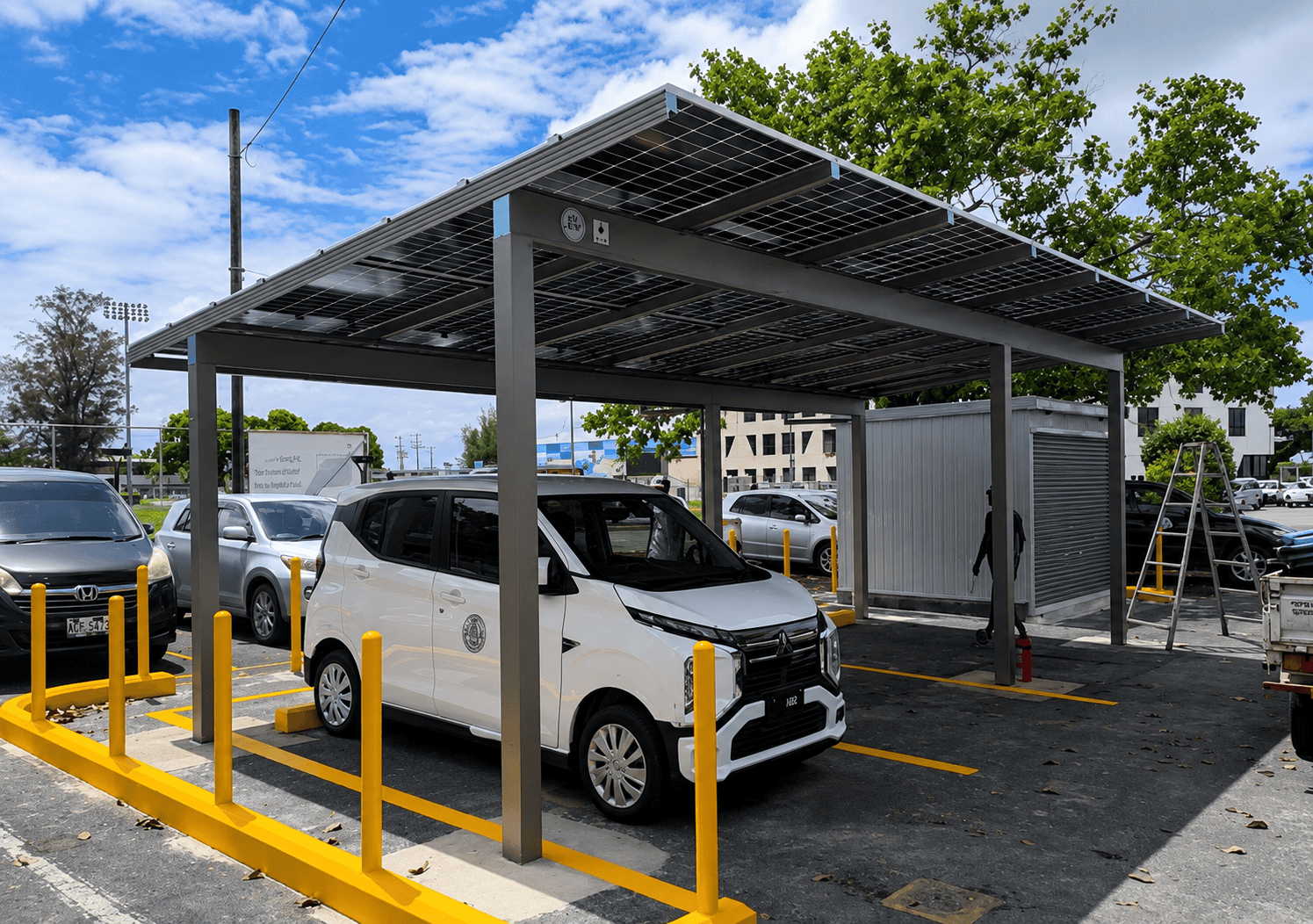
Kofe said Pacific countries should respond by sharing information more systematically and helping each other roll out renewable energy systems.
He pointed to solar projects in Niue and Tokelau as examples that other countries could learn from.
The argument is practical rather than rhetorical: if one island government has solved a technical problem, another should not have to start from the beginning.
“The Pacific needs to work in close collaboration,” Kofe said. “There are success stories in some of the other countries.”
The same principle applies to shipping. Pacific governments are campaigning internationally, alongside Caribbean and African countries, for the decarbonisation of the shipping sector through the International Maritime Organization.
But Kofe said the region must also examine the emissions and performance of its own domestic fleets. He welcomed the launch of the Pacific Blue Shipping Partnership (PBSP), endorsed by eight member countries in Majuro, Marshall Islands, in June, as an example of regional action focused on a sector that is indispensable to island life.
The Pacific contributes little to overall global emissions, Kofe said. But that should not serve as an excuse for inaction.
“It’s important for the Pacific to walk the talk. We’re asking the world to take stronger climate action, but we also need to do that in our own respective countries.”
Sovereignty through cooperation
For small island states, regional cooperation can raise a familiar political concern: whether collective action comes at the expense of national sovereignty.
Kofe rejects that premise.
Countries do not surrender sovereignty when they enter agreements, conventions or treaties, he said. They consent to them. They retain the power to accept or reject regional arrangements, and they can leave if an agreement no longer serves their national objectives.
“I would look at it and say, ‘No, you’re not surrendering your sovereignty,’” Kofe said. “In fact, I think it makes the region stronger when you exercise your sovereignty collectively.”
He cited the Parties to the Nauru Agreement (PNA) as the Pacific’s clearest example of that logic in practice.
The Agreement brings together eight countries whose exclusive economic zones lie within 10 degrees north and south of theequator. Its focus is tuna, a highly migratory resource that moves across national jurisdictions from east to west.
Managing it effectively requires countries to align their laws and regulations rather than compete against each another.
The stakes are not only ecological.
Foreign distant-water fishing nations have commercial interests in the resource. Before the PNA, Kofe said that individual Pacific countries could be pitted against one another.
By standardising their approach, the member states gained leverage.
The PNA, he said, demonstrates what can happen when countries decide that collective control of a shared resource is more valuable than uncoordinated national action.
“They’re doing much, much better working together as opposed to going at it alone.”
Kofe believes the model deserves consideration beyond fisheries, particularly in aviation, cybersecurity, maritime surveillance and border security.
But the political case is harder toVsee in those sectors. Tuna generates a visible connection between regulation and revenue.
Cybersecurity is less tangible until a vulnerability is exposed.
Regional aviation standards can collide with commercial interests, especially where governments own airlines and are also responsible for regulation.
In aviation, Pacific states do not use a single standard. Some follow New Zealand standards, while others apply different rules. Not every country has an airline, and governments may feel pressure to protect national carriers even as they act as regulators responsible for ensuring safety.
Kofe said governments must learn to hold both responsibilities at once.
“You also have to wear the hat of the regulator and ensuring that standards are being met.”
The broader challenge is political imagination: seeing the region as a connected system rather than a collection of isolated national markets and administrations.
A region tested by outside powers
External actors have added pressure to that challenge.
Strategic competition in the Pacific has intensified, and outside countries, industries and companies have interests in the region’s resources, infrastructure and political choices. But Kofe does not believe geopolitical rivalry has broken Pacific unity.
It has tested it.
He pointed to tensions surrounding China and Taiwan, including difficulties faced at earlier regional meetings. The issue was handled successfully, he said, particularly during a meeting in the Solomon Islands.
“If we say that it weakened us, then I don’t think we would have had a solution to the problem,” he said.
The responsibility, in his view, rests with Pacific leaders to recognise when external actors are attempting to influence regional outcomes and to make decisions based on the interests of the Pacific itself.
“The Pacific is our space,” Kofe said.
That position does not deny the influence of outside powers. It places the burden of response on regional governments. External actors can exploit gaps, but those gaps are also created by inconsistent standards, weak implementation, and institutions that struggle to coordinate their own priorities.
The Pacific’s vulnerability, Kofe said, is therefore not caused by a single external relationship or an internal failure. Their interaction produces it.
The cost of labour mobility Labour mobility offers a more personal measure of that tension.
For Pacific families, mobility schemes provide income and opportunity.
Workers leave to fill shortages elsewhere, sending money home and supporting relatives. But the same movement can leave island countries short of the people needed to operate governments and essential services.
Kofe spoke specifically about Tuvalu, while acknowledging that other Pacific Island countries may face similar pressures.
Families can be separated for long periods. Skilled workers are leaving.
Government positions remain unfilled.
The challenge extends beyond labour mobility schemes to other pathways, including the Pacific Engagement Visa (PEV) and the Australia-Tuvalu Falepili Union Treaty.
“For us, it’s not just the labour mobility,” Kofe said. “More skilled people are leaving. There’s a brain drain.”
Tuvalu is reviewing its civil service and considering whether its current structure is sustainable for a small island nation. That could include downsizing, examining individual positions, and reconsidering whether some departments are necessary in their existing form.
“Changes need to be made, and I think it needs to be made quickly,” he said.
The problem is especially acute in the maritime sector. Captains and engineers can take their qualifications anywhere in the world, and Kofe said Tuvalu is seeing trained personnel resign and seek jobs elsewhere.
The government is considering higher salaries for seafarers, training opportunities and shorter contracts, potentially three or four months, to encourage Tuvaluans living overseas to return for short-period work contracts.
The objective is not simply to increase the number of workers. It is to retain enough expertise to keep services safe and reliable.
Tuvalu stretches across nine islands, and shipping is the only way the country connects with its people across that geography.
When skilled workers leave, Kofe said, the consequences can extend to the standards and safety of vessel operations.
“It is a critical service for the country.”
The dilemma exposes the uneven benefits of mobility. Workers gain access to better opportunities, families receive income, and destination countries fill labour shortages. But the countries people leave must still operate schools, governments, ships and public services.
For Tuvalu, labour mobility is both an economic lifeline and a question of national capacity.
Too many priorities, too little delivery
The 2050 Strategy is intended to provide a long-term vision for the Blue Pacific Continent. But Kofe warned that the region could reach 2050 having achieved little if it continues adding priorities without tracking delivery.
Regional meetings involving economic ministers, foreign affairs ministers and aviation officials produce outcomes, declarations and new areas of work.
The accumulation can create the appearance of progress while making responsibility harder to identify.
“Maybe we need to cut down on setting new priorities and new declarations and really look at the implementation side of things,” Kofe said.
The architecture review should examine what regional institutions and agencies have achieved, he said, and bring their work more clearly under the umbrella of Pacific Islands Forum leaders.
That process may face resistance from secretariats and agencies that want to retain control over their own forums. But Kofe argued that leaders must take a higher-level view and align the structures rather than defend institutional boundaries.
The indicators of progress over the next five years, therefore, will not be the number of declarations issued. They will be visible in whether regional standards become more consistent, whether information is shared, whether energy projects can be replicated, whether domestic shipping is decarbonised, and whether governments can retain the workers required to run essential services.
The question is not whether Pacific leaders understand the problem. Kofe believes they do.
The question is whether they will act with enough discipline to convert that understanding into systems that endure beyond a meeting.
A combination of failures
When asked to identify the single biggest cause of fragmentation over the past decade—external geopolitical competition, weak regional institutions or the reluctance of governments to implement collective decisions—Kofe declined to identify a single cause.
“It’s a combination of issues,” he said.
External players can exploit gaps. Secretariats may lack the human resources needed to implement all the activities and priorities assigned to them.
Member countries may need to take greater responsibility for driving initiatives rather than waiting for regional bodies to do so.
And political will remains decisive.
The PNA succeeded, Kofe said, because leaders acted and pushed the sub-regional grouping forward. That lesson applies to the wider Pacific: institutions can coordinate, but leaders must provide the vision and the force to make decisions real.
The Pacific has already agreed on many of the problems it faces. It knows that fossil-fuel dependence leaves island economies exposed. It knows that fragmented rules weaken collective leverage.
It knows that labour mobility can deepen household income while hollowing out national workforces.
It knows that external powers and commercial interests will test regional unity.
What remains uncertain is whether the region can narrow its ambitions enough to deliver them.
“There are so many of these things, these declarations and priorities and work that we’ve set,” Kofe said. “But I think it’s good to have a look at: what have we actually achieved? What have we actually implemented?”
For the Pacific, the answer to those questions may determine whether the 2050 Strategy becomes a working blueprint or another declaration waiting for action.