ACROSS the Pacific, women are entering industries long treated as men’s territory. In the Solomon Islands, civil engineer Rowena Toito’ona Totori is showing what that change demands – and what it can build.
For generations, construction sites across the Pacific have been imagined as places for men. Rowena Toito’ona Totori challenges that idea. A mother of five and a civil engineer, she now supervises major roads and aviation works in the Solomon Islands – and wants girls watching from beyond the site fence to see a place for themselves. “I hope a girl who sees my work can picture herself in this field too,” she says.
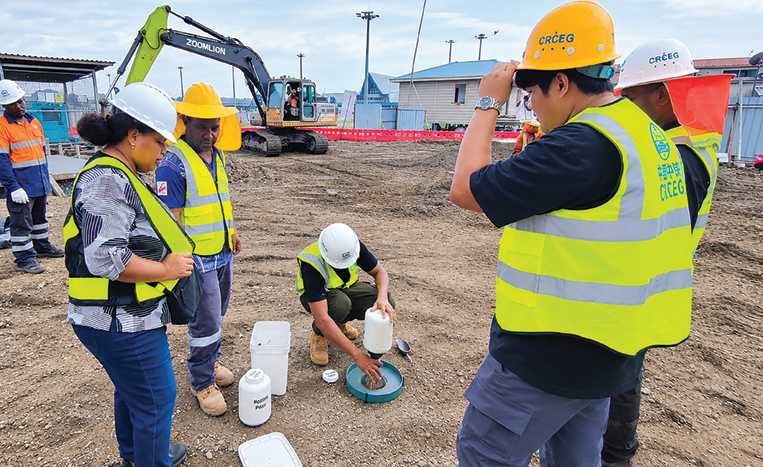
As Resident Engineer with Egis Asia Ltd and local counterpart Azimuth Surveyors Ltd, Totori supervises World Bank-funded works under the Second Solomon Islands Roads and Aviation Project. Her portfolio includes the Aviation Complex Building and 33 kilometres of road works in Malaita Province, with close to 100 workers on site. She monitors quality, checks compliance and coordinates contractors, clients and stakeholders. “I want to ensure contractors deliver the quality work our people deserve,” she says.
Her connection to construction began in childhood. Totori lived with her elder sister and brother-in-law, whose construction company operated around their home. A concrete batching plant, machinery, vehicles and a workshop were part of her everyday surroundings.
“I wanted to learn how things were built and be part of that process,” she says. During school holidays at Dalgro Ltd, she moved from reception and payroll into the precast yard, where wharf consultant engineer Alaric Rore taught her the basics of concrete quality control. The work interested her; the assumptions around it did not. As a newly graduated engineer, Totori met a Resident Engineer who told her women should find desk jobs because site work would not be good for them. “That comment stayed with me,” she says, “but it also motivated me to keep learning and become the best engineer I could be.”
While pregnant, she told no one because she did not want attention, reduced duties or doubts about whether she could keep pace with male colleagues. The sharpest test of that determination came not from engineering, but from the collision between work and motherhood. At 6 o’clock one morning, Totori left her sick baby with her mother at the National Referral Hospital, took a taxi to the airport and cried on the way.
Her son had been ill only two weeks earlier, but another project site was waiting in the provinces. “I worried about how my repeated absences would be viewed,” she says. “I want to be respected as a capable engineer, but I also want to be there for my children.” That tension has never fully disappeared. In one recent week, her mother-in-law had died, two of her children were admitted to hospital, and two active projects still needed her attention.
Totori wanted to quit on three of the five working days. Instead, she stepped back and allowed herselftime to reset. “Some days, continuing simply means taking a breath and dealing with one thing at a time,” she says. Totori says many male colleagues, supervisors and clients have respected her abilities and shared their knowledge. Disagreements still happen. After difficult exchanges, she and a contractor use a simple phrase: “Work is work.”
It lets them challenge decisions without burning the relationships needed to complete the job. What keeps her returning is the satisfaction of standing on site, solving problems with a team and seeing the work take shape. She believes construction can offer Pacific women far more than the physical labour often associated with it: engineering, surveying, skilled trades, project management, income, leadership and the chance to shape essential infrastructure. Scholarships are opening doors, she says, but employers must also trust women with responsibility.
Her message to young women is the lesson she wishes she had understood sooner: “Fear less and give it a shot.” Totori once counted herself out of opportunities before applying. Now, she leads work worth millions of dollars. “If I can find my way in this industry,” she says, “there is a place for you too.”