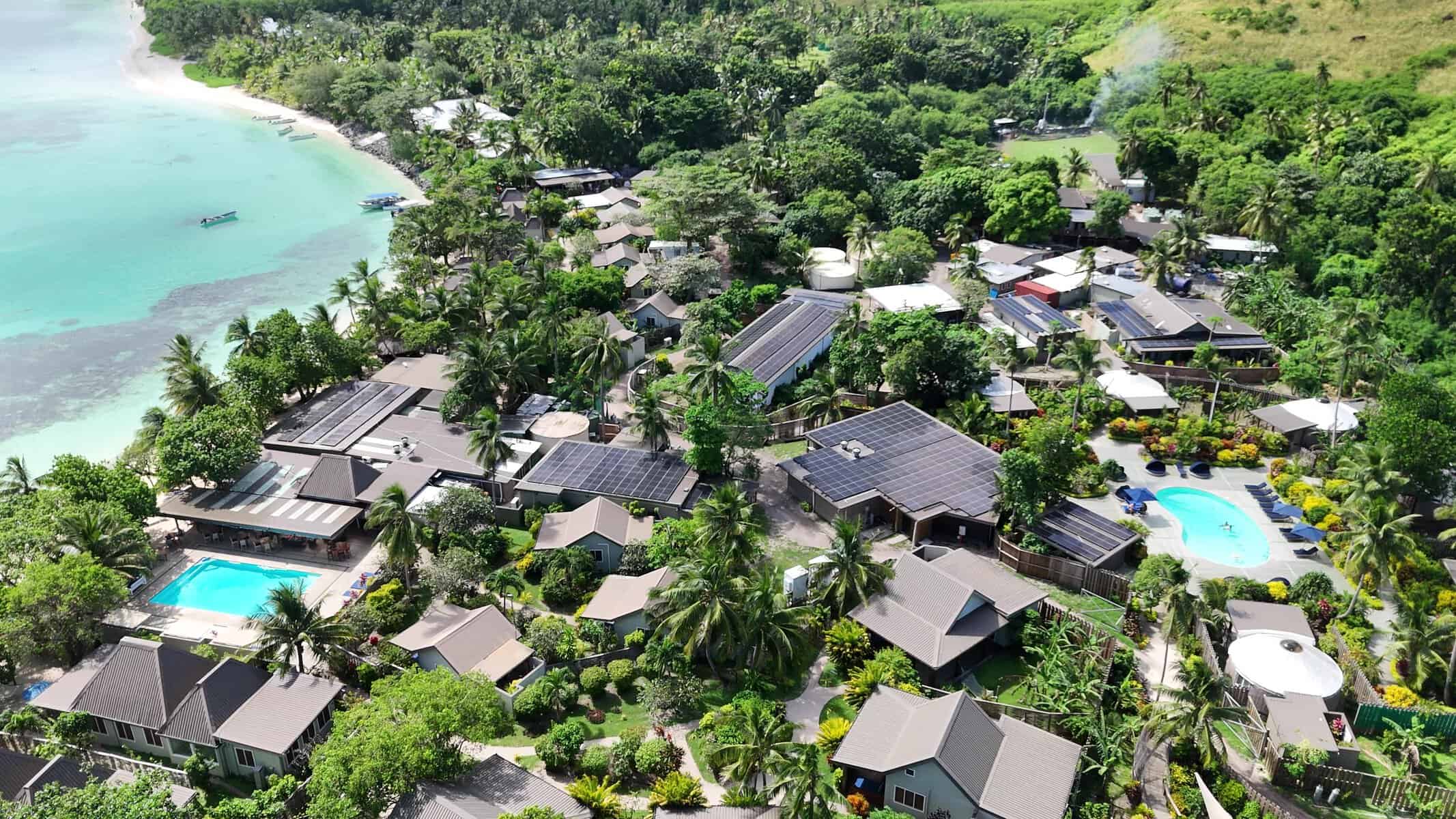
THREE remote Fijian resorts have moved from full diesel dependence to a solar-and-battery system that now covers about 70 per cent of their demand, with New Zealand solar company Future Energy saying the sites are on track to reduce diesel reliance by 95 per cent within the next two years.
Alastair Mortensen, director of Future Energy, said the Yasawa resorts (Paradise Cove Resort, Blue Lagoon Beach Resort and Octopus Resort) were a strong fit for off-grid renewable power because they had long relied on diesel shipped by barge in barrels.
“If we can do it in an environment like this, which is obviously a long way from the mainland, from your supplies, it really can be done anywhere,” he said.
The project comes after diesel prices in Fiji rose sharply, with Mortensen saying the landed cost of diesel at the resorts increased by 93 per cent over the last three months.
“It’s massive numbers. They are essentially paying the same amount. Their annual fuel bill is the same amount now as it was before the prices went up 93 per cent, so they’ve been completely insulated from any of these price increases.”
The installation includes more than 1700 panels, 760 kilowatt-hours of solar capacity, and 1.6 megawatt-hours of storage across the three resorts. The system now provides solar power for desalination plants that support the daily water needs of about 200 live-in staff and tens of thousands of guests every year.
“The company had been working on the transition for more than two years.”
The economics were central. Mortensen said the project was funded entirely out of operational cash flow, and that the cost had been spaced across about two and a half years. The total cost of the project across the three resorts was just under $NZD2 million, or about $FJD2.65 million.
“The beauty of these products is you don’t have to put $2 million in upfront,” he said. “This is spaced across a period of about two and a half years.”
He said the systems save money from day one. “This has been funded out of operational cash flow. “The cost savings from the first project that we did at Paradise actually funded the third project at Octopus.”
Mortensen also said the payback period before Fiji’s tax incentives was two to three years, while the post-tax payback, with the Fiji 100 per cent write-off applied, was 18 to 27 months.
The company says the current installation is expected to cut annual fuel costs by about 75 per cent by December 2027. It says annual fuel savings from the current installation are about $FJD850,000 (about $NZD630,000) before tax incentives.
The diesel cost reduction has already reached about 35 per cent in the first six months, with 50 per cent projected for full-year 2026 and 70 per cent to 75 per cent targeted by the end of 2027, once more batteries and panels are added.
The wider point was not just the lower bill, but the way the system changed how the resorts operated. “You don’t really think about where the electricity is coming from. You just expect the electricity to be there at all times.”
He said the old generator setup could overload, overheat and shut down. “When the noise stops, you realise, “That’s what that noise is. This is what quiet feels like.’
The current system is built to work alongside generators, which now operate at much lower loads. The system could be adapted for places with lower demand, too.
“If your load is anywhere above 50 kilowatts at a particular time, these systems will save you money in a very short time frame.”
On the Yasawa sites, the solar-and battery setup has replaced about 70 per cent of demand, and the next stage at Paradise and Blue Lagoon is expected to allow the generator to be turned off altogether.
The batteries and inverters are housed in sealed cabinets with their own air conditioning and are IP-rated for harsh conditions.
They were designed for humidity and salt air.
“They are completely sealed from all the environments. They could be sitting half underwater and they’d still perform.”
He said the panels had a 25-year lifespan, and the batteries and inverters carried 10-year warranties, while the modular design meant that a failed battery module did not require replacement of the entire system.
Renewable energy revolution
Maintenance has been built into the model, with spare parts kept on hand and local workers trained to service the equipment.
“We’ve trained all the local staff on how to do that,” he said. The logistics were also modest by island-project standards. The equipment was shipped in five 40-foot containers at about $NZD15,000 each, with under $NZD100,000 spent on logistics overall.
“Against the total price of about $FJD2 million, you know that’s less than a per cent. Logistics are no problem, even in the most remote areas.”
The next phase is already planned. Surplus solar generation is expected to support the shift from gas hot water systems to hot water heat pump units across the three resorts this year, with estimated annual savings of $FJD95,000 to $FJD110,000.
The model had already prompted interest from other resorts in the Yasawas. “We’re in talks with a couple of resorts in the Yasawas, and that’s purely based upon what we’ve demonstrated here.”
He said the project matters because it shows the model can be replicated. “The next resorts or the next stages will be a far smoother experience for whoever goes ahead.
“These systems are absolutely beyond proof of concept. They save money from day one. They can be done anywhere. There’s no barrier.”
The same approach could work beyond resorts, including rural health centres, schools, villages and fisheries. “Any country or any resort, any island that has a reliance upon diesel essentially, these systems are very approachable,” he said.
“Anything that’s remote, anything that lacks a stable supply of energy, these systems give you that surety. They give you that stability.”
The project avoids about 465 tonnes of carbon dioxide a year, equivalent to 7668 trees planted.
Mortensen said that it also has value for tourism: “Visually, you see solar panels when you come onto this island.
“It does have a nice warm positive impact to the people’s experience,” adding that environmentally conscious travellers may prefer a resort that generates most of its power through renewable sources.
According to Mortensen, the industry’s old assumption was that switching off diesel meant a huge capital hit. “That’s not the reality. The reality is that you can do this in stages.”
The work was part of a broader mission. “Reducing reliance on fossil fuels across New Zealand and the Pacific is the reason we founded the company. “This project proves it is achievable.”