SOME Bikinians returned to their home island in 1971, but surveys revealed ongoing levels of radioactivity that increased risk to human health. In 1978, the community was again relocated to Kili and Ejit islands, where most people remain to this day, nearly 50 years later.
Communities from other northern atolls have suffered similar dislocation. In 1948, the US military established a new nuclear test site at Enewetak Atoll, displacing the peoples of Enewetak and Enjebi Island to Ujelang Atoll. The islanders were initially told that their relocation would only last 3–5 years, but the Enewetak people were not returned until 1980. The people of Enjebi remain displaced to this day.
The people of Rongelap were initially relocated after radioactive fallout from the 1954 Bravo hydrogen bomb test – a detonation one thousand times more powerful than the bomb that destroyed Hiroshima. The US government evacuated the residents to Kwajalein Atoll, but three years later, officials claimed that Rongelap was safe again, and they returned the islanders to their home.
Over many years, Rongelapese suffered significant rates of thyroid cancer and miscarriages, and sought assistance to move again. In 1985, the Greenpeace vessel Rainbow Warrior evacuated the 300 remaining Rongelapese to the island of Mejatto, where many remain displaced.
Culture and compensation As Pacific governments began to look at the implications of internal displacement for vulnerable communities, there are many lessons to be learned from the experience of people uprooted by nuclear testing.
On the 70th anniversary of the Bravo nuclear test, former Mayor of Bikini Alsen Kelen told Islands Business about the devastating emotional effects for families relocated decades ago to Ejit.
“My grandfather and his siblings agreed that everyone buried on Ejit would have a concrete frame [for the coffin],” Kelen said. “They thought that Ejit was a temporary site, so when we return to Bikini, we can take everyone with us. But today, around that very graveyard, land is eroding so fast, to the point where people want to build a seawall there, so our people don’t drift off. The ocean is eating up the land that displaced people are buried in.”
Some elderly witnesses of the US testing programme relocated from their islands for decades, wanting to return home before dying. However, parts of the northern atolls remain contaminated to this day, as US and RMI scientists debate whether the decaying radioactive isotopes are still hazardous to human health. The descendants of the original communities who live in the capital Majuro often identify with their lost homelands, even though they have never visited their ancestors’ islands.
At the 2024 Pacific Islands Forum in Nuku’alofa, RMI President Dr Hilda C. Heine stressed that “the displacement of communities from ancestral lands has resulted in grave cultural impacts, hindering traditional knowledge from being passed on to younger generations. Certain traditional practices, customs, ceremonies, and even defining our very identity become distant memories – memorialised through chants and storytelling.”
Beyond these cultural impacts, there are more fundamental issues around the United States’ responsibility for clean-up, remediation, and compensation for loss and damage.
The RMI government lodged a “changed circumstances” petition for extra funding from the United States in 2000 to fulfil court rulings by the Nuclear Claims Tribunal on damage to health and property, amounting to $USD2.4 billion.
However, for more than two decades, the US Congress refused to provide specific funding to meet the level determined in court rulings. Even in the latest version of the US-RMI Compact of Free Association, updated in 2023, US State Department lawyers refused to use the word “nuclear”, to avoid future claims and liability.
The parallels with the resistance of OECD countries to meet their obligations on funding for climate adaptation and loss and damage are worrying, to say the least.
United Nations and human rights
In 2018, the RMI was the first country to formally submit an updated Nationally Determined Contribution (NDC) under the 2015 Paris Agreement on Climate Change. That year, the country launched its 2050 Climate Strategy, called Tile Til Eo (“Lighting the Way”). Five years later, RMI finalised Pāpjelmae– the Marshall Islands National Adaption Plan.
Through these updated climate policies, successive governments have begun to address the climate-nuclear nexus, and the problems facing already uprooted communities.
The Marshall Islands has served two terms on the United Nations Human Rights Council (HRC), seeking to use UN human rights mechanisms to raise international understanding of the impact of nuclear legacies on health, housing, environment, and culture.
Mandated by a 2022 HRC resolution, the Office of the High Commissioner of Human Rights (OHCHR) conducted a study on the human rights implications of past US nuclear testing on Bikini and Enewetak. The OHCHR report reaffirms that “the land rights system of the Marshall Islands underscores the intrinsic connection between atoll and identity. Continuing displacement leads to cultural dislocation, undermining the right to participate in cultural life.”
Paula Gaviria Betancur, the UN Special Rapporteur on the Human Rights of Internally Displaced Persons visited the Marshall Islands in 2024. At the time, the UN expert said: “Legacies of nuclear testing and military land requisitions by a foreign power have displaced hundreds of Marshallese for generations, while the adverse effects of climate change threaten to displace thousands more.”
Gaviria explained: “Many Marshallese I spoke with recounted the profound sense of dislocation they feel as a result of their displacement from lands deeply intertwined with their sense of culture and identity as Indigenous Peoples.”
Like other low-lying atoll nations in the Pacific, the Marshall Islands are often affected by flooding events during storm surges or “king tides”. Between 2008 and 2021, flooding disasters displaced more than 2000 Marshallese (around 5 per cent of the population).
This ongoing challenge has particular importance for nuclear-displaced communities. In her October 2025 report to the United Nations, UN rapporteur Gaviria highlighted the connection between past and future relocation: “Marshallese displaced by nuclear tests and military activities are disproportionately at risk of displacement linked to disasters
and climate change. The Bikinians and Rongelapese were displaced to islands that were previously uninhabited in part because of their susceptibility to disasters. Kili, home to displaced Bikinians, is one of the lowest-lying islands in the country, prone to sea-level rise and flooding.
“Mejatto, home to displaced Rongelapese, has experienced increasingly high temperatures and frequent droughts,” she added. “The Enjebi and Enewetakese depend on food from the highly contaminated Enewetak lagoon, which could be contaminated further as sea-level rise causes leakage from the Runit Dome, a nuclear waste storage facility on the atoll.” Many people from Bikini, Rongelap, and other atolls live in exile from their contaminated home islands to this day.
The parallels with loss of land from sea-level rise, water salinity, and food insecurity are clear. The tragic history of the Marshall Islands’ nuclear atolls should inform contemporary discussions about possible displacement from climate change and extreme weather events – and how governments should respond in ways that address human rights and cultural dislocation.
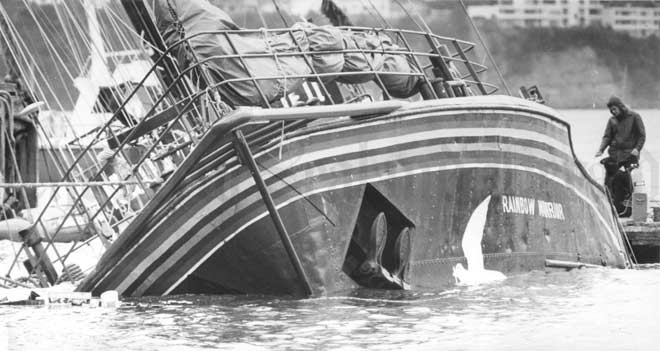
agents after protests against nuclear tests