AS China continues to show its intent to expand the Belt and Road Initiative, the United States and Australia have been forced to respond.
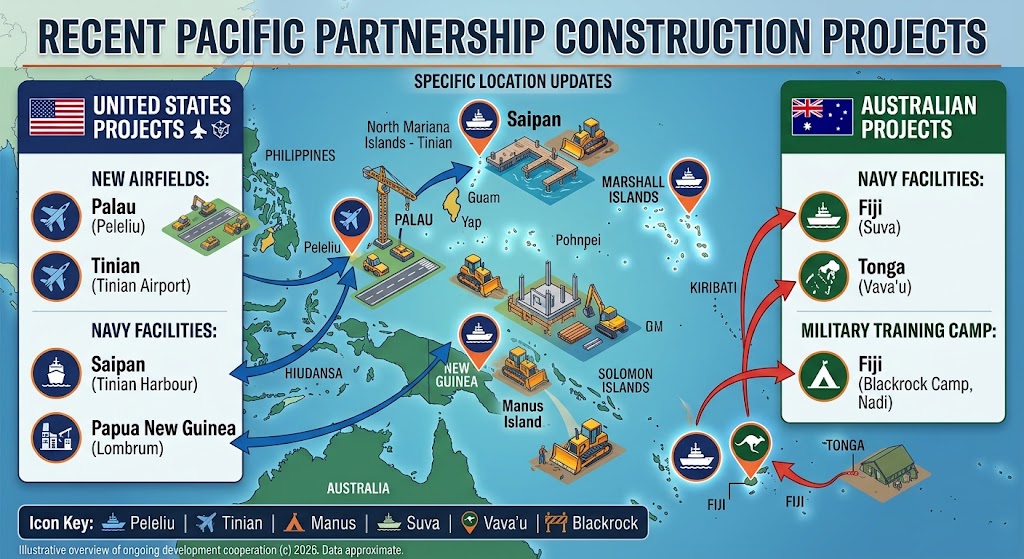
In Saipan, the US is rebuilding a wharf which was part of Japan’s military infrastructure and imperial expansion post-World War I. It has upgraded airfields in Palau and the Marshall Islands, allowing bombers and other systems to be stationed closer to China.
On Manus Island in Papua New Guinea, the US helped its Australian allies to upgrade a patrol boat and training base. These facilities form part of the US second line of defence against China’s strategic ambitions in the Pacific.
Further south, the Australians have built what is ostensibly a peacekeeping operations camp less than five kilometres from Fiji’s international airport, a major regional logistics hub.
In Suva, a maritime surveillance centre built by Australia serves as Fiji’s navy headquarters and may soon become the ears and eyes of Aukus and the Quad in the region. Aukus is a trilateral military cooperation between Australia, the US and the United Kingdom.
On Vava’u in Tonga, the kingdom’s tiny armed forces have a joint northern operating base, thanks to funding from Canberra. The military complex has spent millions of dollars in construction.
Further construction of naval facilities and upgrading of remote airfields left unattended since World War II could soon be a boost to local construction industries.
To counter Chinese infrastructure development and address concerns over “debt-trap diplomacy,” Washington and Canberra have dramatically scaled up development finance.
That means huge construction possibilities throughout the Pacific, from Papua New Guinea to Tonga. In Fiji, Australia has built state-of-the-art facilities for maritime surveillance in the capital, Suva, and a peacekeeping training base at Blackrock, just kilometres from Nadi International Airport.
The facilities ostensibly play a part in regional military preparedness and stability, but they also allow Australia to put boots on the ground within hours if the need arises. Targeted financial packages for Pacific Island nations allow the US and Australia to deliver hundreds of millions of dollars for local maritime surveillance, border security, and regional crime prevention.
These packages also provide much needed employment in an otherwise sluggish construction industry.
Ironically, Chinese state-funded companies such as the China Railway Group hold most of the civil works contracts throughout the region. Military jobs, however, are given to Australian and New Zealand companies.
In recent years, the US and Australia have recognised that Pacific Island nations prefer not to be forced to choose between superpowers. In an adaptive diplomatic stance, the US has reopened and established new embassies across the Pacific (in the Solomon Islands, Tonga, and Kiribati) to rebuild relationships after years of perceived neglect.
Australia has upgraded its presence in Tuvalu along similar lines. That means upgraded or new buildings in the islands, along with more jobs and the trickledown effect in the rental market, restaurants, clubs, supermarkets, and service stations.
This could just be the boost the industry needs.