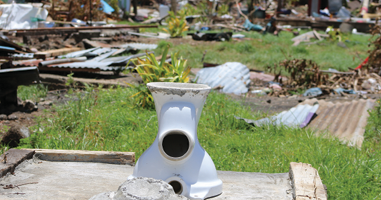
IN a dire assessment, one of the region’s top engineering firms is warning that Pacific infrastructure is being designed for climate conditions that no longer exist. The root of the problem is that a reliance on historical data produces structures that are increasingly vulnerable, costly to maintain or unfit for purpose. Beca, an engineering consultancy which has worked on infrastructure in Fiji and the wider Pacific, says the focus now needs to move away from building for the past to designing structures that will last for 50 to 100 years. If this level of sustainment is not built in to the region’s infrastructure, then transport, water, energy and essential services will be increasingly at risk due to intensifying climate impacts in the decades to come.
From historical records to future projections
Cyclones, extreme rainfall, flooding, sea-level rise, coastal inundation and the attendant erosion that comes with it, are just some of the greatest threats to infrastructure. Beca’s Business Director for Climate Risk & Resilience, Cushla Loomb, warns that because these threats often come concurrently infrastructure must be designed to withstand multiple threats. “It is really important that we plan and design infrastructure to incorporate the latest information on future climate projections to better understand how risk will evolve over coming decades and not just rely on historical records,” she said. “Higher sea levels can amplify storm surge; more intense rainfall can overwhelm drainage networks and cause downstream scour. Understanding how risks interact and cascade through systems is now central to design thinking.” That change in perspective is starting to show. Bridges are now built to survive bigger floods, wharves and jetties are designed with sea-level rise, wave conditions and storm surge factored in. Site selection emergencies and energy resilience are now part of the thought process of building design. Beca is being proactive with their own engineering and designs incorporating flexibility by building wharf decks that can be raised as sea levels rise rather than just sticking to a fixed design.
Fiji case study: Simple solutions, faster recovery
A bridge the company worked on in Fiji shows the outcome of the thought process. The team at Beca working with a rural community found that low-level structures that could absorb flooding were more resilient than highly engineered bridges. The community was able to remove debris and the bridge was back in working order almost immediately post-disaster. A “higher quality” bridge would have needed specialist inspection and repair, delaying a return to normal use. It was a seminal moment in climate risk assessment in Fiji, for as prior to 2015, there was no requirement for climate risk consideration in the infrastructure design process. Hydrological and hydraulic modelling now incorporates climate change effects such as increased rainfall and sea-level rise, with tides and extreme sea levels added to models for bridges near the coast. Results inform bridge deck set-out levels, erosion and scour protection, and hydraulic loading on structures.
Uncertainty, geography and the affordability trap
Although much progress has been made, there is still a long way to go. Not being certain of what is going to happen, when and and at what scale is a real issue. Pacific Island countries also face constraints when it comes to geography, supply chains, funding, asset maintenance, and technical capacity. Infrastructure often must be delivered in remote locations where logistics are difficult and replacement options are limited if assets fail. Governments have to juggle immediate development priorities while setting aside funds for conditions that may emerge decades into the future. Loomb describes this as balancing affordability with long-term resilience. She acknowledges, however, that current engineering practices and building standards are not keeping pace. Climate science is evolving faster than many standards and design processes were originally intended to accommodate. Increasingly, engineers are supplementing standards with climate-informed risk assessments and future scenario testing.
The path forward: Proactive risk management
For the engineers at Beca, governments need to move away from being reactive and become proactive by including climate risk information earlier in planning, assessing investments against future scenarios, and prioritising resilience in investment cases, National Infrastructure Plans, and funding decisions. One Pacific nation that is making real strides in that direction, is the Republic of the Marshall Islands, where adaptive approaches informed the National Adaptation Plan, strengthening governance and implementation foundations for resilience and “no regrets” actions that deliver benefits regardless of how climate change unfolds. Longer-term investment pathways were mapped for critical components of habitability, including water supply, transport and land. This meant that investment could Building and Construction be planned in response to changing conditions thus avoiding being “locked in” to costly, potentially redundant infrastructure. Thinking of it in terms of a whole system is also essential. “Transport, water, energy and community facilities are interconnected, so resilience planning must consider how those systems work together,” Loomb said. “Technical expertise is most effective when combined with local knowledge and community understanding.”
What comes next
Ten to 20 years down the track, Beca would like to see the Pacific building infrastructure that is more adaptive, flexible and interconnected than what is usually the case. There should be greater integration of climate projections, increased use of nature based solutions alongside engineered infrastructure, and stronger focus on protecting critical lifeline services and community well-being. “In the Pacific, success will be measured not simply by whether an asset survives a cyclone, but whether communities can continue to thrive in a changing climate,” Loomb said. “The opportunity lies in combining the region’s long-demonstrated resilience and local knowledge with the best available science, engineering and planning approaches. That will ensure that infrastructure invested in today continues to support communities for generations to come.”


