TWO important meetings have taken place within the past 12 months. The first was in Kazan, Russia, in October 2024, where BRICS nations met; the second was the Shanghai Cooperation Organisation (SCO) summit in Tianjin, China, from August 23 to September 1 this year.
At both meetings, a new world economic and political architecture, without the dictates of the West, was mapped out.
The defining moment was in Tianjin, when China’s Xi Jinping, Russia’s Vladimir Putin, and India’s Narendra Modi met the leaders of 23 emerging nations from what is known today as the Global South to chart a new world order that will be more inclusive and equitable.
This meeting may well go down in history as the 21st century’s equivalent to the Yalta Conference between the United States, Britain, and the Soviet Union that charted the post–World War II global economic order.
While the emerging nations, along with the three non Western global powers, are charting a new order, the South Pacific was missing at both meetings – not by omission but by neglect.
It is the duty of the larger Pacific nations, Papua New Guinea (PNG) in particular, to put their hands up and send the head of state to attend such meetings. Neither PNG nor the other Pacific power, Fiji, have done so and left the region without a voice in shaping the emerging new world order.
For too long, the Pacific has left it to the Suva-based Pacific Islands Forum (PIF) to represent them in such international fora. But, the presence of Australia and New Zealand, who would not identify themselves with the hopes and aspirations of the Global South, has hindered any such linkages.
Sadly, Australia’s military alliance treaty with the US makes them unable to act independently of US interests.
It is interesting to note that both the Kazan and Tianjin meetings talked exclusively about development initiatives, development funding, economic cooperation, and green development—all that is crucial to the future of the South Pacific—whereas the West (which includes Australia) always talks about security threats and military spending.
President Trump has recently authorised US companies to drill the deep seabed for minerals, disregarding the Law of the Sea Convention, whose International Seabed Authority is still considering measures to regulate the ocean-polluting effects of such activity. The first drills are expected to be unleashed in the Pacific Ocean soon, and PIF is expected to keep silent.
The International Court of Justice (ICJ) verdict in July this year opens the door for small island nations, in particular, to seek compensation for climate change damage. However, since the ruling is nonbinding on nations, for the Pacific to receive any form of climatic justice, it would need the support and lobbying power of organisations like BRICS and SCO in the future.
PNG’s closest neighbour, Indonesia, sees itself as an emerging Asian power and is a member of both organisations.
Indonesia joined BRICS as a full member on January 6. Though not a member, Indonesia attended the SCO meeting in Tianjin.
Island nations Sri Lanka and the Maldives are now dialogue partners of SCO, as are PNG’s ASEAN neighbours Cambodia, Laos, and Myanmar, while Malaysia and Thailand have expressed interest in joining BRICS.
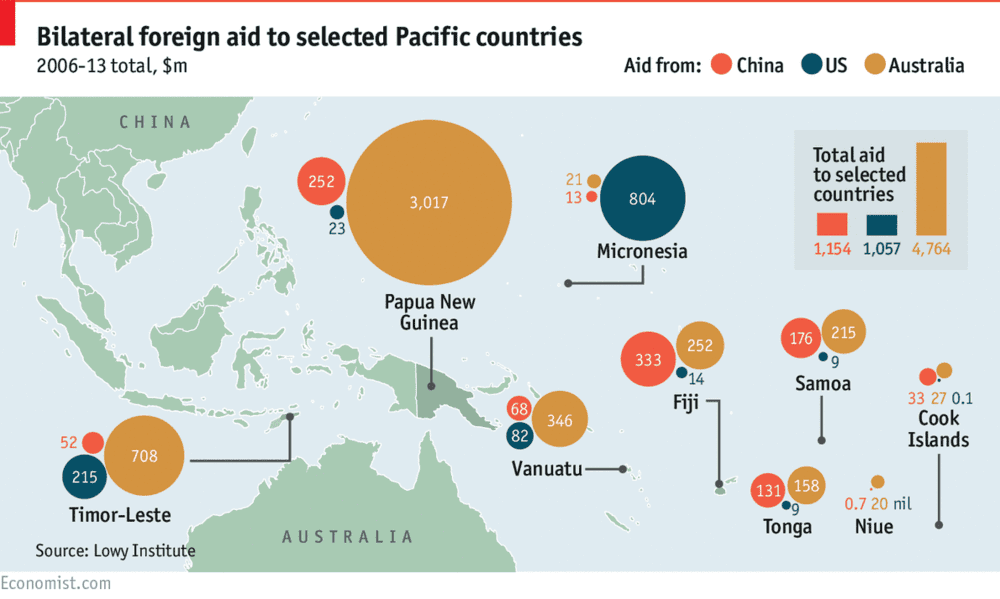
The Bretton Woods system, designed by the West with the International Monetary Fund (IMF) and the World Bank helming the world financial architecture—especially the development assistance structure—was based on the concept of development aid, which has created a system of dependency.
It was an extension of the colonial system of exploitation and plunder, where countries whose resources were plundered were given some crumbs to cushion the impacts, and it was called “aid” – a charitable act.
PNG is a good example. One of the world’s richest countries in terms of mineral wealth, it has been mined mainly by Western and Australian companies for over half a century, yet it remains relatively poor.
The new global economic architecture, designed and led by China, sees development cooperation as an investment that could benefit both parties if the country receiving the investment is well equipped to make good use of it. China, or whoever invests, will also benefit. For such a system to succeed, education, training, and discipline are important.