AS climate change continues to threaten food security, the Taiwan Technical Mission (TTM) in Fiji is taking a hands-on approach to help farmers build resilience and sustainability through innovation and training.
At the forefront of these efforts is Shi-Chian Shiau, Team Leader of the Taiwan International Cooperation and Development Fund (ICDF) Fiji Mission.
“We are here to help farmers improve their livelihoods, earn more income, and build a better life. Our mission is to make farming more resilient and food production more sustainable in the face of climate change,” he says.
The Nausori Research Station, 25 kilometres from the capital, Suva, opened last year and is the heart of this work. Spread across three hectares, it includes demonstration fields for guava and dragon fruit, smart greenhouses, and laboratories where seedlings are mass-produced.
“This new facility allows us to research, test, and share new ideas with Fijian farmers,” Shiau explains.
“It’s where innovation becomes action.”
A major focus of the Nausori station is the revival of Fiji’s banana industry, once a key agricultural export before the Black Sigatoka Disease devastated plantations decades ago. “We are using tissue-culture techniques to produce healthy, disease-free banana seedlings,” Shiau says.
“If we can provide enough clean planting material, Fiji can rebuild its banana production and even look at exporting again.”
Fiji’s banana exports earned the equivalent of $FJD11 million in 1914, with 1.7 million bunches sent to Australia and New Zealand. It was Fiji’s third-highest export, behind sugar and copra.
Beyond bananas, the Mission is also experimenting with taro and short-term vegetable crops that can survive the heat and rain of Fiji’s changing climate.
“We are introducing new, resilient crop varieties that can withstand flooding and high temperatures,” he says.
“For example, guava can stay in water for two days without dying; vegetables cannot. That makes guava one of the most sustainable fruit crops for flood-prone areas.”
The goal is not just research, but real-world application. “We work with the Ministry of Agriculture to ask what people really need,” Shiau says.
“We want farmers to use simple, affordable techniques that keep food growing and income steady.”
The Resilient Cultivation and Extension Project (2024– 2029) expands on this approach. It promotes resilient crop varieties, sustainable farming methods, and the creation of demonstration sites across Fiji.
“We show farmers that with the right techniques, they can still grow food during the rainy season or drought,” he explains.
“That’s how we strengthen food sustainability in Fiji.”
Taiwan’s partnership with Fiji began a year after Fiji’s independence, with a trade office in Suva. When Fiji established diplomatic relations with China in 1975, the office gradually transitioned to its present status as a Technical Mission in 1978.
“In the early years, we focused on sugarcane,” Shiau recalls.
“Later, we shifted to vegetables, then to guava, and dragon fruit. Each stage matched what Fiji’s farmers needed at that time.”
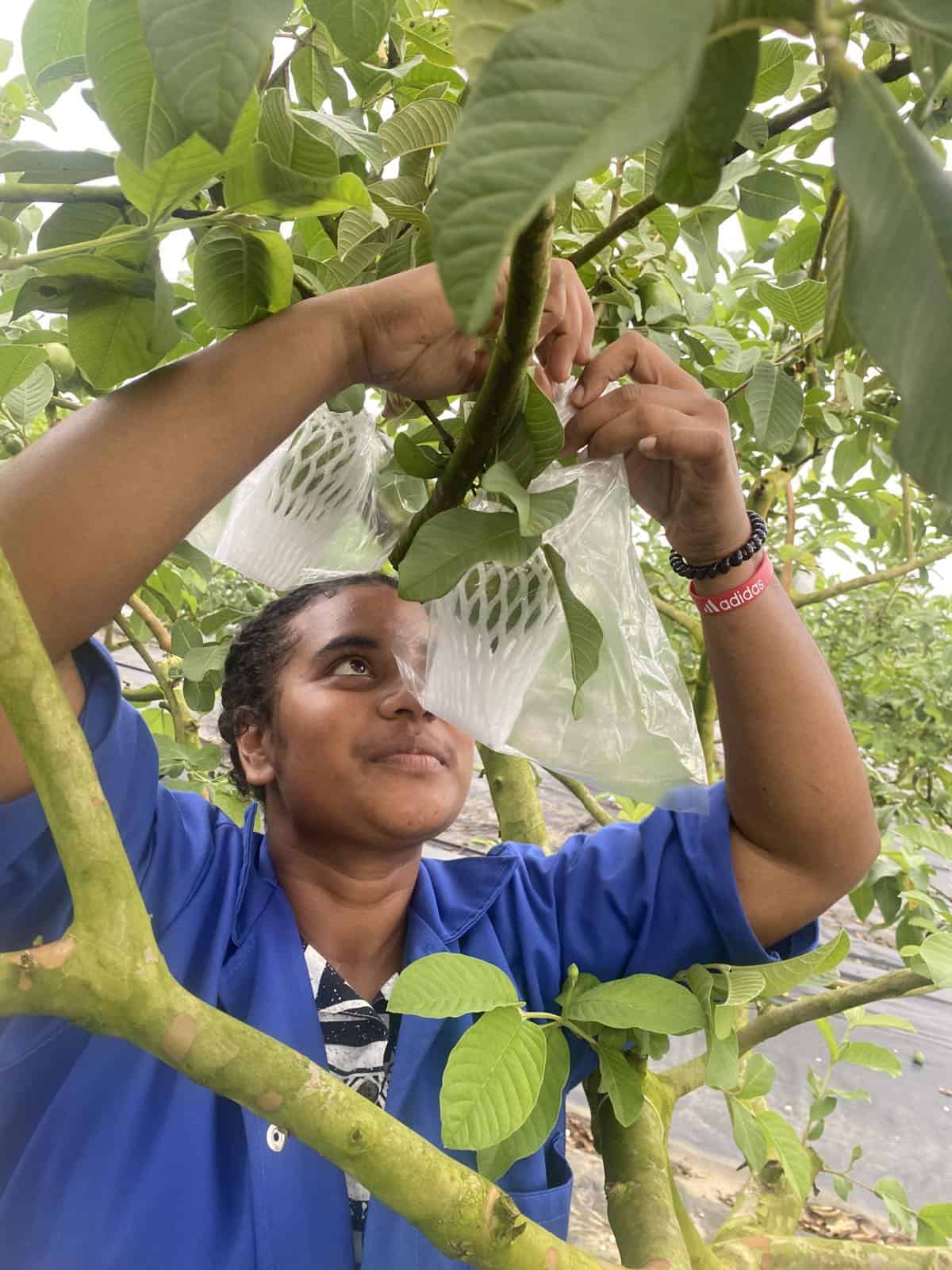
Since 2020, TTM’s guava and dragon fruit initiative has distributed more than 3000 grafted guava seedlings each year. “We use local rootstocks and graft them with Taiwanese varieties,” Shiau explains.
“It produces stronger trees and better fruit. Many farmers are now earning good money from guava; it’s become very popular in supermarkets.”
Guava has potential as an export commodity.
The Mission’s work also reaches beyond crops. Through its aquaculture programme, TTM operates shrimp hatcheries in Sigatoka and Caboni, Rakiraki, supplying white shrimp larvae to community fish farmers.
“By producing local larvae and giving them free to farmers, we can reduce imports and support local food supply.” Taiwan’s ICDF focuses on socio-economic development, human resources, and economic cooperation with partner nations, while also providing humanitarian and disaster assistance.
In the future, Shiau hopes to see more Fijians adopting the techniques pioneered at the Nausori and Sigatoka stations. “Food sustainability is not just about growing crops,” he says.
“It’s about teaching people how to adapt, how to plan for the next season, and how to make their farms survive through floods or droughts.
“If our work can help Fijian farmers make a good living and ensure there’s always food on the table,” he says, “then we have achieved our goal.”