A SERIES of borderline hysterical editorials and op-eds in The Australian have claimed a dramatic failure of Australian policy in the Solomon Islands.
Chinese activities, by contrast, are routinely depicted as a roaring success, feeding a narrative that suits both Beijing and its critics.
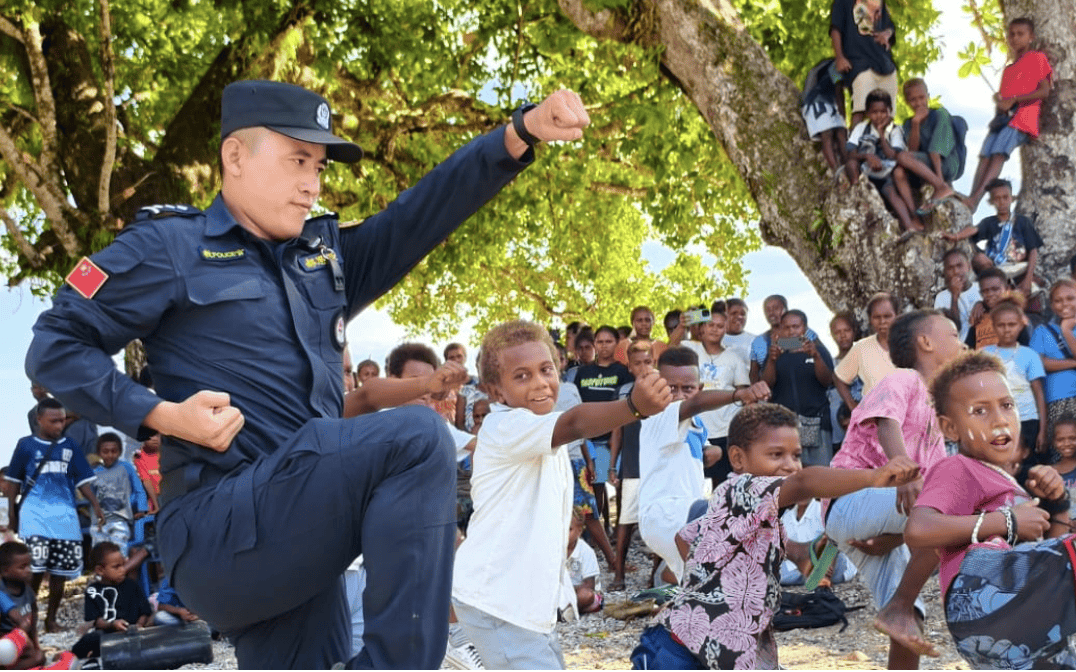
‘China is kung fu fighting in Pacific while we sleep’, headlined one editorial (September 30), while ‘China’s cultural revolution forced on to the Solomon Islands’ (September 13–14) proclaimed another. ‘China’s provocative march into our Pacific backyard accelerates’ insisted a third of many such pieces (September 30).
These Solomons stories depend mostly on snippets gleaned from Facebook or the odd international telephone call to an opposition politician rather than first-hand reporting. They almost invariably focus on something other than what attracts many Solomon Islanders to the Chinese presence: the promise of development.
Take, for example, the kung fu story. This initially stemmed from a press release by the Royal Solomon Islands Police Force reporting cooperation with Chinese police delivering the ‘Fengqiao experience’ on Malaita, including ‘fingerprinting and palm printing’.
It was accompanied by photos of Chinese police officers showing off their combat stances to local villagers. Fengqiao was a method of mass surveillance favoured by Mao Zedong to root out ‘reactionary elements’ in the 1960s. To anyone who knows Malaita, these reports are absurd. Malaita is not Xinjiang.
The Solomon Islands state barely reaches most parts of that island. China is not about to extend its extensive domestic surveillance operations to such remote overseas places.
Earlier, the Fengqiao model was reportedly pioneered in the Fighter One community next to the international airport to Honiara’s east. But even here, so close to the capital city, the power of the central state is severely limited.
There are only a dozen or so Chinese police presently stationed in the Solomon Islands, none of whom can properly speak the local Solomons Pidgin language. The Australian federal police presence is far larger and its inter-agency relations have been cultivated over decades, albeit not without their own problems.
It is true that China has been conducting a charm offensive on the Island of Malaita, but the critical component of that is not villager enthusiasm for the martial arts. It is rather Chinese construction of a road stretching north from the provincial capital, Auki (Australia too is building another road leading south from the town).
That road is not just a critical route to north Malaita. Constructing it also provides many local jobs. The other major aid package on Malaita used to be USAID’s SCALE program—short for Strengthening Competitiveness, Agriculture, Livelihood and Environment—but this was wound down under President Joe Biden and then axed by Donald Trump. China has stepped into the vacuum.
Malaita is important for propaganda reasons. The island accounts for 22% of the Solomon Islands’ estimated 765,000 population (2025), but most of Honiara’s population (another 13%) were also either born on Malaita or have ancestors from that island. After the Solomon Islands dropped its 1983–2019 diplomatic links with Taiwan and forged a new partnership with Beijing, the Malaitan provincial government held out in favour of Taiwan.
Then provincial premier Daniel Suidani condemned China as ‘atheist’ and ‘communist’, threatening to close Chinese shops. In November 2021, major riots in the capital, Honiara, on the neighbouring island of Guadalcanal were initially sparked by Malaitan protests against the Chinese presence, which included ownership of nearly all the town’s retail outlets. Ironically, the national government used those riots as a pretext to sign a controversial security deal with China in early 2022.
The largest per capita recipient of Australian aid to the Pacific had become Canberra’s most troublesome neighbour, despite all the comforting rhetoric about Australia still being ‘the security partner of choice’.
Suidani was removed in a February 2023 provincial no-confidence vote orchestrated and bankrolled by the national government. His ouster was later declared unlawful, but by then, a fresh provincial election had taken place. Suidani had regained his own seat, but his new Iumi for Change party fared poorly and he was unable to resume control of the provincial council. It has been Suidani’s spokesman, Celsus Talifu, who has long been the Australian and New Zealand media’s main source for anti-China invective.
Both men are, controversially, facing trial for allegedly conspiring to orchestrate the 2021 riots. Since Suidani’s ouster, anti-China sentiments have diminished in Malaita, influenced by the increase of Chinese development assistance.
On the national stage, it has not all been smooth sailing for pro-China politicians. Ahead of the April 2024 election, the entire cabinet contested together in a single party, the Ownership, Unity and responsibility (OUR) Party. This was a first. In all previous elections, outgoing cabinet ministers all stood for rival parties or as independents.
The new unity was fuelled by Chinese cash, as were the glossy campaign videos from out in the provinces. On the campaign trail, then-Prime Minister Manasseh Sogavare sang the praises of Chinese-orchestrated development, promising major improvements in living standards. It proved a debacle. Half of the ministers were ousted.
None of the party’s newer candidates won their seats. Sogavare had to step aside, though his successor Jeremiah Manele remains closely allied with Beijing. Foreign policy issues are not what determine the way Solomon Islanders vote. Yet, indirectly, people did not buy OUR Party’s message about big improvements in incomes arising from the new China orientation.
Honiara may now boast a big new shiny Chinese-built stadium, three high-rise dormitories at the Solomon Islands National University, and a four-story Chinese medical centre built at the eastern end of the notoriously dreadful Taiwan-funded Number 9 hospital. But according to the Lowy Institute database, Chinese aid is almost entirely composed of grants rather than loans, aside from $USD66 million to build Huawei mobile telecommunications towers across the country. Close to a third of Chinese aid spending has gone into slush funds for parliamentarians.
The gold mine, now majority-controlled by Wanguo International Mining, may be churning out more precious metals than it did before its closure in 2013—assisted by surging international prices—but there are few signs of any boom in investment by the big Chinese state-linked companies.
Log exports—easily the country’s largest foreign exchange earner—were less than half their 2018 levels in 2024, owing to weak demand in the Chinese construction sector stemming from a protracted collapse of that country’s real estate market. According to the World Bank, there has been negative Solomon Islands per capita GDP growth since 2017.
Just as China nowadays excels at lauding its own achievements, so too do some of Beijing’s fiercest critics in Australia and New Zealand find an incentive to portray Chinese activities in the most grandiose—and therefore scary—light, with the objective of galvanising resistance. Diplomatic relations in the Pacific are compared to a ‘knife fight’.
China in the Pacific is routinely claimed to pose an ‘existential threat’. Anything less edgy is supposedly strictly for the panda-huggers.
Out in the Pacific Islands, diplomatic relations are frosty but cordial. Only a decade ago, ambassadors were keen on courting China, even seeking joint ventures like the New Zealand-China Rarotonga Te Mato Vai water reticulation system in the Cook Islands. Now, they are attacking the multilateral banks for signing contracts that result in flamboyantly Chinese-badged infrastructure projects. In part, the change is a sign of how much China’s foreign policy has changed under Xi Jinping, but Solomon Islands politicians are pragmatic. As long as Chinese assistance seems to offer a net gain in development terms, the alliance will continue. That is where the loophole lies.
The classic belt and road model is not to pump grant aid into a client state for political advantage or to send Chinese police officers to practice their kung fu skills on remote islands. It is to leverage commercial firms into resource-rich or strategically valuable sectors using concessionary loans. There are few signs of that strategy succeeding in the Solomon Islands.