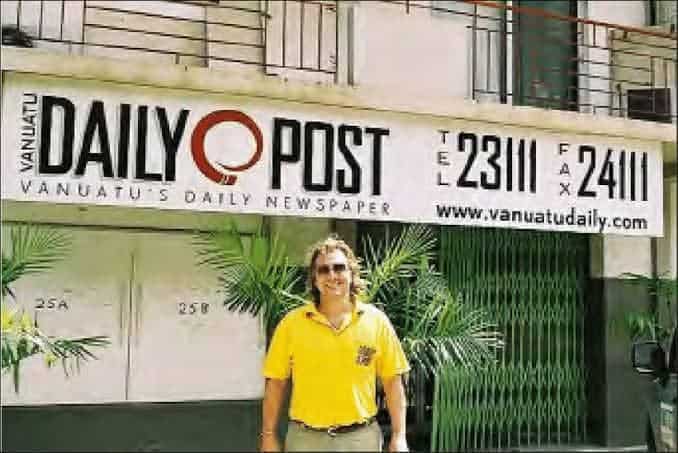
Once seen as a troublesome foreign media person, Marc Neil Jones has been laid to rest as a hero in his new home, Vanuatu.
Often referred to as MNJ, Jones arrived in Vanuatu over 40 years ago from England and immediately introduced a brand of investigative, confrontational journalism to the country.
As publisher of the Vanuatu Daily Post, the country’s only privately owned newspaper, MNJ bravely lit the flame for media freedom and paid for it by being verbally and physically attacked.
Most of those attacks were instigated or performed by people of power and influence. MNJ was once threatened by a government minister who was prepared to send a bulldozer to drive through the Post’s
office. But MNJ and his staff continued to work unperturbed.
In a few short years, he created a platform for independent news in Vanuatu and became a recognised symbol of resilience and a staunch defender of press freedom throughout the region.
Generations of journalists were influenced by him and his fight for the truth, which helped shape the media landscape in the Pacific. MNJ’s initial Pacific arrival was in Papua New Guinea but he soon crossed the sea and settled down in Vanuatu where he married Jenny.
He bought a local business advertising company—the Trading Post—and wanted to turn it into a proper newspaper. Two challenges loomed large for MNJ: he was not a journalist; worse, he was a foreigner.
Around that time, I had resigned as editor of the government mouthpiece, Vanuatu Weekly, due to political pressure. I had drafted a letter on behalf of my 26 colleagues in the Department of Media Service (which comprised Radio Vanuatu and Vanuatu Weekly). The letter challenged the decision of the PM’s Office to appoint a new Media Director.
The response from the PM’s Office was akin to: “You are a tool to do what the government instructs you to do. You have no right to tell the government what to do. If you are not satisfied, the door is open.”
That was when I walked out and became a freelancer. MNJ sent the editor of the Trading Post brochure at the time, Kalvau Moli, to find me and take me to Hotel Rossi for lunch with the man and his colleague Gene Wong. “Len, can you start a newspaper for me?” “Why me?” I asked. “Because you are a trained journalist and readers in Vanuatu know your name. I will make sure your stories carry your byline on the front page. People will see your name and buy my paper,” he replied. I agreed. It worked.
This was an independent print medium which planned to challenge a traditionally male-dominated society in which ‘big men’ were not used to be criticised or told they were wrong.
The Daily Post started with five people on the staff. MNJ was a generous publisher who loved his kava.
He would spend Vatu 5000 on kava for reporters to tail MPs and Ministers to popular nakamal (kava bars) where they would imbibe enough drink to reveal sensitive government decisions on issues of national interest.
As the Editor, I was working late one evening when a number of men quietly entered the front door.
Focused on my computer screen, I recognised a voice behind me, which called: “Tawi, yu go hom naoia kwiktaem!” (Brother –in-law, please hurry home now!”) I rushed home thinking someone wanted an urgent interview, only to find no one at home. Then I received an urgent phone call which warned: “Please do not come back.
Come tomorrow; our sports reporter was badly assaulted and taken to hospital.” Next morning, I arrived at work to find dried blood outside the door, which was padlocked. MNJ arrived and had the appropriate authorities unlock the door. We all returned to our desks and continued writing as if nothing had happened.
Another afternoon, some people quietly entered the newsroom and went straight to MNJ’s office and assaulted him at his desk. I heard him scream, “Please don’t,” and realised his office was full of men. Two senior reporters who knew the men spoke to them in their language and ordered them off the premises.
Then there was a case involving MNJ’s sudden deportation. He was placed on a plane and flown to Sydney. His lawyer had the case overturned overnight. MNJ became the first foreigner to be ordered back to Port Vila within a record 48 hours.
From 2017, The Trading Post became the successful Vanuatu Daily Post. The newspaper had its own printing press and successfully killed the government’s Vanuatu Weekly.
All 13 government ministries began to treat the newspaper as their own, and political threats died down.
Speaking at a funeral service for MNJ, his business partner said Jones left a lasting impact on the development of independent journalism in Vanuatu, ensuring that the country’s media continued to evolve and grow despite the odds.
ITS News reported, “Marc Neil-Jones’ legacy is immeasurable. He not only created a platform for independent news in Vanuatu, but he also became a symbol of resilience and a staunch defender of press freedom.’’
MNJ died following a long fight with diabetes and was buried at Mele Maat Village Cemetery. He is survived by his son, Manu, and his widow, Jenny.