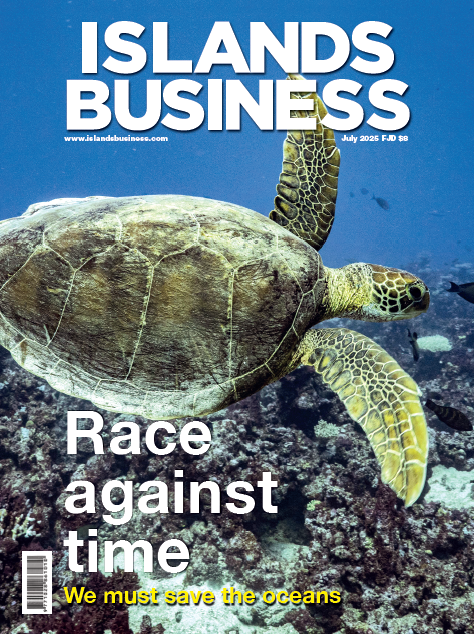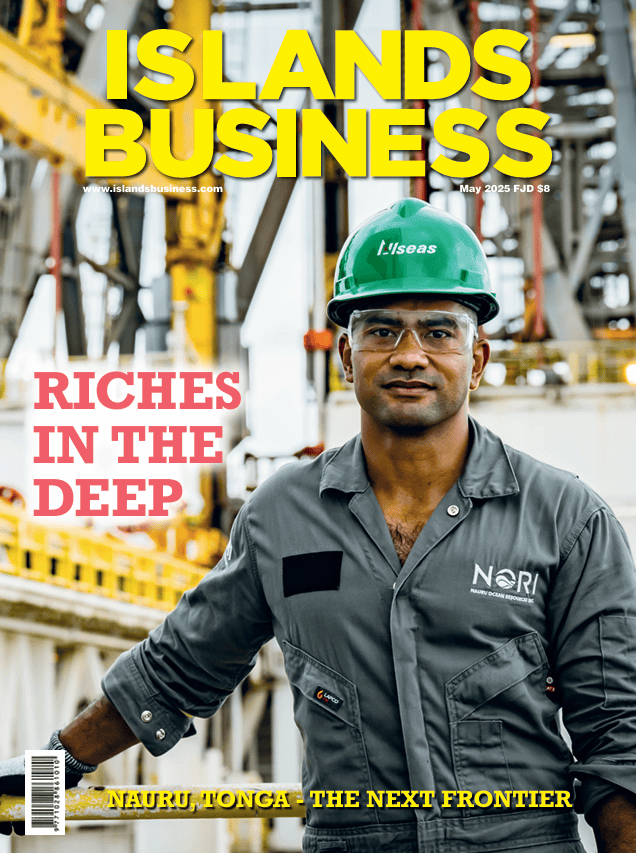
Will riches on the ocean floor change the Pacific region’s destiny?
Valuable metals like manganese, copper, and nickel, perhaps even large gold deposits, are all ripe for the taking, and the machinery to extract this treasure trove sits on the ocean, waiting for the green light from legislators.
While Nauru is among the nations that view deep-sea mining as a potential economic opportunity, other countries are more cautious. As of March 2025, there are 32 countries worldwide in support of a moratorium, precautionary pause, or complete prohibition of deep-sea mining.
Efforts toward regional coordination continue. On April 10, the Ocean Ministers Preparatory Meeting Toward the UN Ocean Conference was held in Suva.
Pacific Islands Forum Secretary General Baron Waqa— former President of Nauru—said: “Let us ensure that our messaging for the UN Ocean Conference is grounded in solidarity, inclusion and the Pacific way, embracing traditional knowledge alongside science, and lifting up the voices of women, youth, and communities often unheard.
“As we look ahead to the UN Ocean Conference and beyond, to the fourth International Conference on Financing for Development and COP30, this meeting should consider how the Pacific positions itself, not just as a region at the front line of ocean challenges, but as a leader in solutions.”
Nauru intends to move forward with submitting its Plan of Work for Exploitation under a two-year rule, urging the International Seabed Authority to finalise exploitation regulations by 2023.
In a letter on November 12, 2024, Nauru’s Permanent Representative to ISA, David Aingimea, notified the Authority that Nauru Ocean Resource Inc (NORI) had been diligently preparing its application for a Plan of Work for Exploitation.
That application will be submitted to the authority on June 27 for approval.
NORI is a subsidiary of The Metals Company, which has positioned itself as a global leader in deep-sea mining and mineral extraction.
But ISA’s exploitation regulations have not been finalised and adopted after two years of work.
A separate development has also attracted attention.
The Metals Company (TMC) has made attempts to secure US approvals for deep-sea mining, noting that the United States is not a party to the ISA or United Nations Convention on the Law of the Sea (UNCLOS) and therefore not bound by its regulations, or lack of rules.
“The United States has a regulatory regime that has been in place since the 1980s,” TMC Head of Stakeholder Relations Corey McLachlan told Islands Business.
“We believe, unlike the ISA regulatory regime, it is complete. It is a transparent process. It is an established process. So, we don’t see any ethical concerns with that at the moment.
“We currently maintain both of the two ISA contracts that are sponsored by Nauru and Tonga. Both of those contracts remain in existence today. And so, nothing has changed with regards to both of those.’’
All stakeholders now await the upcoming UN Ocean Conference in Nice, France.
Will the first cut into the seabed mark a historic leap forward for Pacific nations, or a disastrous mistake for the future of the region and the world?
The Pacific may soon find out.