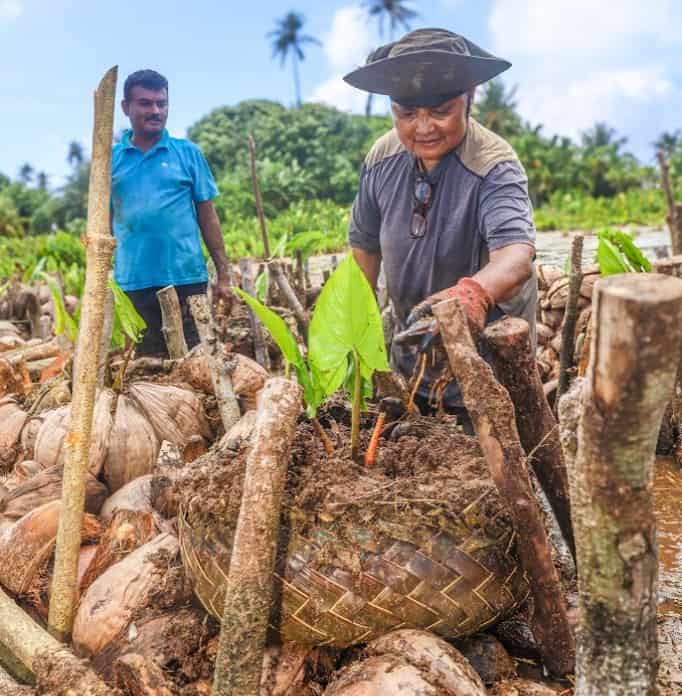
TRADITIONAL crops, giant swamp taro, breadfruit, local yams, and banana varieties are disappearing from Pacific homes – not because people have stopped caring, but because the conditions that once made them ordinary have changed.
In kitchens, gardens, schools, and markets across the region, imported foods have pushed local crops to the margins. At the same time, urbanisation, wage work, climate stress, and shifting ideas of status have quietly altered what family’s plant, buy, and eat.
Karen Mapusua, director of the Land Resources Division at The Pacific Community (SPC), says the change is best understood not as a single trend but as a web of pressures.
“It’s a range of interlinked issues. The overall food system and globalisation have obviously had a huge impact.”
At the centre of that shift is convenience. Imported foods are often cheaper, easier to prepare, and relentlessly marketed, which makes them hard to resist for busy households.
Mapusua describes a food environment in which supermarket-bought, easily prepared foods save time and energy, especially for urban families balancing work and caregiving.
The economics reinforce the habit. Global subsidies favour wheat, corn, soybeans, sugar, and rice – and those products dominate the shelves.
In the Pacific, where price sensitivity is high, convenience and cost become decisive. Families may still prefer local market foods,
she says, but necessity often wins.
“We will move to, often out of necessity, cheaper products, even if we might personally prefer to be buying something from the local market that is locally grown.”
That economic story is also a cultural one. As people move into towns and cities, and as younger generations spend more time in wage labour, the routines that supported home gardens begin to break down.
“Younger generations are entering into wage labour, leaving less time for gardening and farming, and less time for food preparation as well,” Mapusua says.
In many capitals, where land is already scarce, backyard plots disappear too.
“If you live in an urban area, you often have reduced available land for home gardens,” she explains, and for many families, that means one less place where greens, roots, and herbs can still be grown close to home.
“The result is not only less production, but also less memory. Traditional knowledge about seasons, planting times, companion crops, pest management, and the specific behaviour of local varieties can be lost as food systems become more urban and more reliant on imports.”
Preserving food knowledge
She says climate change is deepening the problem by making crops harder to grow and the old rules less reliable.
“We’ve moved into urban areas, and populations have shifted,” she notes, and “with that shift, there has been a loss of agricultural knowledge.
“The knowledge loss feeds back into the climate problem, because when timing and weather patterns change, the old planting calendar is no longer enough.”
The transformation is visible in what ends up on the plate. Imported foods do not just displace local produce; they reshape taste.
“Younger generations in many places in the Pacific are developing a preference for rice over root crops,” Mapusua says, and those preferences are not easy to reverse.
“Our taste preferences develop at a young age, and they’re very hard to change. In other words, the next generation inherits not only a different diet, but a different idea of what food should taste like, look like, and signify.”
What is vanishing is often variety rather than an entire crop. That distinction matters.
In the 1990s, Samoa was devastated by taro blight. To develop blight-resistant taro that matched local tastes, varieties from the North Pacific—including Palau and the Federated States of Micronesia (FSM)—were used for their resistant traits. Without those varieties, Samoa may still not have been able to produce taro today.
“It’s sometimes less about losing a whole crop than losing different varieties,” Mapusua says, especially for staples like
taro and banana.
Pacific taro still exists, but widely distinct local varieties are disappearing from fields and markets, as farmers are pushed toward export varieties.
The same is true for bananas: “We’ve got hundreds of banana varieties, different colours, different flavours, different nutritional profiles, but what we see in the market are largely Cavendish ladyfingers and some of the plantains or cooking bananas.”
The narrowing of what is grown eventually narrows what people know how to eat, cook, and value. For her, this loss runs far deeper than biodiversity alone.
Traditional crops carry medicinal uses, seasonal knowledge, cultural practice, and social meaning.
“It’s more than just about the plant. There’s so much knowledge that is linked to the traditional crops.”
Some plants are tied to ceremonies, some are indicator species for weather events, and some help show how different crops were grown together.
“There are so many interlinks between the traditional crops that we grow and the way cultures are lived through
exchange,” she says.
The argument for preservation is therefore not nostalgic; it is practical, scientific, and cultural at once. “It’s about identity, and it’s about ensuring that we are maintaining our genetic diversity for the future.”
That future may depend on traits that are not yet fully understood. A crop that is overlooked today may carry resilience to heat, drought, disease, or soil stress. It may also hold medicinal properties that have never been properly studied.
“There may be in these crops things that will be needed in the future, like climate or disease-resilient traits, and there may be medicinal properties we don’t know enough about yet.”
The warning is clear: when a crop disappears from the field, it can take untapped value with it.
Schools, Mapusua advises, should be one of the first lines of defence, but they are not doing enough.
“In general, in the schooling system at the moment, there is not a big focus on teaching about the food system; there is very little around indigenous food systems.”
Older agriculture programmes taught children how to raise livestock and grow crops, but those lessons have faded.
“Education has to begin earlier, right from pre-school, if the region wants the next generation to understand where food comes from,” she says.
There is, however, a business case for recovery. SPC’s Pacific Vision for Adapted Crops and Soils is designed to identify forgotten crops, assess their nutritional value, test their performance under climate stress, and build the market systems needed to bring them back to consumers.
“Forgotten crops can have a really strong business case.”
The opportunity is not limited to island communities either. Pacific crops may find demand in diaspora markets and among broader consumers looking for novel foods with strong flavours and cultural depth.
“There’s a growing interest in new, novel foods and indigenous foods, both for flavour and for health.”
Still, the stakes are larger than business. If the region loses these crops, it loses more than just plants. It loses nutrition, resilience, identity, and knowledge. It also risks unravelling relationships within ecosystems that may not be obvious until they are gone.
“Every plant in an ecosystem has a role, and when one disappears, you don’t know what the follow-on effects will be.
“That is why conservation cannot be left to laboratories alone. It cannot be done in a lab alone. It needs to be done in the community, by people.
“Governments, schools, researchers, families, farmers, and consumers all shape what survives.
“Everybody is responsible for protecting the food traditions. It’s not one person’s job; it’s everybody’s job because it’s everybody’s food.”