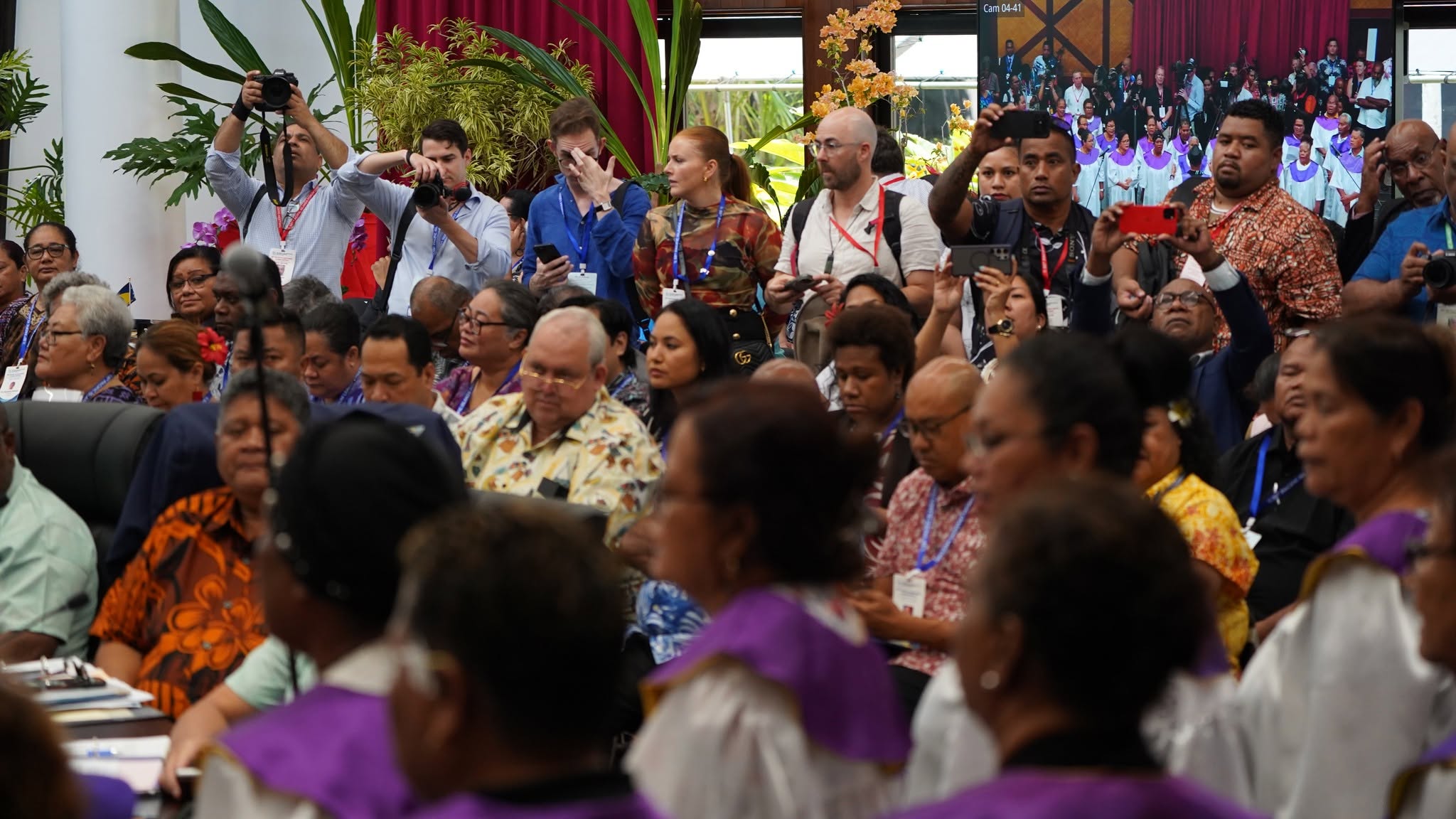
AS regional leaders flew home from the 55th Pacific Islands Forum in Palau, their final communique highlighted a central theme of this year’s summit: partnerships.
The communique stressed that the 2050 Strategy for a Blue Pacific Continent “rests on partnerships that are genuine, durable and accountable, and which strengthen Pacific leadership, voice, and engagement to ensure recognition and alignment with Pacific cultures, values, priorities, and collective interests.”
Fine words, but the Pacific has a problem with partners. And there’s lots of them, as highlighted by the crowd in Koror: 21 Forum Dialogue Partners (with more seeking the status) and one “development partner” (Taiwan).
Then there’s four associate members (Tokelau, Wallis and Futuna, American Samoa, Guam); two country observers (CNMI and Timor Leste); nine observer organisations (from the ADB and World Bank to the UN Secretariat and Western and Central Pacific Fisheries Commission), plus the Pacific Regional Civil Society Alliance, the Pacific Islands Private Sector Organisation (PIPSO), and eight other members of the Council of Regional Organisations of the Pacific (CROP).
Mix in motley crowd of diplomats, lobbyists and green environmental multinationals – each of whom wants a bilateral meeting with a president or prime minister (or two or three). And then there’s the assembled media (100 strong in Palau) who want access to leaders for information they can’t get out of a press release.
No surprise that the Solomon Islands Government—after refusing to hold a dialogue with partners as Forum host in 2025 continues to question whether the leaders meeting should be separate from the dialogue partners’ process.
Leading Solomon Islands scholar Transform Aqorau captured the mood amongst many Forum observers in Palau: “Solomon Islands is right – decouple the Forum Leaders’ Summit from the Donor Dialogue. Pacific leaders need space to meet each other, not spend their Summit in endless bilaterals with outsiders. Big bucks.
Big announcements. But where are the big results? More money does not automatically mean better outcomes for Pacific people, especially when outsiders set the priorities. It is time to rethink the strategy: less donor theatre, more Pacific control and measurable results.”
Most Dialogue partners—and several Forum leaders—don’t agree with this idea. Officials from one dialogue partner told Islands Business that some partners won’t turn up with high-level delegations unless they can speak with presidents and prime ministers.
Many would likely send lower-level representation to a separate Forum dialogue meeting where they couldn’t meet with heads of government assembled in one place.
After an extensive review by Forum Secretariat of the partnership dilemma (best summarised as engagement versus circus), leaders in Palau adopted a two-tiered system. They agreed on the placement of partners in two partnership streams, for strategic
partners and sectoral partners. Only strategic partners will be eligible to join the Forum dialogue with leaders each year, while other sectoral partners will operate at ministerial level.
Forum Secretary General Baron Waqa has now been tasked with formally telling partners who makes the cut in the premier league.
This will involve longstanding players in the region (United States, France, China, European Union, Japan and Canada), but also newly emerging strategic partners, especially from Asia and the Middle East, like Korea, India, Indonesia and
United Arab Emirates.
One Asian country, however, is not eligible to be considered in the new Leaders Policy on Partnerships, adopted at last year’s Forum in Honiara.
Taiwan remains a Forum “development partner”, to meet its three remaining diplomatic partners (Palau, Tuvalu and Marshall Islands) on the sidelines of the annual summit. The priority given to non-traditional Asian parties has been growing over two decades. In 2011, the Asia Group at the United Nations officially changed its name to the Group of Asia and the Pacific Small Island Developing States, allowing PSIDS ambassadors to leverage their numbers to gain significant positions in the UN architecture (in recent years, as vice president of the UN General Assembly or members of the UN Economic and Social Council or UN Human Rights Council).
These advances on the international stage, however, have been met with pushback from a range of major powers amidst strategic competition between the United States and China. As Forum chair, Surangel Whipps Jr. acknowledged island states face “an increasingly complex and challenging strategic environment… we acknowledge that we are in a very uncertain times with many competing priorities and contestation around us.”
Some of the “contestation” is self inflicted. At last month’s summit in Palau, President Whipps welcomed the Taiwanese Foreign Minister Lin Chia-lung to Koror. The minister, a large business delegation and trailing Taiwanese press pack were given a significant number of high-profile sideline meetings. However, the attendance of Taiwan’s Foreign Minister at the official Forum opening sparked the anger of China’s Special Envoy Qian Bo, who told journalists: “There will always be consequences … this should not have happened. We think it’s very inappropriate.”
In his address to the formal Forum dialogue, Qian Bo said: “We appreciate the firm commitment by the vast majority of the PIF members to the one-China principle, which constitutes the political bedrock and fundamental prerequisite for closer cooperation between China and PIF.”
However, they say revenge is a dish best served cold, so keep an eye out for any change in the number of PRC tourists travelling to Palau in coming months. And then there’s the “partner of choice”, which is in a state of “permanent contestation” with China.
Standing before journalists at the Forum in Palau, Australian Prime Minister Anthony Albanese said: “We turn up, we listen and we act on the priorities of the Pacific and that’s how Australia remains the partner of choice for the region.”
After years of on-again, off-again negotiations, using carrot and stick, the partner of choice has now finalised a series of bilateral security treaties with Forum island states, including the Falepili Union with Tuvalu (signed in September 2023), the Nauru-Australia Treaty (December 2024), the PNG Australia mutual defence alliance, dubbed the Pukpuk Treaty (October 2025), the Nakamal Treaty with Vanuatu (June 2026) and the Vuvale Union and Veitacini Treaty for an Ocean of Peace Alliance with Fiji (July 2026).
More treaties are in the pipeline with Solomon Islands, the Kingdom of Tonga and Samoa. Each bilateral agreement has its own benefits for the island state – development assistance, climate finance or migration rights. But a central feature of the new treaties is the trade off between new pledges of assistance and granting Australia an effective veto over security partnerships with third parties. Canberra’s definition of “security” extends far beyond policing and military agreements, to incorporate third country investment in key sectors of the economy.
For example, the December 2024 Nauru-Australia Treaty includes pledges of budget support and $AUD40 million over five years to support Naoero’s police force. In return, the Treaty sets explicit limits on engagement with potential challengers to Australian hegemony: “Nauru shall mutually agree with Australia any partnership, arrangement or engagement with any other State or entity on matters relating to Nauru’s security, including maritime security, defence, policing, border protection and cyber security sectors, and Nauru’s critical infrastructure concerning banking and telecommunications.”
A key provision states that “critical infrastructure shall not be used by any third party for security purposes.” It’s one thing to negotiate and sign a treaty – another to enforce it. The status of the 2024 Nauru-Australia Treaty gives a salutary example.
Just months after the new treaty was signed, Foreign Minister Lionel Aingimea travelled to Beijing to sign an $AUD1 billion agreement with the China Rural Revitalisation and Development Corporation (CRRDC), for potential projects on renewable energy, marine fisheries, sea infrastructure, the phosphate industry, and agriculture.
Even though this deal may turn out to be a chimera, Australian officials were not consulted before the agreement was signed, despite the explicit provisions of the 2024 Treaty. In July this year, President Adeang and Naoero cabinet ministers attended a reception celebrating the 105th anniversary of the founding of the Communist Party of China (CPC), hosted by the Chinese embassy in Naoero.
According to an embassy statement, “President Adeang praised the historic achievements of the CPC and spoke highly of President Xi’s vision of building a community with a shared future for humanity.”
Then at the Forum in Palau, Naoero expressly refused to endorse a statement criticising July’s Chinese missile test into the Pacific (even though the final statement did not use the word “China”). Despite the asymmetry of power with Canberra, the Adeang government retains some leverage, as it supports—mfor now—an agreement to accept refugees and asylum seekers to Naoero,
known as the “NZYQ cohort”. A 2023 High Court ruling found the Australian government had no legal right to detain a stateless person within the country.
Canberra then negotiated an agreement, worth an estimated $AUD2.5 billion over thirty years, that would allow the deportation of stateless refugees to Nauru rather leave them in the Australian community after they finished punishment for criminal offenses.
Facing the rise of One Nation and right-wing racism at home, the Albanese government is unlikely to welcome a decision by Nauru to end the NZYQ deal! Then of course, there’s the elephant in the room. One key strategic partner has: withdrawn from the Paris Agreement on Climate Change; slashed its aid programme; hit struggling Pacific economies with ridiculous tariffs; put exorbitant visa bonds on travellers wanting to visit family in the diaspora; pulled out of SPREP; expanded plans for deep sea mining in Pacific waters; cut contributions to key UN agencies and the World Health Organization; and fired hundreds of ICBMs into the Pacific Ocean.
Guess who? Need we say more about the problem with partners?


