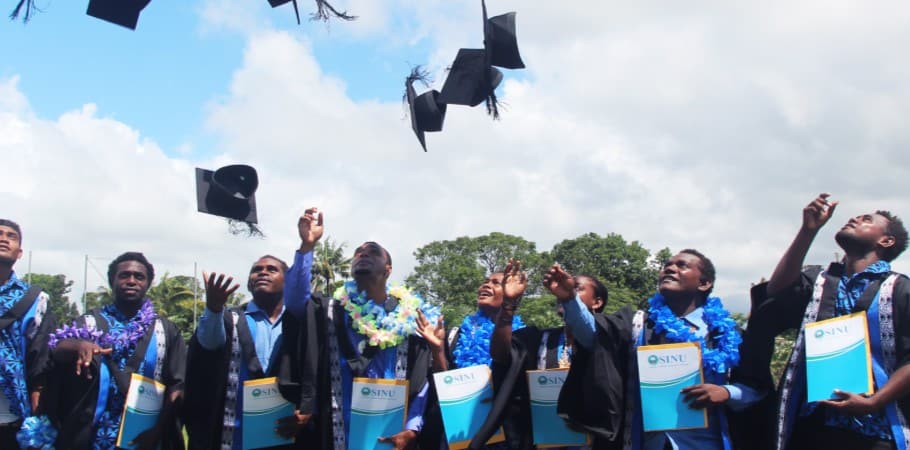
THE Solomon Islands National University (SINU) has decided to carve a niche for itself as a cornerstone of the nation’s higher education system and a catalyst for national development.
Ten years after taking on university status, the institution is a story of vision, resilience, and transformation.
Vice-Chancellor Dr Transform Aqorau said SINU was “laying the foundation for a university that belongs to the people, serves the nation, and aspires to global standards while remaining rooted in Solomon Islands values.”
The university was established in 2012 through an Act of Parliament, amalgamating the Solomon Islands College of Higher Education (SICHE) and other training institutions. It was a bold step toward self-reliance, reflecting a national desire to educate young people on home soil.
“Integrating diverse faculties, building robust governance, and aligning academic standards required determination and unity,” Aqorau said. “But those struggles helped forge a sense of mission and commitment.”
Over the past three years, SINU has undergone sweeping reforms, leading with strengthened governance. Respected professionals were recruited from outside SINU to re-energise its leadership and raise institutional credibility. Aqorau joined the university after an illustrious career at the head of the Parties to the Nauru Agreement (PNA), one of the region’s largest fisheries agencies.
“We made it a priority to fill every Council position and ensure every committee became fully operational,” Aqorau said.
For the first time, students have been invited to serve on academic boards, while proposals are now before the Minister for Education to bring in representatives from overseas universities to the Council. “It’s all about bringing in fresh perspectives and holding ourselves to a higher standard,” he added.
Financial management—once a significant weakness— has been transformed. With support from the Australian Government, SINU modernised its financial systems, cleared audit backlogs, and now operates with complete transparency.
“Our financial accounts are now up to date. We are ready for independent audits – a major achievement, considering the backlog we faced just a few years ago,” Aqorau said. New policies, including a private-public partnership framework, have positioned the university to attract investment and forge strategic partnerships for long-term sustainability.
Academic quality has also been at the heart of SINU’s transformation. The university is on the verge of full accreditation with the Solomon Islands Tertiary Education and Skills Authority (SITESA), and programmes are now benchmarked to international standards.
“We have reviewed and updated all our academic policies, thanks in part to support from Australian academic volunteers,” Aqorau said.
The university introduced new curricula, expanded research capacity, and launched postgraduate studies, raising local and overseas confidence in the value of a SINU education. A flagship initiative is the Centre for Island Futures (CIF), which was launched last year. The centre draws on ancestral wisdom, promotes community-based research, and is attracting international academic partnerships.
“CIF represents our ambition, not just to keep up with the world, but to lead in indigenous knowledge and sustainability,” Aqorau said.
It is a path taken by the Fiji National University and the Pasifika Communities University – embracing local knowledge and wisdom as equal to or better than Western philosophy and education systems.
For SINU, the journey remains challenging, particularly around upgrading facilities and making university education more affordable. But Aqorau remains undeterred.
“SINU is no longer just a university; it’s an incubator of change. Our goal is to be uniquely Solomon Islands in character while maintaining world-class quality. We aim to offer education that is both relevant locally and valued globally,” he said.
“The progress at SINU belongs to all of us. Together, we are building an institution that will serve our people for generations to come.”