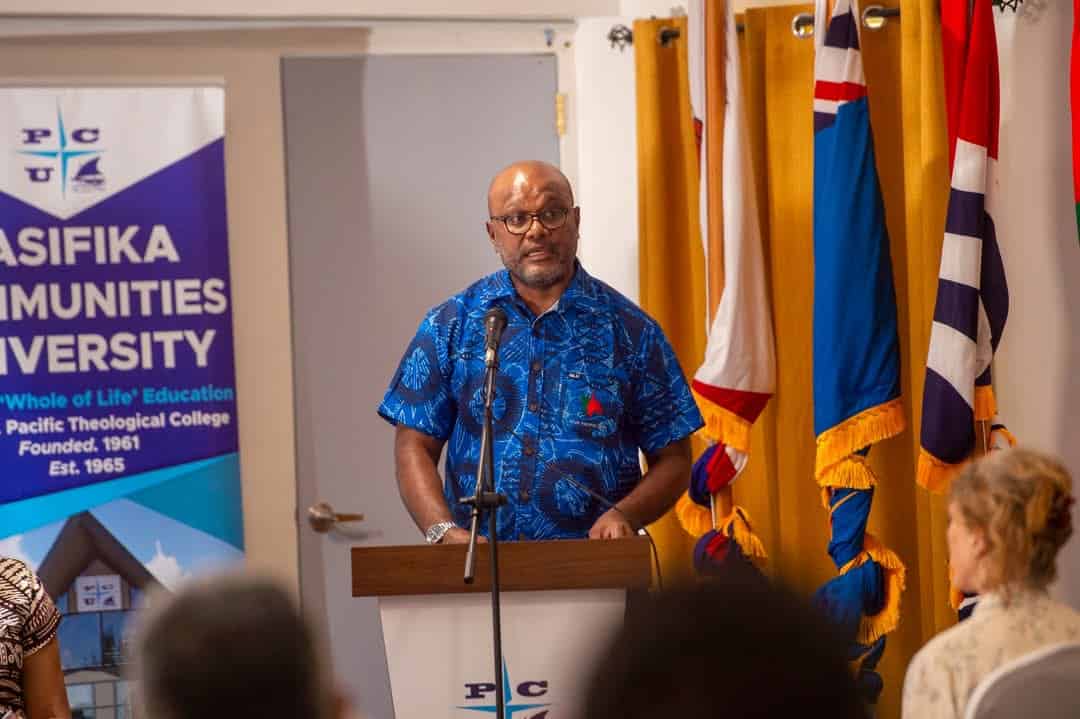
With eyes fixed on the past, the region’s newest university is intent on changing the people of Pasifika.
At is inaugural graduation, the Pasifika Communities University (PCU) saw 168 students receive certificates, diplomas, postgraduate qualifications, master’s degrees, and doctorates.
But while this tiny institution is the newest tertiary educator in the region, its predecessor—the Pacific Theological College—predates the University of the South Pacific by three years.
The PCU has decided that it will take small steps.
“We don’t need to be a rich university to make an impac; we just need to take one step at a time, focusing on good governance and leadership,” the Manu Folau, Reverend Dr Upolu Vaai, told graduands.
Manu Folau is what other universities call the Vice Chancellor.
At the PCU, students are toloa; institutes are bilum – terms taken from the many languages of the region.
The institution has been mandated by church leaders to take a unique approach to education and break the Western mould used since the arrival of the first settler schools.
“The uniqueness of this university is its Whole of Life vision and its commitment to our Pasifika ways of being and knowing expressed in our philosophies, ethics, and values,” Vaai said.
That means oral history and philosophy, often given little recognition or credibility in academia, will receive greater recognition.
Tuvalu student historian, Reverend Ulafale Vaitusi said acceptance of oral history was an integral part of Pasifika learning and identity.
“We appreciate the work done by the missionaries to record our history,” Vaitusi said. “But we must ask – did they capture our stories correctly? What stories did they not tell? Can our history be written from our perspective?” These questions are at the core of the PCU approach to learning.
An equally important focus of the university is restraint. Vaai warned the graduates about being egoistic and proud, pointing them to the wisdom of Pacific elders. “While we claim to have knowledge through achieving a degree or certificate that you deserve, I want to invite you to the idea that knowledge is paradox,” Vaai said.
“The more one knows, the more one must delve deeper into restraint to control the ego. “The reason for restraint is that what inspires us to do the greatest good, also inspires us to do the greatest evil.”
Vaai described restraint as the wisdom to pause, to slow down, to silence. “God created us within the structure of mutual contradiction,” he said.
“That is, we are meant to know both how to speak and how to be silent, how to work and how to cease, how to expand and how to contract, how to live and how to die.
“This is the ‘Whole of Life’ vision. In today’s fast-paced world, with the erosion of values, we are taught to talk everytime, to expand constantly, to develop continuously. We no longer have the wisdom to be in silence, to listen, to contract, to slow down. Our fast-paced culture continues to feed the engine of the ego. The crisis today is not so much the lack of creativity, but rather the lack of the wisdom of restraint to
control the fire of the ego that comes with creativity.
“Silence is not the opposite of knowledge. Rather, silence is the womb in which knowledge is birthed. Silence is divine. It is in the life of God. You will find that love is more authentic in moments of restraint than in moments of creativity. Restraint is a product of age. Everything, from forgiveness, righteousness, salvation, patience, are all connected to restraint. None of this work unless we have the ability to control our ego.”
The PCU sets forth on its second year with 160 students on a journey of discovery and rediscovery. In the words of one student, this will be as much about learning for the future as it is about unlearning some of the past.