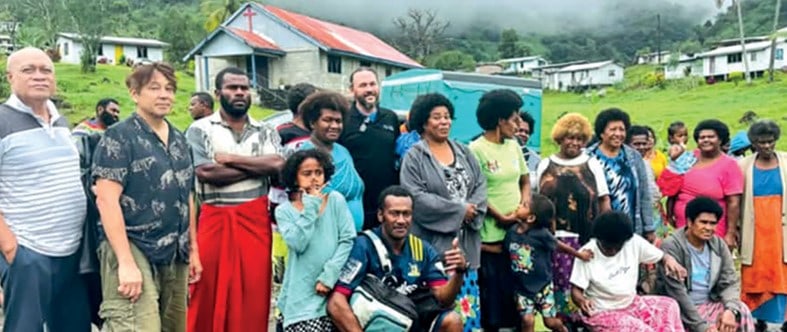
On a bush track in the interior of Fiji’s mani island, Viti Levu, three weary colleagues trudge toward a village, barely visible through the mist.
The team from the Regional Institute for Leadership Development is on a mission to change the way education is delivered in communities. This is the heart of community-based education.
In Vanuatu, Solomon Islands, and Kiribati, institutes of the Pacific Theological College (PTC) have spent four years perfecting teaching methodologies, training needs assessments, research, and consultation.
The evidence is clear. Pacific Island communities want to enter into learning experiences at credible institutions, but they also have much to share to the existing body of knowledge in and about the region.
At the same time, there are opportunities for universities—students and faculty members—to learn the ancient philosophies and wisdom which have guided indigenous communities for centuries, helping them preserve forests, fishing grounds, and navigation methods.
Reverend Dr Tafue Lusama, a Tuvaluan, is head of the PTC’s Institute for Climate Indigenous Knowledge and an advocate for the fight against climate change. He has spoken at several international conferences about the threat of rising sea levels on low-lying island countries.
“Traditional knowledge is often disregarded when it comes to conflict solutions and development in the Pacific,’’ Lusama said. His statement is based on the blatant disregard global audiences have had for messages from people who live on the coal face of climate change. Even the World Council of Churches general assembly in Busan, South Korea, has done little to rally the support of its members to help Tuvalu.
This is despite Lusama’s impassioned plea on behalf of Tuvalu. To counter the lack of attention from the global audience and acknowledging that Western-based education systems do not cater for the needs of Pasifika, the PTC has designed what it terms a whole-of-life learning experience.
“We want to provide for the Pacific churches and the region, an integrated tertiary theological education for leadership that is prophetic and justice-driven, missiological, academic, and socially contextual,’’ said PTC Principal, Reverend Professor Dr Upolu Luma Vaai.
“It is important that Pasifika education respects and celebrates ecumenical and cultural diversity, which is relevant to regional stability, and that is informed by life-affirming Pacific values and insights in an ever-changing environment.’’
The PTC will continue to deliver courses at its Veiuto Campus in Suva, Fiji, and through an upgraded distance and flexible learning by extension component. But it will also deliver tailor-made classes at certificate and diploma level into the community.
Those classes will draw from indigenous knowledge of the environment, philosophies on leadership, mentoring, and governance, as well as the more common mode of classroom and textbook learning.
Students will take a more critical view of established texts and open to oral history and knowledge as the PTC moves to preserve the heart of Pasifika consciousness.
“We seek to offer a deeper, more holistic, balance, inclusive, communities-based, forward-looking, and discourse-changing educational scholarship that offers an authentic and visionary pathway to a transformative and liberating vision of society,’’ Vaai said.
“It also aims to offer a new development paradigm informed by faith and indigenous knowledge to strengthen the Pasifika region’s social, economic, and political security.’’
In time, the PTC will fulfil the necessary requirements to become a university. The process for transition to university has started with the necessary applications made to Fiji’s education authorities.
Vaai says it is about coming down from the high horse of privilege, taking a walk alongside the struggling communities and looking at things from the perspective of those who struggle in the dirt.
The authors critically examine societal frameworks influenced by Western philosophical traditions, questioning their relevance and purpose in contemporary Pasifika societies.
Vaai emphasized the need to revitalise these philosophies and theologies to promote sustainable development in communities. He also stressed the importance of understanding household findings to ensure inclusive and effective policies.