A major new report on the consequences of French nuclear testing in Mā’ohi Nui (French Polynesia) has been released by a parliamentary commission of inquiry in Paris.
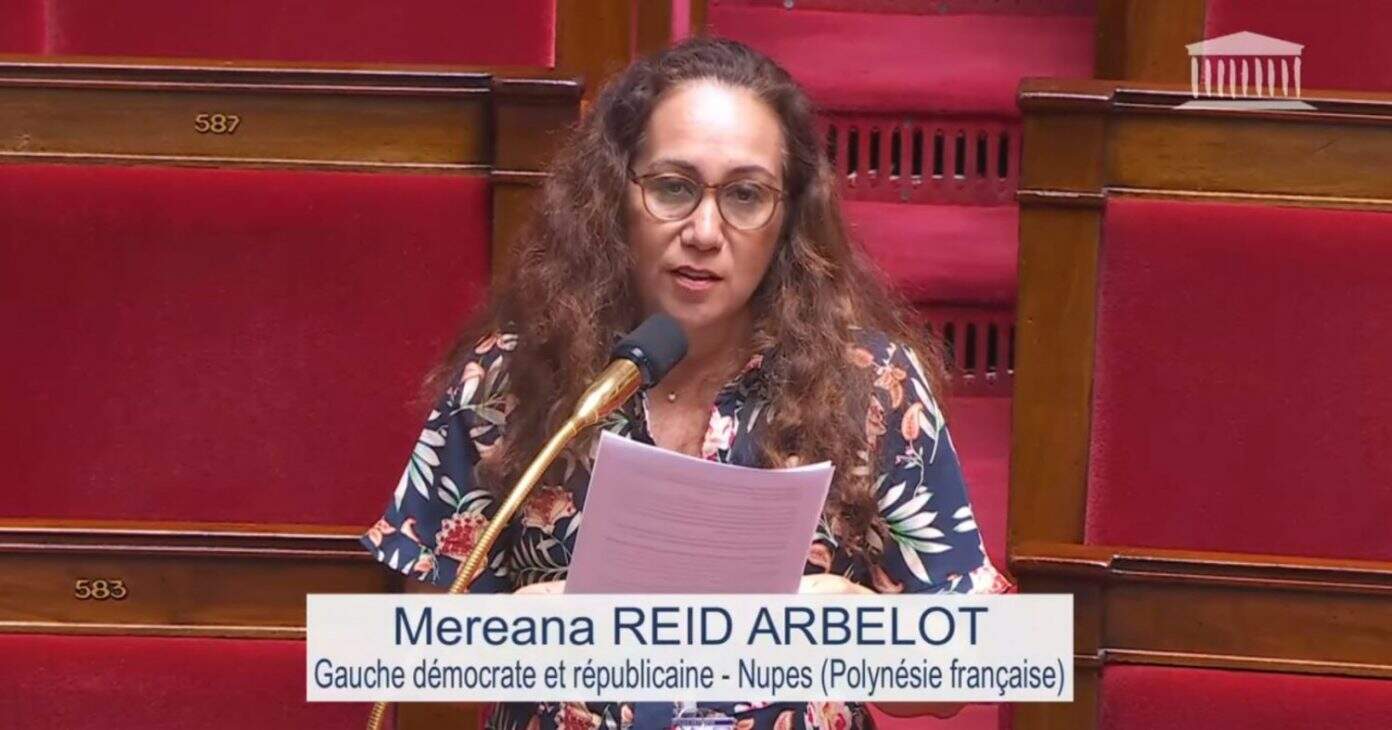
The French National Assembly investigation was led by Mereana Reid-Arbelot, a deputy for French Polynesia from the pro-independence party Tavini Huira’atira.
The 730-page report includes 45 recommendations, calling on the French government to address the economic, health, environmental, and cultural legacies of 193 nuclear tests conducted between 1966 and
1996 at Moruroa and Fangataufa atolls.
The report recommends assessment of the economic costs and benefits of activities by the South Pacific testing site, the center d’expérimentation du Pacifique (CEP). It also calls for the release- to the public- of data from all meteorological and radiation measurement stations in French Polynesia from 1966 to 1996.
The parliamentary commission stresses that “what we are asking for is transparency, in order to rebuild trust between those who made the decisions and carried out the operations, and those who suffered the consequences.”
Law reform
A key recommendation in the report is to reform the 2010 Morin Law, which created CIVEN, a French compensation commission for survivors affected by radiation exposure during the tests.
In the first five years of CIVEN’s operation, only 2% of applications were approved. Since reforms in 2017, only 1026 affected people have received compensation, despite high levels of thyroid cancer, and evidence of birth defects and other illnesses.
One constraint on easier access to compensation is a December 2018 amendment to the Morin Law, which sets an annual radiation dose of at least one millisievert as a measure for making a valid claim.
While this is a low threshold, it requires applicants to prove their level of exposure – a difficult task when the French government still restricts access to crucial radiation data under national security laws.
In response, the new report calls for changes to the Morin Law to “eliminate the requirement concerning the millisievert threshold.” The parliamentary commission “requests the removal of this threshold and to base any compensation decision on the strict adherence to the cumulative criteria of time, place, and pathology that would allow for the determination of a presumption of exposure to nuclear tests.”
After the report’s launch, Reid-Arbelot told journalists in Tahiti: “This threshold is presented as a scientific guarantee, but it is nothing of the sort. The experts interviewed were almost unanimous; there is no exposure threshold below which the risk would be zero. In reality, this threshold is merely an administrative tool, used to classify files – one pile for ‘victims’, one pile for ‘non-victims.’”
The commission also notes the long-lasting effects of exposure and calls on the French government to
“Conduct research on the existence of transgenerational effects of exposure to ionising radiation.”
Apology
For nearly three decades since the end of testing in 1996, Mā’ohi leaders have been calling for an apology from France for the lies told during thirty years of nuclear testing, and the health, environmental, and cultural legacies of the tests.
In November 2018, the then-President of French Polynesia Edouard Fritch told the Assembly of French Polynesia: “For thirty years, we lied to the people that the tests were clean. We lied. I was part of this gang. Why did we lie when our own leader saw a bomb go off? When you see an atomic bomb go
off, I think you realise that it can’t help but hurt.”
Today, Reid-Arbelot says “it is not about asking for symbolic apologies but about proposing a different path. You may know that since 1996, we have had four French presidents who have never even uttered the word ‘apology’, whether sincerely or not.
“Following the failed nuclear tests like Aldebaran or Centaur, the heads of the CEP shut themselves off in a denial of reality, maintaining an obstinate silence to minimise or even reject the evidence,” she said.
“The inaction of the authorities was always tinged with this ‘culture of secrecy’ that characterised their choices before and after the tests, leaving the Polynesian population in complete ignorance about the radioactive risks to which they are exposed.”
For years, the association Moruroa e Tatou has supported thousands of Mā’ohi workers who staffed the nuclear test sites over three decades. But as this cohort of workers ages and dies, Reid-Arbelot argues that it is important to educate a new generation about the legacies of the nuclear era and the islands’ history of resistance to nuclear weapons.
“Transmitting our nuclear history is one of the most important aspects for me,” she said. “It must be taught to our children, here in French Polynesia, but also in mainland France. This history is not only Polynesian; it is also French. It must be included in textbooks, everywhere across the territory.”