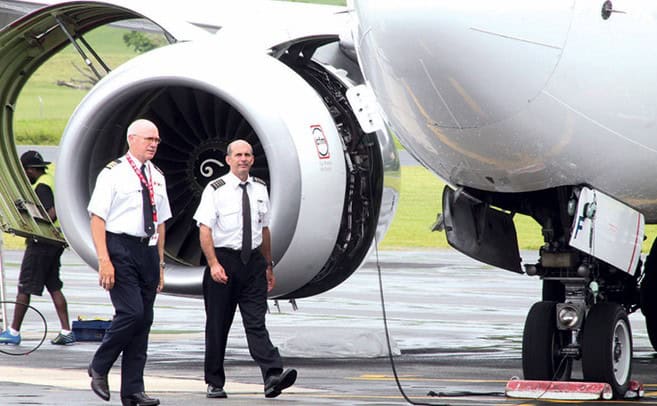
Expanded training will be the backbone of plans to strengthen regional aviation over the next five
years.
The Association of South Pacific Airlines (ASPA) has laid out an ambitious roadmap for collaboration
and support for its initiatives ahead of its regional conference in Honiara, Solomon Islands this month.
ASPA’s Acting Chairman, Ewan Smith, told Islands Business one of the Association’s key priorities
was to improve airline safety and operational standards.
“We’ll be facilitating and providing airline-specific training through IATA and creating a pool of subject matter experts drawn from the airline members to help an airline prepare for IOSA and assist in addressing IOSA Audit Findings,” Smith said.
He also noted the importance of collaboration among airlines, especially in safety oversight. “We are sharing internal safety audits of common contracted service providers – ground handling in Brisbane,
flight simulators, fuel providers, cargo agents, and MROs,” he said.
To further this collaboration, ASPA will continue to host two conferences per year. “These events allow members and industry service partners to come together, share experiences, learn, and network at
the one location,” said Smith.
Despite these initiatives, Smith acknowledged that Pacific aviation faces significant problems. “Access to funding is a major issue, to enable purchase of modern, fuel-efficient aircraft and spares,” he said.
In addition, “there is competition for competent, qualified, experienced personnel covering flight operations, maintenance, and safety management.”
However, infrastructure remains a major barrier to development and expansion of the aviation industry.
“Airports, roads, internet connectivity—many of them supporting aviation—are poor, and some runways are still unsealed,” he said.
Another challenge is regional connectivity, which Smith said is more political than commercial.
“For the most part, trade between island states is minimal. The political aspirations for increased connectivity do not align with the commercial reality,” he said.
In efforts to improve access in the Northern Pacific, Smith said there have been attempts to subsidize flights.
“Through DFAT funding, there are subsidized flights to connect the Northern Pacific via Nauru to Brisbane. However, demand from Australia is not strong enough to sustain this,” he said.
He added that “the main tourism market for the Northern Pacific is China, but with current geopolitical tensions, this market has essentially dried up.”
When asked what the region must do to boost tourism, Smith was clear: “Offer unique experiences that tourists want and are willing to pay for.”
Sustainability is still a big challenge for Pacific airlines, and Smith was clear about the challenges of transitioning to greener fuels.
“This may be possible, but the costs for hybrid or alternative fuels are four to five times higher than for Jet
A1,” he said.
“The Pacific region is far from major suppliers, so there will be supply chain issues. “At this stage, even larger airlines in developed countries are struggling with any realistic plan to achieve emission targets,” he added.
ASPA remains focused on driving regional collaboration and building a safer, more connected aviation future for the Pacific.