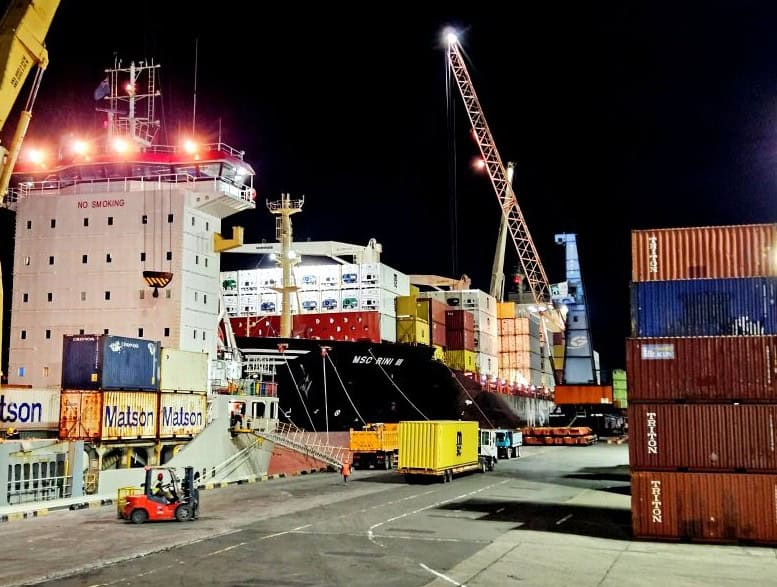
WITH decades of expertise, Shipping Services Fiji has adeptly navigated the evolving Fijian shipping landscape to meet the challenges of global trade.
The company was established in 1992 to function as an agent for international shipping lines; its first principal was a British company called Blue Star Line, which had a long legacy of servicing Fiji and the Pacific, and connecting us to Australia, New Zealand, and the United States.
Over the years, Blue Star was acquired by the British Dutch partnership P&O Nedlloyd Lines; they, in turn, were acquired by the Danish mega shipping line, Maersk, in 2005.
With Fiji’s ports undergoing modernisation and facing growing traffic, Shipping Services Fiji leverage its deep local knowledge to maintain its reputation for on-time and efficient service.
Shipping Services Fiji Managing Director Bernard Hong-Tiy said the company, along with the Fiji Ship Owners and Agents Association (FSOAA) and independently, regularly discuss operational constraints and opportunities with Fiji Ports.
“Issues like container congestion on the port itself and congestion in the harbour with vessel traffic are common to all members of the FSOAA,” he said.
“We gladly make ourselves available to share our views on these matters with the port companies, the government, MSAF, and, importantly, international bodies like the ADB or World Bank when they seek input from us as port users.”
Hong-Tiy outlined the process for ensuring the safe andtimely delivery of critical provisions, such as fresh food and water, to vessels.
“Well in advance of vessel arrival, we require detailed information from the master or operational management of the vessel regarding what they need.
“Whether it be fuel, water or provisions to, or heavy diesel sludge and garbage disposal, we work with the local providers of these services to ensure service or goods are delivered as and when required.
“This is the same for the management and liaison for the movement of ship crews through Fiji,” he said.
Impact and community
Shipping Services Fiji plays a vital role in supporting the economic well-being of local communities by facilitating the export of essential goods like fish, timber, and agricultural crops.
As a licensed shipping agent that is entirely locally owned, they provide crucial services that allow Fijian farmers and exporters to reach international markets.
A significant portion of the revenue earned stays within Fiji, as the company prioritise paying their staff and sourcing services from local providers.
Hong-Tiy said these filters through to local communities, and as a policy, they support an aged care facility in Fiji.
“We contribute to an organisation that cares for children with special needs and provide storage and local
logistics services for registered charities.”
Beyond commercial operations, the company also contributed to a national crisis operation by providing logistical support for relief efforts.
During cyclones and floods, the company assisted with sea and land transportation of relief items and foodstuffs and provide containers for the storage of relief and food to support DISMAC, the Red Cross, and other registered charities.
Into the future
As a 100% locally owned company, Shipping Services Fiji has happily assisted many start-ups with advice on the import and export process—critically, the customs aspect of international shipping—as well as general guidance on the importance for prospective exporters or importers to have a reputable partner at the other end of the chain.
Looking to the future, Shipping Services Fiji is preparing for the growing focus on sustainable shipping practices and “green ports” in the maritime industry.
“The environmental policies and procedures of our principals guide us. They, in turn, work internationally to conform to the policy laid out by the International Maritime Organisation (IMO) and foreign governments,” Hong-Tiy said.
“Many ships will switch from using heavy diesel oil to a lower-carbon output biofuel hybrid before entering the economic zone of the United States.
“On a local level, most, if not all, of our newer vehicles and trucks use Adblue, which reduces the carbon emissions of our operational vehicles.
“We use less paper in our offices, and we are considering purchasing electric-powered forklifts for our freight stations,” he said.