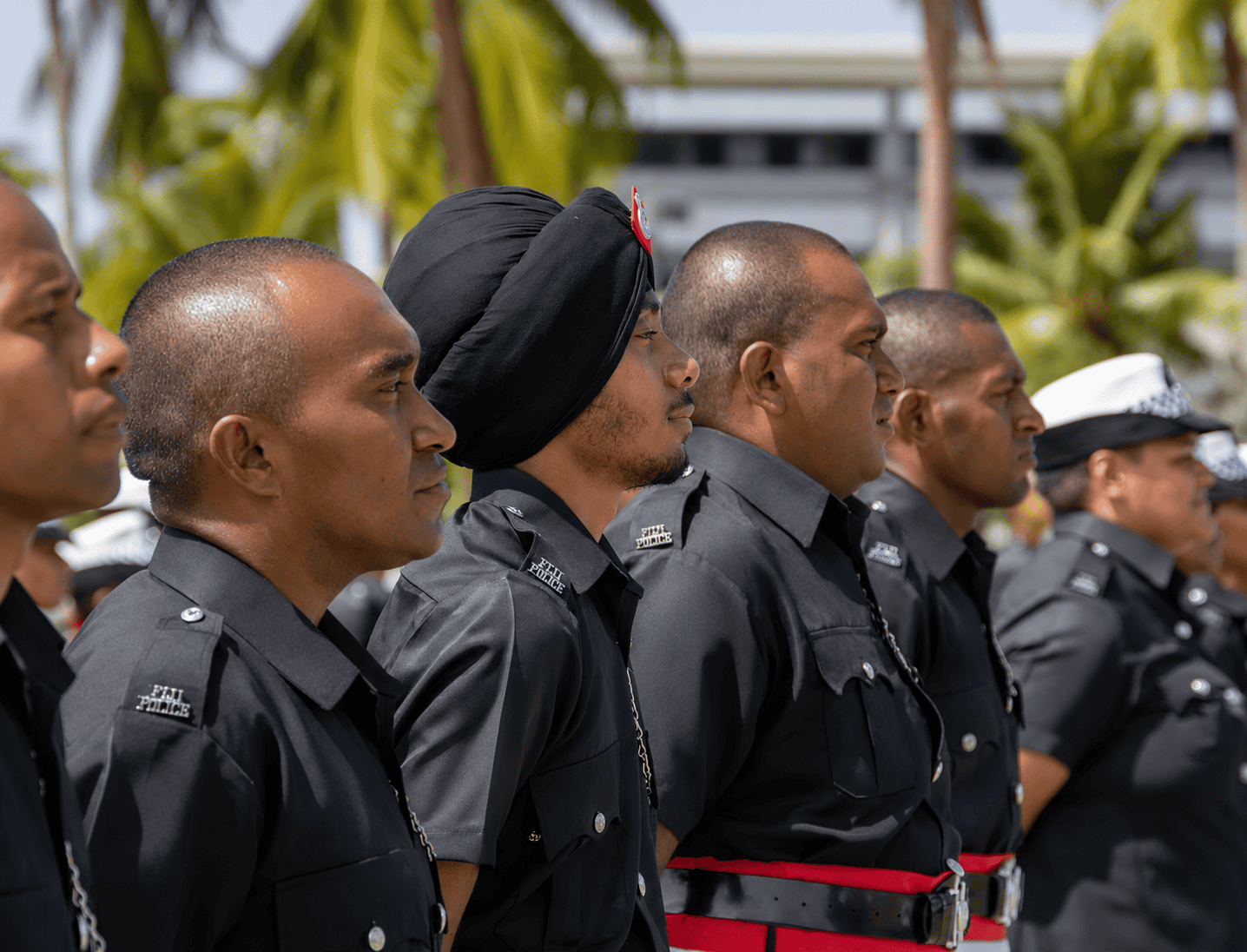
AT the end of a shift in Fiji, the police badge may come off, but the work often does not.
It follows officers home in the body: in the tight jaw, the racing pulse, the sleepless hours, the stomach that turns, the head that throbs, the mind that will not let a scene go.
For some, it sits at the dinner table. For others, it stands between them and their families. For many, it arrives long before the next callout. And the real question is no longer how much pressure police can absorb, but how much pressure a health system built around policing can survive.
That is the unsettling human centre of Impacts of Everyday Policing on Police Officers’ Psychological, Emotional, and Physical Well-being in Fiji, a study by Soropepeli Ramacake,
Social Work Assistant Lecturer at the University of the South Pacific, with co-author Julian Lawakeli.
The study strips away the usual idea that trauma belongs only to the dramatic incident, the extraordinary night, the headlinegrabbing tragedy. In this force, trauma is ordinary. It is built into the rhythm of work.
In an interview with Islands Business, Ramacake said “the sheer prevalence of traumatic exposure” was the most striking finding.
Ninety-two per cent of respondents reported traumatic incidents, and 84 per cent said those incidents had negatively affected them.
The numbers are severe, but the texture of the responses gives them weight. Officers were not describing a rare disaster. They were describing a working life in which domestic violence, suicide, sexual abuse, community violence and fatal accidents are regular features of the day.
The study becomes even harder to ignore when it shows that the damage is not only outside the institution. Officers reported bullying, discrimination, stand-over tactics, sexual harassment and racial abuse within the workplace itself.
Ramacake calls this “the layering of external operational trauma onto internal organisational harm,” and says it creates “a particularly damaging environment.”
Trauma built into the job
In one of the study’s most pointed observations, the workplace itself, in some cases, “was a source of the very trauma officers were expected to manage.” That is the cruellest kind of contradiction: the place meant to contain harm becomes one of its producers.
Of the three dimensions Ramacake examined, the psychological appeared most damaging. That is not because it was the loudest; it was because it was the most hidden.
“The psychological dimension appeared most damaging, largely because it is the least visible and the most stigmatised.”
Officers spoke of disturbed sleep, recurring nightmares, intrusive memories, depression, anxiety and despair.
One respondent said a traumatic scene stayed with them for days. Another said they could not sleep for two consecutive nights.
These are the sorts of injuries that do not always announce themselves in public, but they shape the hours after work, and then the hours after that.
The body kept score too. Fatigue, high blood pressure, gastritis, migraines, and coping through alcohol, kava and smoking surfaced as part of the same picture.
But Ramacake’s point is that these physical and emotional strains are often downstream effects of psychological injury left to ferment in silence.
The mind, in this study, is not an abstract category. It is the starting point of a chain reaction.
When the job follows officers home
That chain reaches into the home. Nearly half of the respondents (49 per cent) said they struggled to balance work and family time, and two-thirds said policing had negatively affected personal relationships.
Officers described becoming emotionally hardened at home, withdrawing from intimacy, arguing more often and, in some cases, facing accusations from spouses. Ramacake is direct about what this means: “Family strain is not a footnote to this crisis – it is one of its central mechanisms.”
In a Pacific context, where family is not a separate sphere but a core measure of identity and wellbeing, that strain lands with force.
The study argues that the force has crossed a threshold. This is no longer simply about stress, burnout or the demands
of a hard job. Ramacake says that when 92 per cent report traumatic exposure, 84 per cent report negative impacts, and over half have never sought any help, “this is no longer a matter of individual resilience. It is a systemic public health condition.”
The phrase matters. It shifts the burden away from the officer alone and places it where the evidence belongs: on the
institution, its culture, and its structures.
Policy on paper, pain in practice
That institutional gap shows up most clearly in the distance between policy and practice. The Fiji Police Force adopted a National Wellness Policy in 2013 and has run wellbeing initiatives over the last decade.
Yet 32 per cent of officers surveyed did not know such a policy existed. More telling still, 66 per cent said officer wellbeing was never prioritised within the force.
Ramacake’s reading is unsparing: officers believe what they live, not what they are told. If the roster is punishing, the support invisible, the trauma unacknowledged and the stigma intact, then the real policy is the one written in daily experience.
Stigma, in this account, is not an atmosphere. It is a barrier with consequences. Sixty per cent of respondents said stigma around help-seeking exists within the force.
Ramacake says the biggest fear is not simply embarrassment, but career damage – the possibility that asking for support will be read as weakness and punished with reassignment, reduced prospects, or ostracism.
That fear can make support feel “career-destroying.” To break it, he says, leadership must model help-seeking openly, and confidentiality must be real, not ceremonial.
The single most important change, he argues, would be structural: mandatory, confidential, non-punitive psychological debriefing after critical incidents. Not something officers must chase. Not something left to personality or luck.
A system needs regular and consistently meaningful debriefing after each traumatic experience, and police supervisors need to be trained in clinical supervision to support their police officers, unpack potential psychological or emotional experiences, so that they are not carrying it with them needlessly.
Officers involved in incidents such as fatalities, suicides, sexual abuse cases or serious assaults should receive a structured debrief within 48 to 72 hours, led by a trained professional outside the direct chain of command.
It would normalise care, catch trauma before it hardens into chronic harm, and signal that psychological safety matters as much as physical safety.
Still, Ramacake does not present this study as a conclusive conclusion. It is a beginning. He says a follow-up qualitative study using the Talanoa approach would allow officers to speak in a culturally grounded and relationally safe way.
And he argues the force should not wait for a complete strategy before acting; counsellors in every division, wellbeing reporting, supervisor training, and peer support network could begin now.
The deepest force of the study is not in its statistics alone. Still, in the portrait they form: women and men trying to remain composed while absorbing other people’s worst days, then carrying the residue home, where it changes how they sleep, how they love, how they speak, and sometimes how they hope.
In the end, the study shows that the emotional cost of policing does not stop at the station gate. It walks out with the officers, rides home with them and asks for something in return every night they cannot rest.