THERE is a weather station on Tofua, an active volcanic island in Tonga’s Ha’apai group, and getting there is a small expedition. You take a boat. Then you take another boat, and sometimes you wait days for the weather to let you onto the island. When that station stops transmitting, it is not easy to fix.
“It’s not like the equipment breaks down today, you get into your car, start it, and you drive on the road to get it fixed,” Tonga’s Director of Meteorology, Laitia Fifita, said. “You have to go by boat, island hopping and do another small boat, and it costs all those logistics, fuel costing. That is the unseen or untold challenge about missing data.”
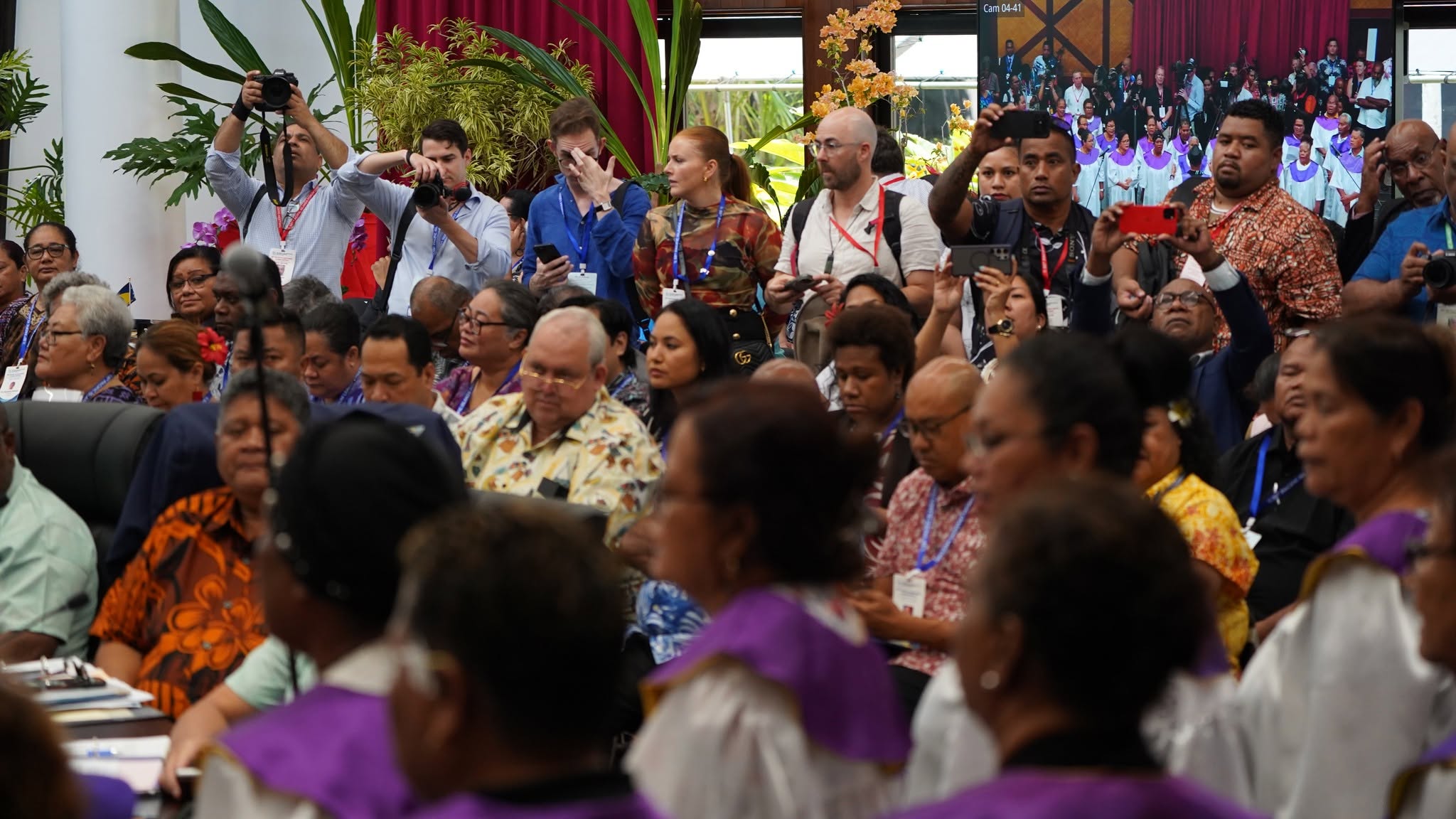
Multiply Tofua across the Pacific and several thousand kilometres of ocean and you have the quiet crisis that was discussed in almost every session of the 8th Pacific Meteorological Council in Nuku’alofa last week.
Climate change in the Pacific is not in doubt. Whether the region can prove what it is doing to us is. A paper tabled at the meeting, citing the Australian Bureau of Meteorology, said the Pacific has lost one long-term dataset every two years, and the trend has been downward since 1980. Weather Ready Pacific estimates that $USD15–20 million of investment in climate monitoring is lost every year because stations and equipment are not maintained. Maintenance can account for up to 70 per cent of an asset’s full life-cycle cost. It is almost never funded.
Stations that are there, and data that isn’t “We still have the observation stations,” said Salesa Nihmei, Director of Climate Science and Information with the Secretariat of the Pacific Regional Environment Programme (SPREP). “But the credibility of those stations…some stations are there but because they are not maintained, we lose data.
By the time we bring them up online, we cannot use the data anymore, because there are a lot of gaps in those datasets. Those stations cannot be used for any long-term analysis because the integrity of the data that they collect is questioned.”
SPREP is now assessing 700 observation stations across the region to work out what can be salvaged. Elsewhere, the problem is the opposite. Some islands and atolls never had enough stations to begin with.
For 28 years, Niue’s weather and climate record rested on one automatic station at Hanan Airport, installed in 1996. Two more went up in the last few years, on the eastern and northern sides of the island. “We relied so much on just one reference station and we assumed that everything was the same anyway,” Niue’s Director of Meteorology, Rossy Mitiepo, told the Council. “But it wasn’t.”
They found a significant temperature difference between villages on an island around which you can drive in an hour. Palau’s version of the problem is a boat timetable. A station it is required to run under its international observation commitments sits on the far south-east of the archipelago, two and a half days by boat from Koror, each way.
Papua New Guinea, with some of the most complex terrain in the Pacific, has two functioning automatic weather stations and about a thousand rainfall gauges it is trying to replace.
Where the money isn’t Funding is the constraint in every weather office in the region. Between 70 and 80 per cent of their budgets go to salaries. Half of the 20 to 30 per cent left goes to operational costs.
“Very little is used to maintain stations,” Nihmei said. “And this is why this issue is coming up.” Then there is getting hold of the
equipment at all.
Vanuatu’s Director of Meteorology and the outgoing chair of the council, Levu Antfalo, said he waited six months for equipment for upper-air observations. “These are not produced in our region. They’re produced on the other side of the world,” he said. “It might change ships four, five, six times to get to our country and on top of that, there are logistics challenges, and Customs have their own rules.”
The meeting, which ended on Monday, put several funding options on the table. Weather Ready Pacific, the region’s 10-year programme for weather and early warning services and the channel through which World Bank and Green Climate Fund money will reach the Pacific, tabled a paper on a maintenance facility, a shared service to repair equipment countries cannot fix on their own.
Without it, the paper warns, the region will keep “building, under maintaining and rebuilding” the same infrastructure. The plan is to raise a fund once, leave the money invested, and spend only what it earns each year.
The Pacific Resilience Facility, owned by Pacific governments, has been asked to manage such a fund. Its own target was cut from $USD1.5 billion to $USD500 million after COVID-19, “not because our needs were less,” its General Manager Finau Soqo said, “but because of the funding environment at the time.”
Conservatively, she estimated, $USD500 million invested earns about $USD25 million a year for the whole region. The Systematic Observations Financing Facility, a global fund that has approved $USD33.4 million for Pacific surface observations, will also deliver its programme through Weather Ready Pacific.
But when delegates asked when the maintenance facility would be ready, the answer was another seven years. In between those timelines, there is a harder date.
The Climate and Oceans Support Programme in the Pacific, which has run since the 1980s, ends on June 30, 2027. About 90 per cent of the climate and ocean products Pacific met services use such as tide gauges, sea-level monitoring, coastal inundation models, tide calendars, even the survey benchmarks that make tide-gauge data mean anything on the ground, are supported by the programme.
At least eight countries spelled out what its loss would mean for them. Australia’s Bureau of Meteorology representative, Dr Stuart Minchin, acknowledged “the uncertainty and anxiety”, pointed members towards a Pacific-led design process and promised to clarify arrangements “as soon as we can”.
No commitment was given.
Where the risk is, where it isn’t Not all of the Pacific’s climate evidence is in danger. The headline measurements are safe because they are taken from space rather than from the ground. Sea-level rise in the western tropical Pacific is measured by satellite. Ocean heat comes from robotic floats drifting in the sea. The record extent of marine heatwaves in 2024 was also measured from orbit. A
corroded wind gauge on an outer island affects none of it.
What is at risk is everything measured at national level and below like rainfall trends for a single island, drought indicators or the calculation of how often an extreme rainfall event can be expected. It is also the baseline a government needs to show that what happened to it was not simply bad luck.
The IPCC says the same thing in its own words. Its Sixth Assessment notes that “constructing climate information for Small Islands is challenging due to lack of observations and high-resolution climate projections”. Its confidence in Pacific rainfall change is medium. Its confidence in temperature and sea-level rise is high because those are the ones satellites measure.
It is also why the enthusiasm for artificial intelligence at the meeting came with a warning attached. Tuvalu is running an AI forecasting tool at two-kilometre resolution that can finally see islands global models treat as open ocean, and Vanuatu, the Marshall Islands and the Federated States of Micronesia are deploying similar tools.
“AI is absolutely dependent on data,” said Dr Andrew Tupper, the World Meteorological Organization’s Chief of Early Warning Services. “AI is not discerning. AI does not have a good record of working out when data is junk or not.” Garbage in, garbage out, he told the Council, has not changed in all the decades of computing.