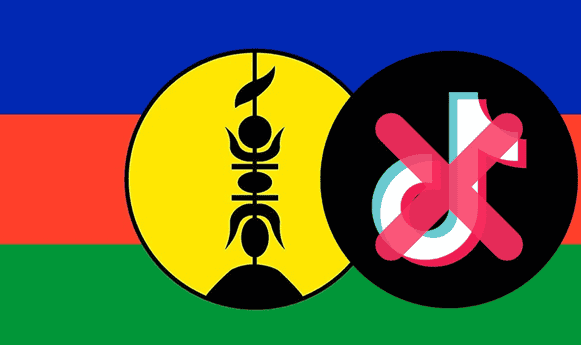
A ruling from France’s highest administrative court, the Conseil d’État, has criticised former Prime Minister Gabriel Attal’s temporary ban on TikTok in New Caledonia.
The court ruled that Attal’s May 2024 decision to restrict use of the popular social media app in New Caledonia failed to follow proper procedure. It declared that “the decision to suspend the social network represented a disproportionate infringement of the rights and freedoms of expression and communication.”
Debate around the banning of TikTok in New Caledonia echo similar arguments in other Pacific nations, such as Papua New Guinea, Fiji, and Tonga. Without a total ban, many Western governments have also placed some limits on the use of the app on government devices, fearing that TikTok’s Chinese parent company might access sensitive data.
When Pacific politicians have called for bans on Facebook, TikTok, Instagram or YouTube, they’ve highlighted the use of social media to share inappropriate material, from pornography to racist hate speech or misogyny against women and girls. Critics of such bans, however, note that social media
is often used to share accurate information about political corruption, nepotism or bad policy emanating from political leaders.
This tension between freedom of expression and social protection is overshadowed by deeper structural concerns, such as the way unaccountable corporate owners have distorted information flows. This is highlighted by Elon Musk’s US$44 billion purchase of Twitter (now rebranded X), which opened the way for more racist and white supremacist propaganda on the platform, in the guise of free speech.
Blocking TikTok in New Caledonia
TikTok is a social media platform for creating, sharing, and discovering short videos. It’s widely used across the globe, especially by young people, with the parent company ByteDance claiming more than 1.6 billion monthly active users worldwide (including 170 million monthly users in the United States). It’s estimated that 16,000 TikTok videos are uploaded every minute of the day.
France’s short-lived decision to ban TikTok in New Caledonia was taken by the Attal government in Paris, as riots erupted in Noumea on 13 May. As clashes spread between Kanak protesters and French security forces, Prime Minister Attal declared a state of emergency on 15 May. He also decided to restrict the use of TikTok, in an attempt to stop Kanak activists sharing online images (especially those ridiculing anti-independence Loyalist politicians or suggesting the “forces of order” were involved in killing young Kanak).
Independence supporters had quickly used a range of social media platforms to share images of the protests, including the construction of roadblocks in parts of New Caledonia’s capital.
One TikTok video “Playing cat and mouse” showed French gendarmes removing roadblocks on the highway from Noumea to the international airport at Tontouta, followed by images of Kanak activists rebuilding the roadblocks at the same location – all accompanied by jaunty music and sped up motion that made the French police look like clowns.
Other social media videos were shared with pictures of police forces deploying around the country, such as the arrival of French riot squads in Lifou in the outlying Loyalty Islands, even though the initial violence was centred in the capital.
France’s then-Overseas Minister Gérald Darmanin and Armed Forces Minister Sébastien Lecornu were also quick to allege that the TikTok ban was designed to limit foreign interference from China, Russia, and Azerbaijan. Criticising “foreign manipulation”, the French ministers blamed Azerbaijan and its Baku Initiative Group (BIG) for promoting anti-French propaganda and misinformation.
To justify the ban, a technical fact sheet was issued three days after the riots began by the French agency Viginum (a section of the General Secretariat for Defence and National Security that monitors disinformation and misinformation).
The document argued that “between 15-16 May 2024, Viginum detected on X and Facebook, the massive and coordinated dissemination of manifestly inaccurate or misleading content—photo or video montages—blaming France for its handling of the situation in New Caledonia in the context of the riots.” The factsheet, however, did not include any examples of misinformation on TikTok.
Media organisations around the world seized on the Baku connection, blaming the Aliev regime rather than President Macron’s policy for triggering the riots. However, at year’s end, the cyber agency Viginum issued another briefing paper that quietly acknowledged the lack of impact of alleged disinformation from Baku: “Despite its repeated and crude attempts to establish itself in the French-speaking digital
public debate, the BIG has not succeeded in obtaining the visibility probably expected among the populations targeted by its manoeuvres.”
Human rights responses
The May 2024 state of emergency and TikTok ban were short-lived, as human rights and media organisations mobilised against the overarching restriction of one social media platform. Critics noted that the restriction of TikTok in New Caledonia was the first time a social media network had been completely censored by a member state of the European Union, which routinely publicises its support for freedom of expression and freedom of the media.
On 18 May, Amnesty International issued a statement noting that “the state of emergency declared by the French government and the deployment of the French army, coupled with a ban on the social media app TikTok, must not be misused to restrict people’s human rights.”
French digital rights advocacy groups La Quadrature du Net said that the decision was “strongly criticised by the independence movement and human rights activists, but also within the governing majority. This is especially because targeting a single social network seems particularly ineffective. Moreover, no particular content was targeted or given as an example to justify such a decision.”
In Paris, La Quadrature du Net had quickly sought an interim injunction to lift the TikTok ban in New Caledonia. Before the court, French government lawyers tried to justify the ban based on a 1955 law introduced during France’s colonial war in Algeria, which states that “the Minister of the Interior may
take any measure to ensure the interruption of any online communication service to the public, provoking or glorifying acts of terrorism.”
During the hearing, officials from Prime Minister Attal’s office admitted that TikTok had been chosen above other social media platforms because “the profile of the rioters matched the profile of the users” – meaning that most protestors were young and indigenous Kanak.
TikTok management complained that the New Caledonia ban had been introduced “without any questions to the company, or requests for the removal of content by the local authorities or the French government.”
In late May 2024, the Conseil d’État declined to issue an interim injunction, as the state of emergency in New Caledonia was coming to an end. The French High Commission in Noumea announced that people could again access TikTok: “From Tuesday 28 May 2024, following the end of measures taken under the State of Emergency in the territory, the ban on the social media platform TikTok has been lifted.”
Legal challenge
To address ongoing concerns about freedom of expression, a formal case against the French government was lodged last June by the Ligue des droits de l’homme and La Quadrature du Net. They argued that “this episode marks a milestone in the rise of authoritarianism in France and the failure of our institutions to prevent it.”
After months of hearings, the Conseil d’État issued its decision on 1 April this year, which criticised the
New Caledonia ban, but also noted that “in exceptional circumstances, the government may temporarily interrupt access to a social network.”
France’s highest administrative court set out three detailed conditions that must be met to justify any restriction: firstly, “that the ban is essential to deal with events of particular gravity; secondly, there is no technical means of immediately taking alternative measures that are less intrusive on rights and freedoms; and thirdly, that the interruption is taken for a limited period necessary to research and implement these alternative measures.”
Ruling the 2024 ban was “illegal”, the Conseil d’État concluded that “the Prime Minister’s decision to suspend access to TikTok in New Caledonia in May 2024 did not meet all of these conditions.”
Reacting to the ruling, La Quadrature criticised the loopholes that may allow future governments to ban social media platforms. They noted “the regimes that have ventured down the path of arbitrary Internet censorship and been condemned by the European Court of Human Rights are all authoritarian regimes, led by Russia and Turkey. And perhaps, tomorrow, France.”
It’s all China’s fault!
Since 2023, many Western governments have expressed concern about TikTok’s parent company ByteDance, arguing that it comes under Chinese control and may open the way for data theft. The United States, Australia and many European Union states have banned the use of the TikTok app on government phones and computers, due to national security concerns.
In response, the company argues that “TikTok’s parent company ByteDance Ltd was founded by Chinese
entrepreneurs, but today, roughly 60% of the company is beneficially owned by global institutional investors such as Carlyle Group, General Atlantic, and Susquehanna International Group.” TikTok’s current CEO Shou Chew is a third-generation Singaporean, and the company has headquarters in Los Angeles and Singapore.
The China connection appears to be one reason that TikTok was the app chosen for censorship in New Caledonia. Responding to media criticism of the ban, French officials announced that “TikTok was effectively banned on Wednesday by the Prime Minister and the government because of the interference and manipulation of the platform whose parent company is Chinese.”
Despite the allegation of PRC interference in New Caledonia, Chinese diplomats and media were notably quiet during the early stages of the crisis. China is the largest export market for New Caledonian nickel, and the Chinese government was certainly watching the crisis unfold. But at last year’s Pacific Islands Forum, PRC Special Envoy to Pacific Island Countries Qian Bo told Islands Business that “our policy is we never interfere in internal affairs of any countries.
We hope and we trust that the central government of France and the local government will deal with the issue in a very appropriate manner, which is acceptable to all.”
For many decades, successive governments in Beijing have shown little public support for the right to self-determination in the Pacific. As Ambassador Qian Bo noted: “Over the years, particularly in the 1970s, we support those countries in the region to be independent, based on their own will. But this is a domestic issue of France, and we respect this is an internal issue.”
Debate across the region
Across the Pacific, there have been repeated calls for the banning of TikTok, Facebook, and other social media platforms, despite their popularity amongst young people and communities reliant on social media for news and entertainment.
Governments have promoted such bans by highlighting a significant rise in cyber bullying and violence against women in public life, with online harassment of female politicians, journalists and sportspeople. In February, PNG Prime Minister James Marape threatened to ban TikTok and Facebook after online abuse of Miss Papua New Guinea, May Hasola.
Apologising to Hasola and her family, Marape called on police and the Information and Communications Technology (ICT) department to track down online abusers.
Public petitions in Papua New Guinea also called for a TikTok ban to support “protecting the next generation; preventing unpleasant influences; safeguarding family integrity; and ensuring a focus on education and integrity.”
The July 2024 Triennial Conference of Pacific Women and other regional women’s meetings have begun to look beyond physical violence and sexual harassment to examples of cyber-bullying. Speakers at the triennial reported that Artificial Intelligence (AI) had led to an increase in deep fake pornography, including transposing the faces of women onto pornographic images and videos.
Changing social media policy in the Pacific, however, will be complicated by decisions taken in Washington, given the influence of US internet billionaires like Elon Musk and Mark Zuckerberg on the Trump administration.
Last year, former US President Joe Biden signed the “Protecting Americans from Foreign Adversary Controlled Applications Act”, which proposed that ByteDance sell or transfer TikTok to a non-Chinese company. However, President Donald Trump issued an executive order on his first day of office, telling the US Department of Justice to delay enforcement of these rules.
Now, as the trade war between the United States and China ramps up, TikTok may once again be a casualty of the increasing tensions between the world’s two major powers.