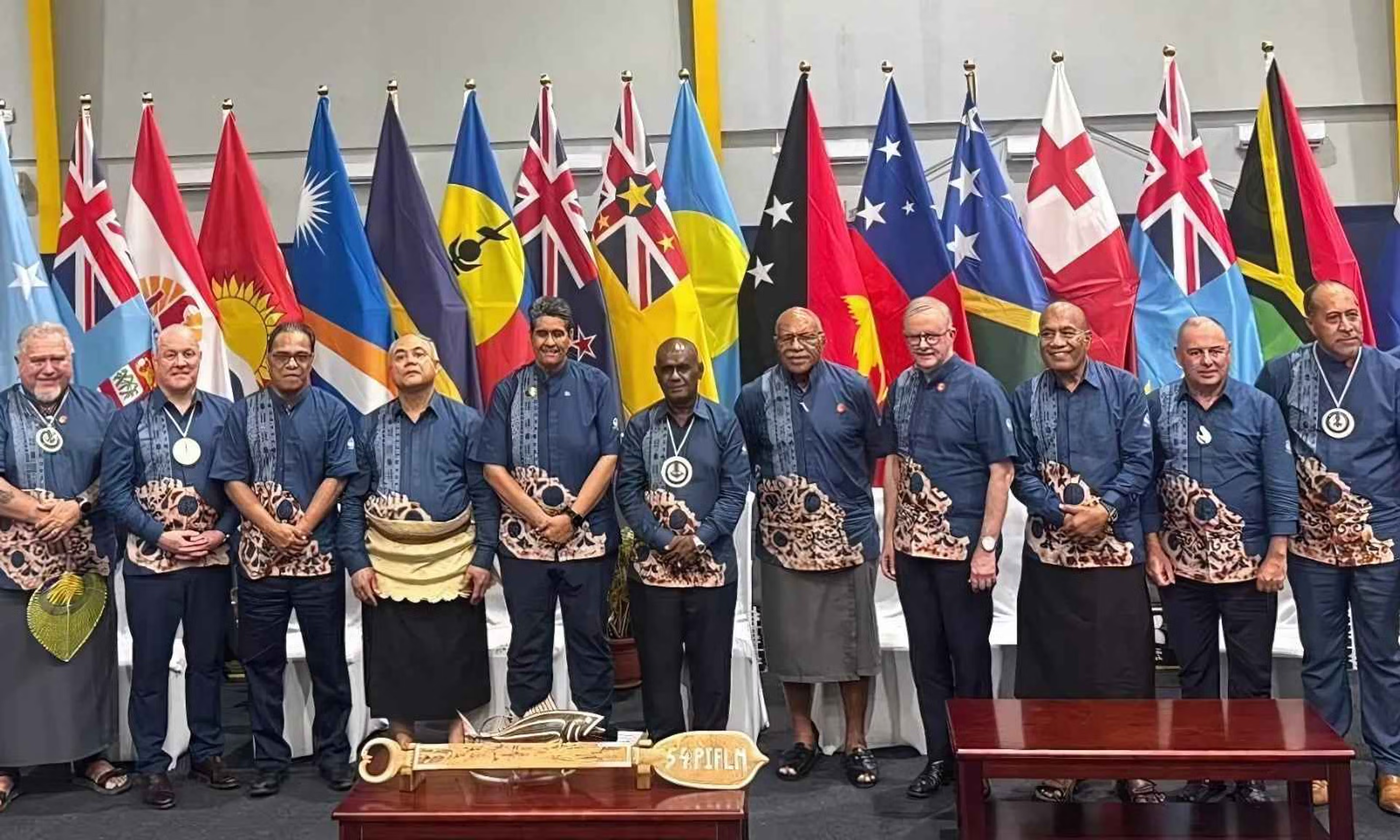
AT September’s Pacific Islands Forum in Honiara, leaders launched the Blue Pacific Ocean of Peace Declaration.
Forum leaders agreed to “embed the Blue Pacific Ocean of Peace as a cornerstone of future national and regional policies and strategies.” They proposed “cultivating a culture of peace grounded in the Pacific Way, drawing on the depth and diversity of our cultural practices and Indigenous knowledge systems.”
The Ocean of Peace concept was first proposed by Fiji Prime Minister Sitiveni Rabuka, who reiterated the importance of regional solidarity, non-alignment, and collective security in a 2023 address to the United Nations General Assembly.
As he welcomed the launch of the Ocean of Peace Declaration in Honiara on 10 September, Rabuka stressed: “The world knows that we, the Pasifika people, mean business and it starts here with us.”
Incoming Forum Chair, Prime Minister of the Solomon Islands, Jeremiah Manele, highlighted the ongoing legacies of conflict on local communities, noting that people are still being maimed by unexploded ordnance from the World War II conflict between Japan and the United States.
“Nearly eight decades ago, the tranquil shores of Solomon Islands were the site of one of the most brutal confrontations of the Second World War,” Manele said. “The Ocean of Peace Declaration is a reclamation of our sovereignty and our shared destiny. It is a solemn vow that our seas, air, and lands will never again be drawn into the vortex of great power rivalry.”
Today, as the Trump administration changes the name of the US Department of Defense to the US Department of War, it’s notable that Forum leaders are promoting an Ocean of Peace. However, the adoption of the declaration is just the beginning of a longer debate, at a time when the Pacific is a strategic battleground for competing powers, and colonial powers like France and the United States are militarising their Pacific territories.
For church and civil society representatives who addressed leaders at the Honiara summit, the Ocean of Peace must also be an Ocean of Justice.
Reverend James Bhagwan, General Secretary of the Pacific Conference of Churches (PCC), said “the Ocean of Peace offers us an opportunity for transformation across the board. But civil society and churches have one thing that we’ve constantly talked about in the context of peace: for an Ocean of Peace, we need it be demilitarised, denuclearised, and decolonised.
“The test for an inclusive Ocean of Peace is just a simple question,” Bhagwan said. “Will this declaration ensure that life and dignity is improved for our market women, our young people, person with disabilities, and our maritime families? If not, then it’s not peace – it’s publicity!”
Moving beyond Boe
Meeting in Nauru in 2018, Forum leaders adopted the Boe Declaration on Regional Security, which seeks to define an “expanded concept of security inclusive of human security, humanitarian assistance, prioritising environmental security and regional cooperation in building resilience to disasters and climate change, including through regional cooperation and support.”
While the Boe Declaration sets out a spectrum of security challenges, including state-to-state conflict and transnational crime, a crucial provision stresses that “climate change remains the single greatest threat to the livelihoods, security, and wellbeing of the peoples of the Pacific.”
Since then, many are concerned that the Forum’s Dialogue Partners have not shifted enough financial resources, technical assistance, and diplomatic action to address climate change as the “single greatest threat” to livelihoods, security, and wellbeing. At a time when OECD nations like the United States, Britain, and Germany have cut their development assistance and climate finance budgets—even as they pour
billions of dollars into the manufacture of armaments—there’s a long way to go.
For Terio Koronawa of the Pacific Islands Forum Secretariat, the new Ocean of Peace Declaration “extends beyond the strategic areas of the Boe Declaration. As a region, we’re not really as focussed on the traditional, hard-edge aspects of security, but the non-traditional ‘soft’ aspects of security. We’re talking about climate change, we’re talking about health security, we’re talking about economic security. The Ocean of Peace declaration builds upon that.”
As Regional Security Adviser at the Forum Secretariat in Suva, Koronawa will play a key role in collating and combining all the existing action plans that are supposed to implemen previous Forum declarations on security – from Biketawa (2000) and Niue (2009) to Boe (2018)
He notes that “for us to establish peace in the communities, it’s important that we address the development issues that exist. The declaration recognises that development is very important in the region. If you are not able to address the insecurities within the communities, we will not be at peace.”
Development and peacebuilding
Speaking before the Forum, Tuvalu Prime Minister Feleti Teo said: “Peace is not simply the absence of conflicts. Instead, I would argue that peace occurs where there is the presence of justice, where there is social inclusion, and where there is respect of relationships grounded in mutual care and responsibility
“When we speak of an Ocean of Peace, we are not only simply referring to geopolitical security dynamics,” Teo said. “We are in fact talking about the deeper fabrics and structures of our societies, about how we treat each other in our homes, how we treat each other in our villages, and in our institutions.”
In Honiara, youth delegates also stressed that peace must be grounded in the lived experience of grassroots communities.
Josie-Anne Ashley of the Solomon Islands National Youth Congress said: “For us young people, everything comes down to the community level and what happens there. For us, peace and security is having a supportive environment within our communities where our young people have the
opportunity to grow and thrive.”
With young people making up 70% of the Solomon Islands population, Ashley threw out the challenge: “How can we make sure our children go to school without interruption? How can we create a healthy environment which is free from contamination and that our families have enough food to eat?
How can we make sure our communities adapt to sea-level rise and other environmental challenges?”
From Vanuatu, researchers Anna Naupa and Derek Brian argue that “there is no guarantee that the Pacific will remain peaceful under the ‘business as usual’ approach to development policy and practice. Development gains remain vulnerable to the ‘slow violence’ associated with exclusion and inequality—which may be gradual, often invisible, yet pervasive—from which societal tension and conflict can grow.”
The Ocean of Peace Declaration acknowledges “the diversity of Pacific peoples and cultures across our region, and the importance of grounding peacebuilding, peacemaking, and peacekeeping approaches in national governance systems and cultural contexts.”
For the Forum Secretariat’s Terio Koronawa, “the declaration acknowledges the good work that is being done in peacebuilding, particularly by civil society organisations and women’s groups. When we look at peacebuilding at the national level, it is almost non-existent in many of the National Security Statements adopted by governments.”
Filling the gaps
The Ocean of Peace Declaration promotes “our shared commitment to a Pacific, free from nuclear weapons, nuclear weapons testing, and the dumping of radioactive waste, and to the elimination of nuclear weapons, recognising the treaty’s enduring role in promoting peace, security, and environmental stewardship across the Blue Pacific Continent.”
But many academic commentators and community activists have raised questions about other gaps and silences in the declaration. Some argue the lengthy declaration is long on rhetoric, but lacks detail on how many of the lofty sentiments will be implemented.
From Auckland University of Technology, Marco de Jong and Sione Tekiteki note that “like many negotiated texts, the Ocean of Peace Declaration is filled with ambiguities that allow for diverging interpretations and opportunities for it to be co-opted.”
For Tekiteki, recently retired as Forum Secretariat Director of Governance and Engagement, “the Ocean of Peace Declaration is light on ambition. It avoids any reference to demilitarisation, even as the Pacific sees unprecedented military build-up. That omission is deliberate – consensus was preserved, but only by avoiding the hardest questions. For larger Forum powers, peace cannot be separated from deterrence. Since the China-Solomon Islands pact in 2022, bilateral security deals have proliferated, now including reports of a landmark PNG-Australia defence treaty promising ‘total integration.’”
The final declaration never mentions the term “decolonisation”, even though the Forum’s standing agenda includes issues like West Papua and New Caledonia. Indeed, the declaration repeatedly refers to respect for “the national sovereignty of all Forum Members”, which is often used as an excuse to ignore criticism of the violation of human rights and breaches of international law.
In “Re-Imagining the Ocean of Peace,” young scholars from the University of the South Pacific argue that “there cannot be an Ocean of Peace when the Pacific Islands remain the most colonised region in the world. The Ocean of Peace, therefore, should integrate explicit commitments to support decolonisation and self-determination efforts across the region, including West Papua and Kanaky.”